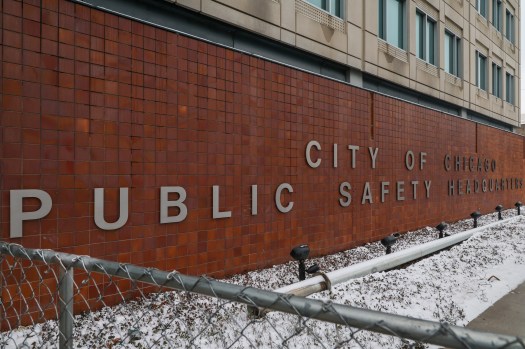

A visibly frustrated federal judge on Thursday took the city to task over the Chicago Police Department’s move to pull a North Side police officer out of a deposition late last month in order to strip him of his police powers.
Judge Mary M. Rowland stopped short, however, of ordering CPD to turn over the written communications that led to what plaintiff attorneys described in court records as an unprecedented move. Instead, she asked the attorneys to submit descriptions of what they were looking for and said she’d make a final call after she evaluated those requests.
Officer Richard Rodriquez Jr. has been a member of a now-scattered tactical team that’s racked up dozens of misconduct complaints and a stack of lawsuits related to a series of allegedly abusive traffic stops and searches in some of the city’s poshest neighborhoods. Rodriquez had already had his deposition for the case before Rowland rescheduled several times before Feb. 20.
That’s when a CPD sergeant appeared about 90 minutes into the deposition and took Rodriquez back to police headquarters, where he became the fifth member of tactical team 1863 to be stripped of police powers. His attorney, Brian Gainer, told Rowland that Rodriquez completed that deposition earlier this week.
But Rowland told Gainer that his client had “taken a lot of special attention” to get the deposition done and said that the reschedulings and the events of Feb. 20 were “peculiar” and generated suspicion around Rodriquez.
“It makes plaintiffs feel like: What do you have to hide, what does CPD have to hide?” Rowland said. “I’m not saying it’s a fair inference, but it’s where they’re going.”
Rowland made clear that her own irritation was more about the further delay in the deposition and confusion over how the call had been made, not that she thought CPD was ignoring or trying to cover up misconduct by Rodriquez.
“They went after him — so much so that they dragged him out of a deposition,” she said. “Good God! Who does that?”
She repeatedly questioned attorneys for the city and the two officers who are defendants in the case about the timing of the move and why it had to take place in the middle of sworn testimony, noting that Rodriquez’s conduct has been a known issue for “months, if not years.”
“The guy has problems,” she said. “And the white shirts, or whatever we’re calling them, must know he’s a problem. What’s happening at CPD HQ that this has to happen in the middle of the deposition?”
Attorney Michael Sheehan, representing the city, chalked the interruption up to “coincident, separate processes” where the sergeant who took Rodriquez back to headquarters had simply seen him from the front desk and walked him out of the building.
“There was no intention by us to act in bad faith,” Sheehan said. “It was expressly said we’re gonna bring him back. We did bring him back. There was no intention to not follow through.”
Jordan Marsh, representing the plaintiffs, said he had “absolutely no intention” of accusing the city or CPD of acting in bad faith but argued that they should still turn over the communications that led to the interruption.
“When the operation of the court is interrupted and it is disregarded, that should be investigated,” he said. “I think it behooves all of us to know what happened.”
Gainer argued that the push to get records related to the now-completed deposition “seems like a wild goose chase designed to focus on collateral issues as opposed to the important issues in the case.”
The specific complaint cited on Rodriquez’s relief of power memo is connected to a 2025 civil rights lawsuit filed against him and another member of the same tactical team, which alleges that they falsified a police report about a 2024 traffic stop.
The specific lawsuit for which Rodriquez was being deposed late last month alleges that he beat plaintiff Jovan Streeter’s head against the side of his car during a traffic stop and threatened Streeter and the second plaintiff, Marquita Beecham, with Beecham’s own gun, for which she held a license.
Rodriquez personally accumulated 67 misconduct complaints over eight years as a cop, per a memo from the Civilian Office of Police Accountability, making him the officer with the second-highest number of complaints lodged against him in the entire department. The top officer was also a member of team 1863, which racked up more than 50 misconduct complaints by December 2024.
Many of those complaints, which largely focused on traffic stops and searches of civilians, have joined a parade of lawsuits alleging civil rights violations around the Near North (18th) District in the Gold Coast, Lincoln Park and River North neighborhoods.
Including Rodriquez, five of the officers on that team have been stripped of their police powers. The team’s sergeant has been reassigned to the department’s Gang Investigation Division, police said, while two members of the tactical team were still assigned to the Near North District.