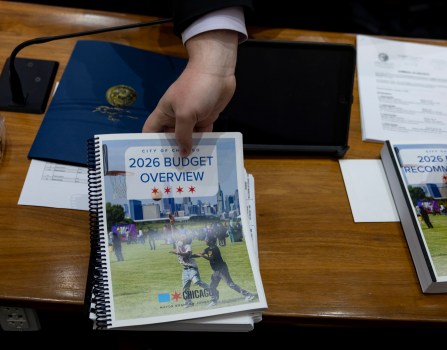

The Feb. 27 editorial on the city’s financial stress is as illuminating as it is horrifying (“Mayor is leaving successors with a financial ash heap. It’s worse than we thought”). It sketches a fiscal trajectory that should concern the entire nation. Chicago’s budgetary problems (like those of many other American cities and states) are the culmination of long-standing structural imbalances such as excessive spending despite a shrinking tax base, mounting pension obligations and political reluctance to impose fiscal discipline. Rather than fix these issues, officials in the Windy City hope to get continued relief from Springfield and Washington.
This strategy carries national implications. When city officials signal that they expect federal and state backstops to cushion budget stress, it means they expect to disperse the costs. The pain of budget stress gets shifted from Chicago residents to taxpayers across Illinois and the nation. If that shift occurs, Chicago’s leaders will have little reason to undertake the necessary budget reforms. Additionally, other cities (such as New York) observing this dynamic may seek to replicate this cost-shifting strategy for themselves.
The pandemic reinforced this risk. As unprecedented federal stimulus funds flowed to cities, including Chicago, city leaders used them to paper over structural deficits and temporarily boost credit ratings without addressing the underlying issues that caused the problems in the first place.
Unless Illinois state lawmakers and federal policymakers make a credible, explicit commitment against future bailouts, Chicago’s fiscal trajectory is unlikely to change. The next few budget cycles will determine the Windy City’s solvency and shape expectations about fiscal federalism nationwide. If Chicago is rescued without reform, the precedent will echo well beyond Lake Michigan.
— Thomas Savidge, Indianapolis
Americans’ daily situation
Pursuing economic common ground as proposed by Justin Callais and Clay Routledge in their op-ed (“The economic common ground America isn’t talking about,” March 7) is a worthy pursuit. Unfortunately, the version they are lauding is an artifact of the way they asked the question.
Imagine if the alternatives more realistically reflected the choice our society faces, something more like this: On the one hand, an economy dominated by a few large corporations that fuels the unimaginable wealth of a few entrepreneurs, which allows them to use their leverage to further reduce all forms of government control on their activities. Or, on the other hand, an economy of open but regulated competition where government assures that the rewards of increased productivity are spread equally and that fewer people are left to fend for themselves in an increasingly difficult economy.
I concede that neither version gets at the full complexity of our current situation. But imagining that we could achieve consensus around an economic vision that does not reflect the real, daily situation of most Americans is not going to make a dent in polarization that, in large part, is caused by the real struggles many are experiencing.
— Mike Koetting, Chicago
Rigged markets bad for us
In their op-ed, Justin Callais and Clay Routledge aptly conclude: “Progress requires cooperation. And cooperation is facilitated by finding common ground. Most Americans … just do not always agree on what to call it.”
We could start by ending the “either/or” dichotomy between capitalism and socialism and admit that all modern economies are mixed economies. Europe calls the mix a “social market” economy, and there’s our common ground. The U.S. can have an economy based on free market principles of entrepreneurship and fair competition, while also providing a social safety net that keeps people from starving because they lost their jobs or sleeping in the streets because they are homeless.
This goal is exemplified by a U.S. “victory” poster from World War II with the words “Together We Win.” It shows the hands of three people clasping, one with a red-white-and-blue cuff, one with a suit cuff and one wearing a work glove, symbolizing the three pillars of the economy: government, management and labor. The three came together during the war to produce massive amounts of essential materiel, and the three continued to work together for two decades after the war, leading to the largest economic growth period and the largest expansion of the middle class in U.S. history. The cooperation unraveled during the late 1960s over friction from the Vietnam War, the “Great Society” programs and other factors. The three are now out of sync.
Since the 1980s, four decades of neoliberal privatization policies driven by crony capitalism have pushed enormous wealth to the top while gutting labor unions and creating a gig economy in which many people are stuck in low-paying jobs with few benefits, often needing two to three jobs.
Current policies favored by government and business oligarchs are again leading to monopolies and unfairly high prices, and tax cuts for the rich are further tearing apart the social safety net, while vital public transit and infrastructure continue to deteriorate.
We need to cooperate and innovate to bring the three pillars together again and rebuild a social market economy that works for everyone, not just political and financial insiders. An economy that relies only on tariffs, endless consumption and skyrocketing defense spending, while cutting social services, is broken. That is not a free market; that is a rigged market, and rigged markets, whether capitalist or socialist, are bad for everyone except the corrupt actors doing the rigging.
— Franz Burnier, Wheaton
Higher ed funding formula
As the president and student body president of Eastern Illinois University, our perspectives may be different, but our devotion to our beloved institution is the same. With regard to the article “University funding in lawmakers’ crosshairs “ (Feb. 22), we believe the time is now for Illinois to support a student-focused funding formula for sustainable and affordable public universities across the state.
We are grateful that Gov. JB Pritzker and the General Assembly have begun to reverse two decades worth of disinvestment in higher education — and we applaud their efforts and value their leadership. Yet, our students continue to bear the costs of historical underfunding and an outdated funding model that have pushed up tuition rates, priced students out of higher education and encouraged many to enroll at out-of-state institutions.
The legislative proposal for adequate and equitable public university funding (SB13/HB1581) would be a boon for EIU, every public four-year institution, our communities and the entire state. Grounded by data-informed recommendations from a state commission of experts, the bill provides a pathway to a stronger higher education system that is efficient, effective and responsive to the needs of students, local industry and the communities we serve.
This January, EIU’s Student Government Association passed a resolution supporting this proposed funding formula. Simply put, an adequate and sustainable funding formula would make college affordable again for Illinois residents, enhance our workforce and strengthen communities.
— Jay D. Gatrell, president, and Claire Weber, student body president, Eastern Illinois University
Icon for Italian Americans
We of Italian descent grew up with great regard for Christopher Columbus for discovering America. I’m not so sure landing on an island and later other islands means you discovered two continents. After all, he thought these were islands off of India.
We don’t sing “Columbia, Columbia, God shed his grace on thee.” We sing of “America” due to Italian explorer Amerigo Vespucci.
Mother Cabrini is a fitting person to represent Italian Americans unless the representative must be a man. In that case, Vespucci is more appropriate than Columbus.
— Anthony Carrollo, Cape Canaveral, Florida
Submit a letter, of no more than 400 words, to the editor here or email letters@chicagotribune.com.