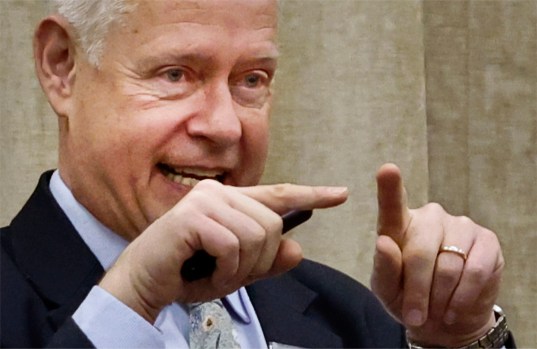

The earth’s and its inhabitants’ standard of living is better and worse, if you ask Niclas Svenningsen.
Svenningsen, who is the Manager for Climate Action Outreach at the United Nations Framework Convention on Climate Change, told a group of about 40 students, professors and other audience members during Purdue Northwest’s inaugural Interdisciplinary Sustainable Development Academic Symposium that the changes that have made people’s lives easier are also the things that are killing the planet. And it’s all happened way faster than anyone imagined.

In 1905, when Svenningsen’s grandmother was a young child, there were 1.6 million people inhabiting the planet, and the world’s GDP was $1.1 trillion, he said. By time he was born in 1965, the earth’s population had reached 3.4 billion with a $18 trillion GDP, he said.
When his grandson was born in 2022, the population more than doubled to 8.3 billion with a $117 trillion GDP, he said.
Between 1905 and the 1960s, the world saw many things inventions, such as mass transport; the telegraph, radio and TV; synthetic fertilizer; refrigeration; and hot showers. During the same period, medical advances like penicillin, vaccines and contraceptives helped extend life expectancy. The 1980s then brought pacemakers, the CT scan, lithium batteries, the human genome map and mass-produced computers, he said.
“In less than 120 years, three generations have never been where we are today,” Svenningsen said. “Where extreme poverty was once 50% of the global population, it’s now only 10%, but still 700 million people; and most people of both genders can get an education. Child mortality is now 3.6%, down from 20%.”

All that sounds great until you realize that the entire animal population is down to 27% of what it was; coral reefs “are history” in the next 10 years; catastrophic warming is not only driving catastrophic weather events but spreading disease faster and making land harder to farm; and the multilateral governance the world enjoyed from 1945 is “under threat,” he said.
The UN meets every year to try and reach a consensus on how to beat back some of the biggest threats, Svenningsen said, but member countries are stuck in doing things the way they want in their own ways versus best practices, he said. Still, he remains hopeful that the 197 countries of the world will eventually pull together, especially with regard to climate change.
“Doing things piecemeal helps, but the better thing is writing policy upon failed experience. For example, fossil fuels cost the world $7 trillion per year. If we could get governments to push clean energy, we save $4 trillion,” he said. “We’ve also looked at one growth factor, GDP, and we realize we have to think differently, because development has to be inclusive: ‘growth in context,'” he said.
PNW’s Interdisciplinary Sustainable Development Program, created from a grant the school’s CHESS College received in 2025, asks students to look at the UN’s sustainable development goals to see how they can apply them to their communities. Two students, Cassie Vickers and Leo Winders, of Dyer, chose hunger as their research project.

The two have been working with Citizens Concerned for the Homeless out of Michigan City, an organization with a shelter that houses children, and their goal is to have legislation implementing proper nutrition in homeless shelters written.
“CCH has a teaching kitchen, so we’ve tasked ourselves with coming up with recipe cards for different diets: regular, diabetic, vegetarian and gluten-free,” Winders, who’s working on his masters in social work, said. “Looking at studies, we found that shelters met only 38% of any nutritional guidelines and offer only one or two meals a day because of budget constraints or even lack of effort. And some homeless people qualify for SNAP, but some don’t.”
“They get donations of pastries, which is great, but if you’re just eating fats and sugars, you can’t function,” Vickers, an undergrad studying business, added.
Michelle L. Quinn is a freelance reporter for the Post-Tribune.