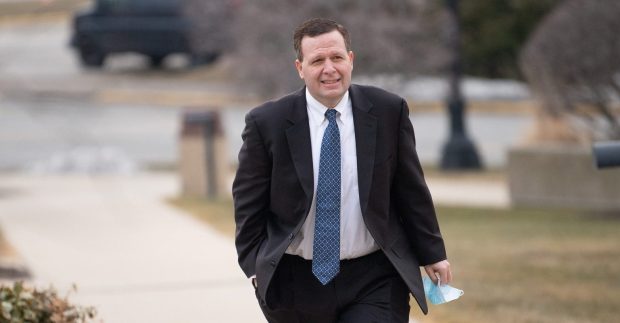

Nearly a decade after he was indicted on bribery and tax charges, former Portage Mayor James Snyder will be sentenced Tuesday on his conviction for obstructing the IRS, according to court records.
Prosecutors will seek a 21-month prison sentence “given the seriousness of (Snyder’s) criminal activity over several years … and the need to reinforce the message that the law applies to everyone,” according to the government’s sentencing memorandum.

Snyder’s attorneys argued that prosecutors are “trying to impose on Mr. Snyder a harsher sentence … than he would have received if he had never appealed his (bribery) conviction in the first place.”
“Looking at the facts fairly, the tax count does not warrant any term of imprisonment,” Snyder’s attorneys wrote in his sentencing memorandum.
Snyder asked for a new trial on his conviction for defrauding the IRS in federal court filings in October 2025. Federal prosecutors, in their response, said his request is untimely and without merit.
This is the latest chapter in a saga that began more than nine years ago when Snyder was indicted in November 2016 on one count of defrauding the IRS and two counts of bribery, one involving towing contracts and the other involving garbage trucks.
A jury in U.S. District Court in Hammond found Snyder not guilty on the charge involving the towing contract, and convicted him twice on the garbage truck charge, a case that made its way to the U.S. Supreme Court, which ruled in June 2024 that the $13,000 payment Snyder received over a garbage truck contract was a gratuity, not a bribe, because the payment came after the contract and not before. The case was remanded to the lower courts.
A jury convicted Snyder on the IRS charge, which involved his personal business and not his duties as mayor at the time, and that conviction had remained unchallenged.
Snyder was scheduled to go to trial for a third time on the charge involving the garbage truck contract, but prosecutors have said they would like to sentence Snyder for obstructing the IRS and forgo a third trial on his bribery charge.
Snyder, awaiting sentencing on the IRS conviction, which has been repeatedly pushed back, argued in an Oct. 31, 2025 filing that he wanted a new trial on the IRS charge because the information presented on the bribery charges could have improperly swayed the jury.
The U.S. Attorney’s Office argues that Snyder’s request “is both untimely and meritless.”
In the sentencing memorandum, prosecutors argued that between January 2010 and April 2013 Snyder executed a scheme to obstruct the IRS’s collection of his unpaid business and personal taxes.
In 2007, Snyder created First Financial Trust Mortgage LLC, a mortgage loan origination business, where he withheld a portion of employees’ paychecks for payroll and income taxes, Medicare and Social Security, prosecutors said.
But, in 2007, 2008 and 2009, Snyder didn’t remit those taxes taken from employees’ paychecks to the IRS. Snyder also didn’t file IRS forms in a timely manner, prosecutors said.
“Instead, (Snyder) embarked on a multi-year effort to lie to the IRS to avoid paying taxes that he owed. The scheme involved shell companies, unfiled corporate tax returns and bald-faced lies to the IRS,” prosecutors said.
By November 2009, the IRS discovered that the company owed approximately $97,000, prosecutors said, while Snyder paid himself approximately $110,000 from the company bank account.
In January 2010, Snyder signed an employment agreement with a mortgage company called GVC and opened a “branch office” out of the First Financial Trust Mortgage LLC office. Under the agreement, GVC hired Snyder as an employee and hired and paid all his employees, prosecutors said.
In 2010, GVC paid Snyder approximately $141,891.27, prosecutors said. Also in 2010, Snyder began creating “phony invoices” from a company called SRC to bill First Financial Trust Mortgage LLC for “consulting” work, prosecutors said.
GVC paid SRC over $400,000 in 2010, 2011 and 2012, and SRC received deposits totaling over $640,000 in that same time frame, prosecutors said.
“By routing GVC’s payments through SRC instead of FFTM, (Snyder) concealed FFTM’s true financial status from the IRS. It was a shell game to obstruct the IRS in its tax assessment and collection obligations,” prosecutors said.
On his personal taxes, Snyder owed the IRS $31,369 for tax years 2005, 2006 and 2007. But, under penalty of perjury, in March 2010 Snyder stated his personal tax debt was uncollectible and instead offered to pay $1,000, prosecutors said.
Snyder didn’t disclose to the IRS his employment at GVC, didn’t list his income from GVC and didn’t disclose his ownership of SRC or its bank accounts. The March 2010 tax form didn’t disclose, for example, that Snyder received $141,891.27 in wages from GVC, prosecutors said.
In total, the total tax loss in this case is $125,149.57: $96,111.57 in what FFTM failed to pay and $29,038 in Snyder’s personal taxes, prosecutors said.
In Snyder’s sentencing memorandum, his attorneys said his actions “did not involve sophisticated means,” and argued that prosecutors prohibited Snyder from introducing evidence “that the IRS could have and yet left to discover the information.”
“The government also has miscalculated the restitution amount, ignoring Mr. Snyder’s voluntary efforts to repay tens of thousands of dollars toward his tax debt prior to being indicted,” Snider’s attorneys wrote.
Snyder started his mortgage loan business before the collapse of the real estate market in 2008 and “like many small businesses in America during the recession” the company struggled financially, his attorneys wrote.
“Rather than firing his employees and declaring the business bankrupt, Mr. Snyder attempted to keep the business running in the hope that the economy would turn around and that he would be able to fulfill FFTM’s financial obligations. To do so, Mr. Snyder used withheld payroll taxes to pay FFTM’s operating costs, including payroll, to avoid layoffs,” his attorneys wrote.
Since his conviction in February 2019, Snyder has worked many jobs, from consulting to painting homes. Since then, he has established a consulting business “which a non-custodial sentence would allow him to continue,” his attorneys said.
While Snyder’s lawyers have requested no prison time, they argued against sentencing enhancements, like Snyder acting as a leader of a criminal enterprise.

Seven people wrote character letters on Snyder’s behalf, including George Cortina, the son of Snyder’s co-defendant in the case John Cortina, who pleaded guilty and served at-home detention.
“It has always bothered me knowing my dad’s propensity to say crazy things that the government actually believed him and built a federal case on his words. Mr. Snyder forgave my dad and continued to treat him with kindness even after his conviction,” Cortina wrote.
Snyder helped his father with his bills, supported him when he was sick in the hospital and gave the eulogy at his father’s funeral after he died last February, Cortina wrote.
“Through my dad, I know the punishment and consequences of going through a matter like this for even a year or two. Mr. Snyder and his family have suffered enough and it is my hope you find the same,” Cortina wrote.
Snyder, a Republican, was first elected mayor in 2011 and reelected in 2015, a term cut short by his federal conviction in February 2019.
Snyder received a sentence of 21 months in prison for the bribery and IRS convictions and a year on supervised release from U.S. District Court Judge Matthew F. Kennelly of the Northern District of Illinois.
Snyder successfully argued that the start of his sentence should be postponed until his bid to have the Supreme Court hear his case was complete.