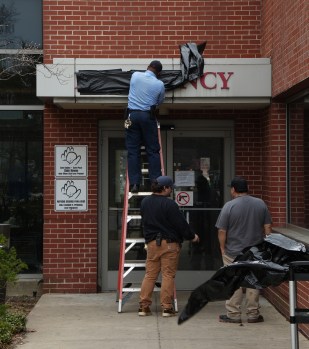
The Lake Forest City Council has taken the first step toward banning coal tar sealant, a pavement product that contains compounds known to cause cancer.
Upon the recommendation of the city’s Environmental Sustainability Committee, the council unanimously voted March 2 to give initial approval to a citywide prohibition of the thick black sealant commonly used on parking lots to enhance appearance and protect asphalt.
Coal tar sealant contains toxic compounds known as polycyclic aromatic hydrocarbons, or PAHs, which are recognized as human carcinogens, according to city officials.
In addition to potential health concerns, the city contends the sealant can damage plants, ravines, lawns and water quality as it erodes into streams, affecting fish and wildlife.
“There are significant concerns about the negative impacts of coal tar as it erodes,” Assistant to the City Manager Keri Kaup told the City Council.
Kaup added that asphalt-based sealants contain PAH levels approximately 1,000 times lower than coal tar products.
As for availability, Kaup said staff contacted 10 local companies that provide sealant services in Lake Forest and found that eight no longer sell coal tar sealant. She also noted the city does not use the product, opting instead for asphalt-based sealant.
Alderwoman Nancy Novit, 1st, who chairs the Environmental Sustainability Committee, said “passive exposure” allows the sealant’s chemicals to enter the air, grass and streams.
“Because it is passive exposure, I think we have a duty to protect people from that,” she said.
Alderman Nick Bothfeld, 3rd, who also serves on the committee, expressed a similar view.
“I think it puts our residents at risk, and we have a responsibility to protect them as much as we possibly can,” he said.
Former Alderwoman Melanie Rummel advocated for the ban on behalf of the local chapter of the League of Women Voters. She noted the council examined the issue six years ago when she was a member.
“It is finally time to ban it entirely. It is not a safe product. It shouldn’t be going into our streams and our drinking water,” she said.
While the proposal received unanimous voice approval, Alderman John Powers, 2nd, questioned whether a ban was necessary given the product’s declining availability.
“I hate to get in the habit of passing an ordinance just to pass an ordinance instead of letting people make the proper decisions on their own,” Powers said.
Kaup said several neighboring communities — including Highland Park, Deerfield and Vernon Hills — have enacted similar bans. A statewide bill with a similar intention is pending in Springfield.
The ordinance would be enforced on a complaint-only basis and would apply to homeowners or companies that use the product. Violators could face fines of up to $750.
Kaup said coal tar sealant typically has a stronger chemical odor and glossier finish, which can help distinguish it from asphalt-based products.
A final vote is expected at the March 16 meeting.
Daniel I. Dorfman is a freelance reporter for Pioneer Press.