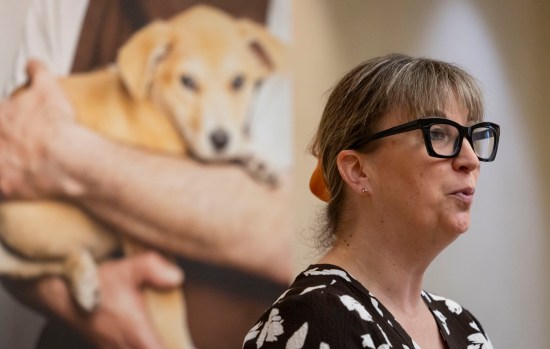

A week ahead of a vote to determine the leadership of Chicago Animal Care and Control, officials and advocates are tangled in a heated battle over the current nominee.
Susan Cappello was the acting director of the city shelter for the last three years before being nominated for the permanent post by Mayor Brandon Johnson a month ago.
Cappello’s nomination has drawn a wave of criticism from shelter volunteers and animal rescue leaders around the city who cite dirty shelter conditions, high euthanasia rates and a poorly run volunteer program. At the same time, the city’s three largest animal welfare organizations have risen to her defense.
Similarly, her nomination has divided aldermen.
On Tuesday, a group of aldermen and animal advocates gathered for a news conference at City Hall to oppose Cappello’s appointment.
“ One of my biggest concerns is that we really continue doing business as usual, and it’s not an option,” said Ald. Ruth Cruz, 30th. “If people are comfortable with dogs going into a kennel that’s full of feces for days, I’m not. If people are comfortable with not having a strong leader who’s going to change the culture and bring change, I’m not.”

Ald. Nicole Lee, 11th, echoed those sentiments.
“Many of the advocates and volunteers who have reached out to me over time have shared concerns about the challenges at CACC,” Lee said Tuesday, ahead of the City Council’s Committee on Health and Human Relations meeting to consider Cappello’s appointment. “We are asking the committee to hold this appointment until a nationwide search can be conducted.”
Heather Owen, the co-founder and executive director of One Tail at a Time, said she has gradually noticed more animals in the city’s shelter are not receiving the care they need.
“The biggest population of animals that are suffering right now are large dogs,” she said. “If you walk in the shelter right now, there are many of them who are stressed out and very sick, and a lot of them are quite simply just going to die.”
Owen said 27 local animal welfare organizations have signed onto a letter asking the City Council not to vote for Cappello.
Last month, a group of aldermen also sent a letter to Johnson outlining their concerns about the agency under Cappello’s leadership, including poor shelter conditions, high euthanasia rates, lack of staff and increased dog bites in the community.
Following the Tuesday news conference, members of both animal welfare factions attended the health committee meeting where more accusations flew. Aldermen voted to recommend Cappello’s appointment to the full council, which will decide her confirmation at its March 18 meeting.
At an unrelated news conference Tuesday, Johnson addressed the division surrounding Cappello’s nomination. The mayor said Cappello has his unequivocal support as well as that of the City Council and animal welfare organizations like PAWS Chicago.
“I mean, look, this public servant has been serving the city of Chicago for I believe 36 years,” Johnson said. “I mean, how much more experience can you ask of someone? Thirty-six years total, 26 years with animal control and working in this position as acting for the last three years during very difficult times.”

One of the main points of contention has been the city shelter’s euthanasia rates. Under Cappello’s term, volunteers and animal advocates say rates have remained too high, and some animals have been prematurely euthanized.
“Volunteers will leave on Monday night and Tuesday morning, that dog is gone. And the problem is they’re indicating that the dog was euthanized for behavioral reasons,” said Irene Jordan, an animal control volunteer. “There are a lot of situations where you’re getting inaccurate information. There’s a lot of secrecy.”
The shelter’s intake has risen dramatically during Cappello’s term. Between 2023 and 2025, the annual intake of cats and dogs at the shelter shot up from 13,419 to 18,337, according to animal control data. Over that period, the adoption of cats and dogs also grew from 17.5% to 19.8%.
The euthanasia rate has remained stable at around 29%, but because of the growing intake, more animals are being euthanized.
Volunteers have also raised concerns about unsanitary shelter conditions and Cappello’s leadership record.
“There’s a lot of sheltering best practices that aren’t being used that have been proven across the country,” Stephanie Grohovsky, another volunteer at animal control, said. “There have been multiple volunteers who have written her emails with suggestions and policy changes that would make things more consistent among the volunteers, and she just takes none of that feedback.”
Like her predecessors, Cappello has been operating animal control on what many agree is an underfunded budget. The agency’s 2025 budget of $7.5 million was cut by over $160,000 compared with the previous year’s. In an interview with the Tribune on March 5, Cappello said that this year’s budget has seen an increase over 2025 of close to $660,000, which will mainly go toward increased staffing.
Some of the complaints about staffing include cleanliness and dogs getting walked only once a week. Cappello said the kennels get cleaned once a day but acknowledged there are staffing vacancies. She said she plans to address these concerns once she is confirmed and has a more robust say in funding for the agency.
“We did little things along the way, making partnerships, but now we’re really looking and digging and reaching out to get even more in the budget,” Cappello said. “The key thing is knowing where we need to invest to make things better moving forward.”
Cappello said she is considering more advertising and expanding partnerships to increase the number of animals rescued.
At a news conference earlier this month, representatives of PAWS Chicago, the Anti-Cruelty Society and the Tree House Humane Society — the city’s three largest animal welfare organizations — commended her leadership.
“Adoption rates haven’t been as robust as they were prior to the pandemic, but Sue has done a great job of overseeing the city’s largest intake facility, managing the largest population of animals and growing relationships with other rescue organizations,” said Darlene Duggan, president of the Anti-Cruelty Society.
Paula Fasseas, the founder of PAWS Chicago, said Cappello’s collaboration with shelter organizations like PAWS has demonstrated her impressive ability to navigate complex challenges, like the agency’s strained budget and high shelter intakes.
“Bringing outsiders is not always a solution. Bringing someone here who has had success and made a great impact — why would we change that?” Fasseas said.
Jerry Wu is a freelancer.