
When was the last time you wrote a letter?
Not a text. Not a tweet. But a real, ink on paper letter?
It’s becoming a vanishing art. But a pack of letters written between 1924 and 1928 form the foundation of a delightfully clever play, “Dear Rhoda,” which gives you a pair of letter-writing lovers set against a roaring Chicago era with a pack of characters and places that include ill-fated Italian anarchists Nicola Sacco and Bartolomeo Vanzetti, Carl Sandburg, Ben Hecht, Fanny Brice, the bohemian neighborhood of Tower Town, Clarence Darrow, Sophie Tucker, and a hangout called the Dill (often spelled Dil) Pickle Club.
It is the work of Donna Russell and David Ranney. It had a staged reading in May 2015 and a world premiere in June 2016 by the Island Players, a community theater group on Washington Island, Wisconsin, which sits a few watery miles north of the Door County mainland in Lake Michigan.
“Dear Rhoda” was born when Russell bought an old trunk at a garage sale in 1986. “It was locked, so it sat in the garage for 20 years until my husband and I were moving to another home in Florida,” she says, adding that they had first come to Washington Island in the 1970s and now split their time between there and Naples, Florida. “He thought we should throw it out but decided to break the lock and open it, and what we found …”
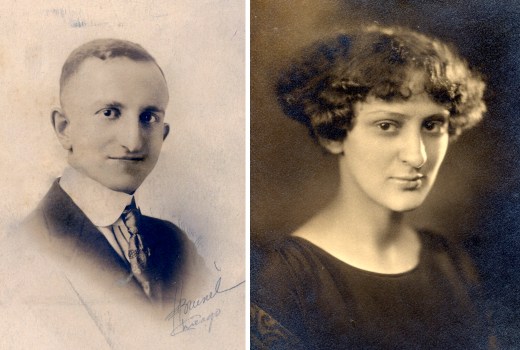
… Was a life-changing pile of clothes and other items from the 1920s, assorted mementos and newspapers and, most notably, hundreds of letters written by Chicago bookseller Jerrold “Jerry” Nedwick to the object of his affection, named Rhoda Katz.
Over the next decade, as Russell read and reread the letters, she was beguiled (“haunted,” she would say), and though she had spent her career as a hairdresser and restaurant manager, “never writing anything longer than a grocery list,” she thought she might use the letters for a book.
As she started to fashion the letters “into something or other,” she says she could hear music and see dancing when she read the letters.
Soon she approached a Washington Island friend named David Ranney. He had been visiting the island for decades and eventually he and his wife had purchased a house there, splitting their time with Chicago. He was a retired professor of Urban Planning and Public Affairs at the University of Illinois-Chicago. He also had considerable experience in labor organizing and has written five books. He had deep theatrical roots, since his father had been a theater critic for the Cleveland Press and his mother a managing director of a theater company. He was active with the Island Players.
“She talked to me about collaborating and after a few glasses of wine I agreed,” Ranney said, with a laugh. “There was really a gold mine in those letters.”
They spent a couple of years fashioning a play, she massaging the letters and he doing some deep research, which enriched what they knew of their two main letter-writing characters. But none of Rhoda’s letters existed and it was Ranney who convinced Russell that she could “become Rhoda.”
“That took a few glasses of wine too, for her to agree,” said Ranney. The imagined letters from Rhoda are a testament to Russell’s imagination and surely influenced by her nearly 60-year marriage to her husband Larry.
Finally they were ready. The response to that 2016 premiere was sold-out enthusiasm. Shortly afterward, Russell donated the letters to the Modern Manuscripts and Archives Collection of the Newberry Library.
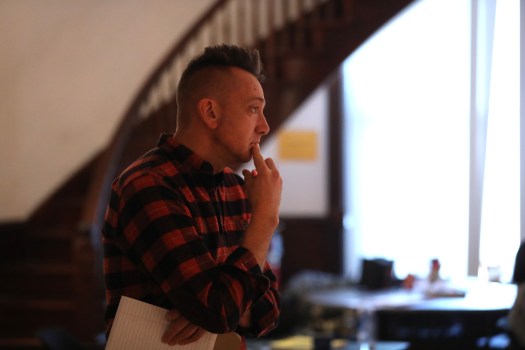
If you find this tale so far worthy of, oh I don’t know, Shakespeare, how fitting then that it came to the attention of Peter Garino. He is the founder and artistic director of the Shakespeare Project of Chicago, which since 1995 has presented many Shakespeare plays at the Newberry and elsewhere, as well as dramatic offerings concerning such authors as Hecht, Truman Capote and Lynn Redgrave.
“Of course I was intrigued by the play,” Garino tells me. “We were asked to present and I came to admire what Donna and David had created. They asked if I might get involved and I was very open to that.”
His involvement, formally as “adaptor and director,” consisted of writing new scenes, casting from the Shakespeare Project actors and directing the play.

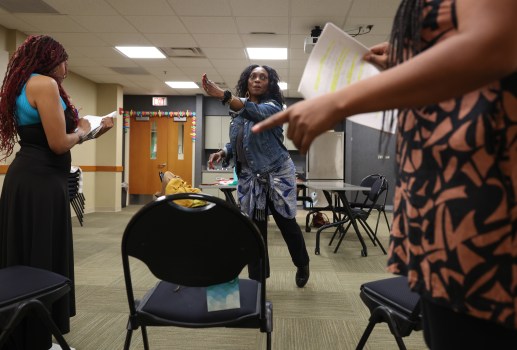
A reading came in October 2024 and “the response was so enthusiastic from the crowd and the actors that we decided to keep developing the script,” says Garino.
There are nine actors in the cast in the collaboration that is infused with Russell’s inventive crafting of Rhoda’s letters, Ranney’s historical research with its labor focus, and Garino’s imaginative theatrical expertise. There is live musical accompaniment. There is humor and there is drama, as Rhoda is inflicted with tuberculosis and hospitalized in suburban Winfield and Denver. Jerry is arrested and tossed in jail and has an affair with Brice.
The play is peppered with such issues as social justice, politics, prostitution, women’s rights and anti-semitism.
For all of its action, “Dear Rhoda” remains, at its core, a love story.
The show has three upcoming presentations: 7 p.m. March 20 at the Niles-Maine District Library, 2 p.m. March 22 at the Prospect Heights Public Library; and 6:30 p.m. March 23 at the Des Plaines Public Library. More information about all three at www.shakespeareprojectchicago.org.
There are also plans for future productions. “In November we will be back at Newberry and travel to some other libraries,” says Garino.
Libraries. Words. Reminds me that Jerry and Rhoda began corresponding during World War I when a poem written by Nedwick was published in a newspaper. Rhoda read it and loved it and wrote a letter telling him so. He was fighting in Europe but eventually that letter made it to him. He wrote back and, well, here we are.
rkogan@chicagotribune.com