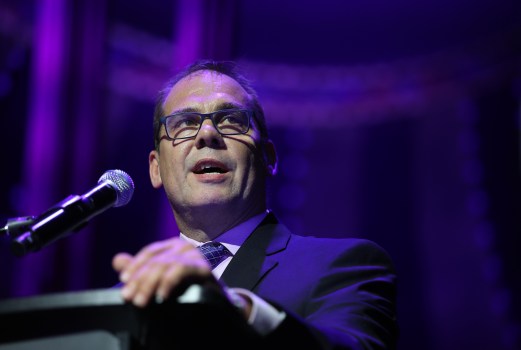

After an hour and a half of discussion and alternate proposals at a meeting on Tuesday evening, the Aurora City Council voted to further delay the ethics reform package proposed by Mayor John Laesch.
The proposed regulations would prevent those who are doing business with the city, or looking to, from donating more than $1,500 per year to candidates running for city office. It would also expand economic interest disclosures required of candidates, elected officials and certain city employees.
In a 9-3 vote, the proposal was sent back to one of the City Council’s committees for further review. The ethics reform package, which was a key part of Laesch’s mayoral campaign, has seen delay after delay and various changes since it was first formally proposed in early October.
“Any ordinance that impacts the 12 alderpersons in any way takes a few months to get through Council,” Laesch said at Tuesday’s meeting. “This one is no different.”
In the past, Laesch has said that the proposed package was designed to increase transparency and “reduce the influence that outside money has on city contracts.”
Two of the aldermen who voted to send the proposal back to committee — Ald. Patty Smith, 8th Ward, and Ald. Mike Saville, 6th Ward — said early in the meeting that they and others were not against ethics reform, but they just had some issues with the details of the proposal.
As brought forward on Tuesday, the campaign ethics reform package would limit those doing business or looking to do business with the city from making over $1,500 in contributions to city candidates or elected officials per year. Counting towards the cap would be donations made by the business itself as well as any made by parent companies or subsidiaries, and in some cases donations made by employees themselves.
Lobbyists would have even stricter limits. If doing business with the city or looking to, a lobbyist could not donate any amount to a city candidate or elected official, Aurora Chief of Staff Shannon Cameron said on Tuesday.
Those who do not follow the rules would be barred from doing business with the city for up to four years.
Expanded economic interest disclosures would also be required of those in a city elected office, those running for a city elected office and certain city employees under the proposed code changes.
These fillings would ask not only a person’s occupation but also if their employer has ever done work for or received any financial assistance from the city of Aurora, all real estate they own within the city or nearby, any organizations or businesses they own, any city-funded or affiliated organizations they are involved with, and any gifts they’ve received from those doing business with the city or looking to. Many of these details would also be required of immediate family members over the age of 18.
The filings would only need to be turned in once per year, down from the four times per year that is currently required, and they would continue to be available for the public to view online.
The reporting requirements and other proposed restrictions would apply to a candidate once they file their petition signatures to get on the ballot. At that point, they would have 15 days to submit their disclosure statements to the city.
These proposed requirements would be enforced through the DuPage County Ethics Commission, according to Cameron. Possible penalties would include $100 per day for failing to file required disclosures and $1,000–$5,000 per day for knowingly submitting false information, her presentation showed.
Most aldermen seemed hesitant to support the entire proposed package of changes, for various reasons.
Some wanted the proposed restrictions to apply only to the mayoral position, since they argued that seat has the most power over city contracts, and to rethink the portion that applies to aldermen, who in comparison have little control over contracts beyond final approval. Others took issue with the economic disclosure portion of the proposal, saying it needed more work.
The only successfully-approved change to the reform package was proposed by Ald. Daniel Barreiro, 1st Ward. He moved to delay for reconsideration the section related to the disclosures, but still move forward with voting on the portion limiting certain campaign donations.
“I spent a lot of time calling most of my colleagues here to try to have a discussion,” Barreiro said. “I can tell you that, the people I talked to, they all have an issue with it as a whole, so that’s where the problem is.
“I don’t think we’ve gotten to where everybody can be happy and live with it,” he said.
His proposal received a tie vote, with Alds. Juany Garza, 2nd Ward; Shweta Baid, 10th Ward; Keith Larson, at-large; Carl Franco, 5th Ward; Saville and Smith voting against. Tie votes are broken by the mayor, and Laesch voted in favor of it.
With the City Council from that point only considering the portion of the proposal that would limit certain campaign donations, Saville proposed applying those restrictions only to those running for mayor. Restrictions on campaign donations for aldermen would then go back to a committee for further work, he said.
Saville’s proposal also received a tie vote, with Alds. Jonathan Nunez, 4th Ward; Javier Banuelos, 7th Ward; Edward Bugg, 9th Ward; Ted Mesiacos, 3rd Ward; Larson and Barreiro voting against. Laesch, breaking the tie, voted against it.
The final proposal was made by Smith, who wanted to send nearly all of the proposal back to committee for reconsideration except the $1,500 donation restriction on those doing business with the city.
Again the vote was split, with Alds. Barreiro, Mesiacos, Nunez, Banuelos, Bugg and Larson voting against it. And again, Laesch broke the tie by voting against it.
Finally, Bugg made a motion to send the entire proposed ethics reform package back for reconsideration to the committee he chairs: the Rules, Administration and Procedure Committee. That vote passed, with Alds. Barreiro, Garza and Nunez voting against.
The Rules, Administration and Procedure Committee of the Aurora City Council, which next meets on March 18, is where the ethics reform package was first proposed in October. The committee held the package for nearly two months before eventually recommending it for approval with significant changes.
On Wednesday, Smith told The Beacon-News that she wants aldermen to be given the chance to have outside, nonpartisan legal counsel look at the proposal, just like the mayor got the chance to do.
Ald. Keith Larson, at-large, said at Tuesday’s meeting that his experience talking to voters and polling data shows people overwhelmingly support campaign contribution limits even across political party lines. Several people spoke during the public comment period of Tuesday’s City Council meeting about the proposed ethics ordinance, with the vast majority speaking in favor of it.
On Sunday, Laesch posted on Facebook about his proposed ordinance, questioning whether it would pass and explaining how to speak during the Tuesday meeting’s public comment period. For those who couldn’t attend the meeting, he suggested in the post that they write or call their alderman.
Last week, the reform package was discussed at length by the Committee of the Whole, which sets the agenda for City Council meetings. Out of the 12 City Council members, seven raised at least some issue with the proposal, while only two spoke in favor of it.
rsmith@chicagotribune.com