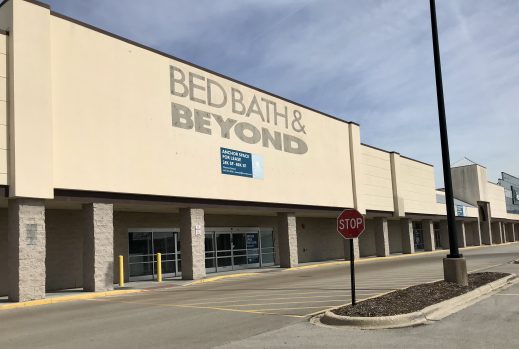
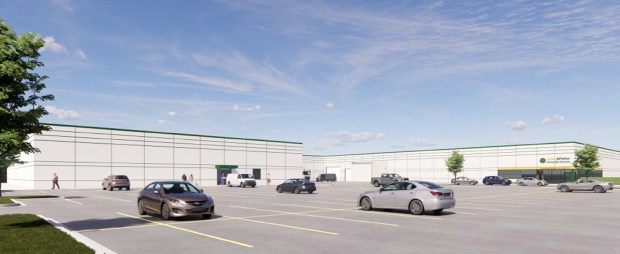

Naperville-based Loaves & Fishes Community Services could receive $2.5 million from the DuPage County Board to help expand the nonprofit’s food distribution center in Aurora.
Dubbed “Hub 2.0,” the expansion would add 32,000 square feet to the facility at 580 Exchange Court, quadrupling the number of cold storage areas and potentially more than doubling the number of people served. The warehouse opened in 2021 and delivers to 13 “spokes,” most of which are located in DuPage.
If the funding is approved, Loaves & Fishes will be about $500,000 short of the $8 million it needs to pay for new space, officials said.
“Our pantries are pretty much at capacity with the resources and the infrastructure that exists today and so it’s difficult to catch up with a rising need, creating more unmet need,” Loaves & Fishes CEO Mike Havala told the DuPage County Board at its meeting Tuesday.
The agency assists people in a four-county area: DuPage, Will, Kane and Kendall.
Its main pantry/grocery store is located at 1871 High Grove Lane in Naperville. The Aurora hub, in addition to offering storage space and delivery services, also serves as the facility where people can pick up pre-packed groceries. And every Wednesday, food is distributed from their Bolingbrook location at 151 E. Briarcliff Road. In addition to in-person shopping, clients can shop online at www.lffood.org.
Since 2019, food insecurity has grown in DuPage County by 64%, affecting anywhere between 90,000 and 100,000 people, Havala said. He attributed high cost of living as the primary reason for the increase, but also noted that reductions in the money provided through the Supplemental Nutrition Assistance Program (SNAP) is having an effect.
Since 2019, food insecurity has grown in DuPage County by 64%, affecting anywhere between 90,000 and 100,000 people, Havala said. He attributed the area’s high cost of living as the primary reason for the increase, but also noted that eligibility requirements and limitations in the Supplemental Nutrition Assistance Program (SNAP) are also having an impact.
On average, the cost of living for a DuPage County family to break even is $91,000, he said. SNAP cuts off at $43,000 for a family of that size, leaving many in what Havala called the “SNAP gap” and in need of help through organizatons like Loaves & Fishes.
“All the pantries in DuPage County collectively provided about 26 million pounds of food last year, which is wonderful. It’s a big number,” he said. “Unfortunately, there’s a bigger need out there. The unmet need is about 21 million pounds. … The pantry system is doing a great job, but we would almost need to double that capacity in order for us to meet the entire need here in DuPage County.”
Plans to expand the Aurora hub have been in the works for the past three years, with land for the project purchased in 2023 and engineering on the new space completed last year, officials said. The goal is to start construction this spring, Havala said.
One question raised by some board members was why DuPage should give such a large amount to the hub expansion when the three other counties with residents who benefit from Loaves and Fishes services have not contributed.
“We see DuPage doing a lion’s share, and basically the other three counties doing nothing,” board member Brian Krajewski, R-Downers Grove, said.
Board member Grant Eckhoff, R-Wheaton, said he would like to see Kane County in particular participate given the high number of its residents served by the agency.
Havala said Loaves & Fishes has reached out to the other counties, but they are not in the same financial position as DuPage.
Of the 10,000 people who are served by the nonprofit every week, 38% are from DuPage, 41% from Kane, 17.5% from Will and 3.5% from Kendall, based on a three-year average, according to Joni Wiltz, Loaves & Fishes marketing director.
“Is there a disproportionate investment versus outcome that DuPage County is getting? The answer is yes,” Havala said. “It’s in the favor of DuPage County. DuPage County is investing 20% and the output is between 35% and 40% to DuPage County residents.”
Board member Saba Haider, D-Aurora, said she supported the funding because it would benefit her District 5 residents, most of whom live in Aurora and Naperville.
“I know that affordability is a really big issue locally, in my district, in the county, in the state, in the nation,” Haider said. “And so, if we can give relief to our residents just with their food costs so they can actually afford child care or an Uber to their workspace, to be able to become more independent, I think that’s the best thing we can do as a board to support that.”
Challenge grant
The county board is also looking for ways to support smaller food pantries in the area, including through a proposed “challenge grant” that would help pantries transform their infrastructure system to provide food to those in need in the most efficient and cost effective ways possible.
The grant would run from 2026 to 2027 and projects would need to create a significant improvement to their food assistance infrastructure and impact multiple food pantries or organizations to receive the funding. Minimum grant requests would be $500,000, cannot exceed 50% of the project’s total cost and must have funding fully secured by 2027, according to the proposal.
“We’re basically challenging organizations to think big, apply for a significant amount of funds, and then go out and develop additional partnerships through corporate sponsors, private philanthropic organizations or other government entities,” said Mary Keating, county director of community services.
The goal is for the organizations to make “infrastructure investments that would make the system overall more efficient,” Keating said.
Board member Greg Schwarze, D-Carol Stream, said the challenge grant was created in response to board members’ concerns about equity among food pantries.
“Going back to what we heard today from Loaves & Fishes, it’s been a three-year project to get to this point so we just don’t want to exclude anybody,” Schwarze said. “We hear you guys loud and clear. We want everyone to have this opportunity to get, potentially, up to a $2 million grant. And that’s what this is all about.”
Some board members questioned if the program should include projects focused on operations and whether a minimum of $500,000 was too high for smaller food pantries to meet.
“For these tiny little food pantries like Lisle, they would have to come up with 50% of that,” board member Dawn DeSart, D-Naperville, said. “They’d have to come up with $250,000 and our little food pantries don’t have that kind of money to meet us halfway in that.”
Board member Lucy Chang Evans, D-Naperville, raised a similar concern, suggesting there should be a summit to better understand what the needs of smaller food pantries are and to ensure the grant program is feasible for them.
Keating also recommended the county set aside $2 million to assist the Northern Illinois Food Bank’s fresh produce program, which would help the food bank purchase produce to distribute to various food pantries for the next two years. She also suggested earmarking $322,000 for the Naperville-based Conservation Foundation’s farm-to-pantry program, which will provide relief to the food bank in the wake of federal funding cuts.
cstein@chicagotribune.com