

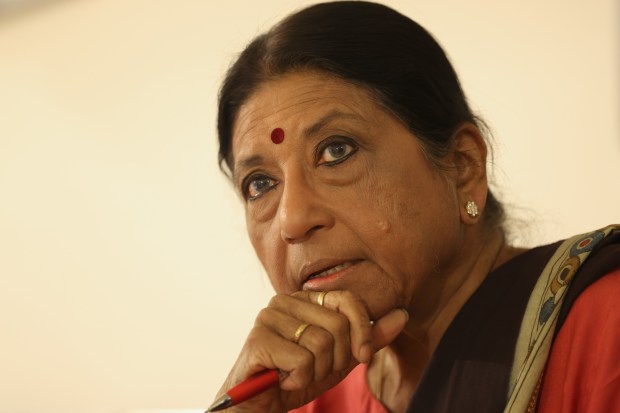



Hema Rajagopalan says the last 50 years have flown by.
“It seems like a short time to me,” says Rajagopalan, the founder, artistic director and chief choreographer of Natya Dance Theatre.
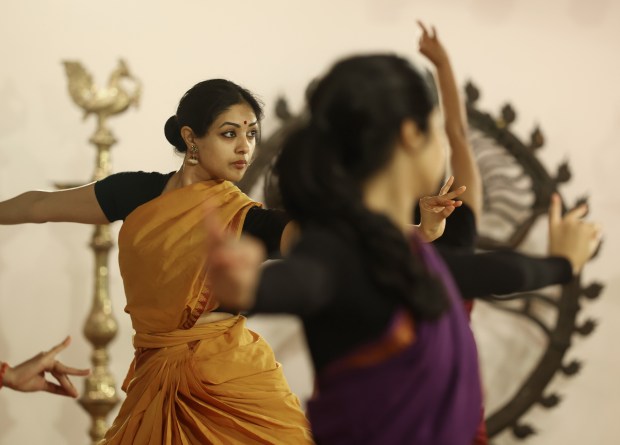
The Indian dance company celebrates its 50th anniversary with three performances at the Dance Center of Columbia College Chicago.
“I can’t believe it’s already 50 years. It seems like yesterday that I struggled and I came here,” she says.
Rajagopalan moved to the United States from New Delhi, India, in 1974. She had been studying the South Indian dance form called Bharatanatyam since age 6 and came to the U.S. intending to give it up.
“I was in my prime, in the sense that I was dancing a lot,” she says, “but the political scenario there wasn’t that great. It was bureaucratic. I had postpartum depression as well. Put together, I was feeling very low.”

Rajagopalan and her husband agreed to visit the U.S. for two years and never moved back; their daughter, Krithika, joined the family, which settled in the western suburbs.
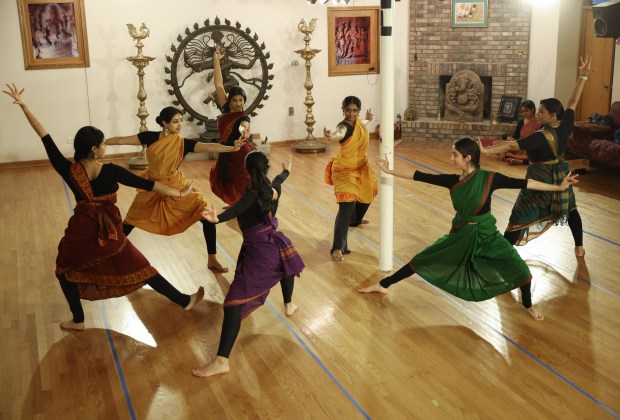
For a short time, Hema Rajagopalan worked as a dietitian but quickly realized it wasn’t for her. She resumed dancing, privately at first, in a one-room studio in her home. She got an invitation to perform, then another to teach — and that’s how Natya Dance Theatre began.
“Culturally, it was sparse,” Hema says of the Indian diaspora at the time. “There was a dearth of understanding of our own culture.”
Fast-forward 50 years, and Chicagoland is now home to more than 250,000 Indian Americans, among the largest concentrations of Indian immigrants in the country.
Students still flock to study with Hema, whose primary studio is in the basement of her Oak Brook home. Krithika, who currently lives in California, has developed her own following, despite (like her mother) not initially intending to make dance her profession. In addition to teaching and preparing dancers for professional study, marked by a solo debut performance called an arangetram, the two women together run a company dedicated to performing concert dance works — a format Hema pioneered for Bharatanatyam in Chicago.
“I was always interested in sharing our culture,” Hema says, but she simultaneously sought to immerse herself in other cultures and communities.
Hema listened to jazz music and attended dance concerts, forging intentional connections with Chicago’s modern dance scene — including a decades-long kinship with the Dance Center’s founder, Shirley Mordine. What resulted was not a fusion form — Natya Dance Theatre quite clearly stays in the Bharatanatyam lane.
“It’s not fusion, it’s influence,” Hema says, developing a brand of the artform uniquely informed by Chicago.
“Everything we did got ridiculed in India,” says Krithika, Natya Dance’s co-artistic director.

She recalls a review of a performance in India about 25 years ago that criticized her for turning her back to the audience and moving diagonally, bucking conventional thought that the dancer should always face forward.
Krithika says Bharatanatyam practitioners around the globe are more comfortable now with innovating the form. Nowhere in “the book,” she says, does it say you can’t turn your back to the audience — the book being the ancient treatise on the performing arts called the “Natya Shastra.”
That desire to press at Bharatanatyam’s boundaries without breaking them came naturally to Hema from the start. Her first collaboration with a modern dancer was “Conversation,” a duet created in 1995 with Jan Bartoszek of Hedwig Dances. In 2004, Hema and Krithika created “Inside-Outside,” further interrogating traditions that were expected — but didn’t appear anywhere in the “Natya Shastra.”
“I had this drive to expand my own artform,” Hema says. “One goal specifically was that I needed to connect with everyone.”
There were conversations and collaborations with a range of artists like Mordine, Trinity Irish Dance Company founder Mark Howard and critic Ann Barzel, who Hema says helped her develop language that led to the company’s first National Endowment for the Arts grant.
“If I had not met these beautiful artists in my life in Chicago — and so many others who were in the arts — my art would not be what it is today,” says Hema. “If I were in a different city, I don’t think this would have happened.”
Natya Dance Theatre’s newest work, “Sharira/Shariri: Held Within,” is a variation on that theme, based on ideas from the Hindu philosopher Ramanuja that all beings are interconnected and dependent on a larger divine force. In Sanskrit, Sharira means “body” and Shariri refers to the “embodied one,” or the soul that inhabits our physical bodies.

Hema’s choreography is complemented by music from Rajkumar Bharathi, lyrics by S. Raguraman, and lights and costumes by Elyjah Kleinsmith and Sandhya Raman, respectively. Krithika has been refining the work through dramaturgy. “Sharira/Shariri” explores the metaphor of a river — an exercise in letting go of ego and control. A river, Hema says, is simultaneously aware of its own power and unable to control its inevitable journey to the sea — a fitting tribute 50 years down the road from a single invitation to perform.
The Dance Center is also an intentional choice for the piece; since 2001, the venue has been a cyclical presence throughout Natya’s history, most recently hosting “Inai —The Connection” in 2019.
“Inai” was about bridges, initially inspired when Hema happened upon a billboard in Europe that said, “What is the bridge between thrive and survive?”
It’s a question every dance company faces — particularly one as long-lasting as hers. Natya Dance Theatre didn’t become a nonprofit until 1994, which made it eligible for grant funding. But even that has been precarious. Bharatanatyam, which in India is characterized as a professional fine art like ballet or opera, is only eligible for state and national funding in the crowded “ethnic dance” category.
The company performed for 13,000 people in Millennium Park with Yo-Yo Ma’s Silk Road Ensemble, was selected as the first dance company to ever appear at New York’s World Music Institute and danced at the 2002 Olympic Games in Salt Lake City. A PBS documentary in 1994 featuring Natya Dance Theatre won an Emmy.
But for Krithika, it’s not about the accolades.
“We don’t look for back scratching,” Krithika says. “We do the work because this is where we think it needs to go.”

Documenting not just the highlights but the intricacies of Hema’s teachings and choreography is a major focus moving forward, plus developing a succession plan. Hema, 75, is trying to approach NDT’s next phase like the river — aiming to (eventually) let go and allow Krithika to take the reins.
“How do we develop an understanding in that next generation of artists and also grow that understanding to things that are going to come that we don’t know about yet?” Krithika says. “It’s complete comprehension of the roots, but those roots can be picked up and placed in a new environment and still thrive.”
Lauren Warnecke is a freelance critic.
If you go
“Sharira/Shariri: Held Within” runs March 19-21 at the Dance Center of Columbia College Chicago, 1306 S. Michigan Ave.; tickets $30 at 312-369-8330 and dance.colum.edu.