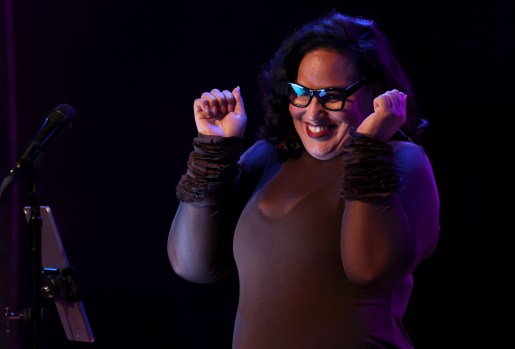

In 2020, Leslé Honoré’s “Brown Girl, Brown Girl” poem went viral. The original work from Honoré’s 2017 book of poetry “Fist & Fire,” was revised and posted on social media to coincide with Senator Kamala Harris’ transitioning to the role of the vice president of the United States. By 2024, that poem became Honoré’s first children’s book with the same name.
The mom of three and Urban Gateways CEO penned a poem after the killing of Tyshawn Lee, the 9-year-old found shot in an alley in Auburn Gresham in 2015. She also used her words to commemorate the moment Meghan Markle married Prince Harry in 2018. She found the words to pay homage to Betty Reid Soskin, the oldest serving National Park Service ranger in the United States, as well as Rev. Jesse Jackson, Sr., D’Angelo, Assata Shakur, Misty Copeland’s history-making presence on stage, and the death of friend Brenda Langstraat Bui. In 2024, the work of the self-identifying Blaxican’s (Black and Mexican) lyricism was again on the world stage with her poem “If You Raise Daughters That Are Free” — recited by Supreme Court Justice Ketanji Brown Jackson during the Spelman College commencement ceremony.
In case you missed it, Honoré’s poems capture the zeitgeist of the moment.
“This year has been really hard to channel because there’s not a point of my identity that this administration has not negatively attacked, whether it be being the daughter of an immigrant or the descendant of enslaved Black Americans, whether it be a single mom, or the CEO of an arts organization — every area that builds me, my friends, my family, my city, has all been under attack, it’s been heavy,” she said. “I have found myself not necessarily writing less, but maybe not writing fully all the time, and giving myself a little bit of space to mourn, as we all do. And then I come back to it.”
Her latest children’s book, “My Brown Boy,” centers male youths with melanin — their joy, their vulnerability, their brilliance, their creativity, their humanity and their possibilities. Paired with the illustrations of the late New York Times bestselling illustrator Keturah A. Bobo, the story is one “born out of a desire to say aloud the things that are often whispered, and to say the most important thing even louder: that my son and boys like him are filled with and capable of so much more than the world expects.”

The Tribune spoke with Honoré about her poetry and her desire to read her book to youth in all the city’s library branches. The following conversation has been edited for length and clarity.
Q: You dedicated the book to your late father, Louis Honoré Sr., and your son Solomon. Your dad told stories every night as you fell asleep. What stories would he tell you?
A: He made up a story called “The Magic Rocking Chair.” It was set in France, about a family waiting for the father to come back from the first World War, not knowing if he was dead or alive. The grandfather encountered a leprechaun who granted him a magical rocking chair that when you sat in it, it granted wishes, but only those made for other people. When you wish for something for yourself, the magic goes away. The rocking chair traveled all over the world.
My book is about so many amazing brown men that aren’t doing what is stereotypically associated with the pathways to success for them. There’s a whole world of professions and talents that we don’t automatically think of as spaces for brown and Black men. For me, it’s it’s the artists, the poets, the dancers, the painters, the cooks — Black men that are a huge part of the narrative so that it’s easier for the next generation to walk tall.
Q: When your first children’s book was released, Kamala was VP and DEI was becoming part of the lexicon. What do you hope this book says in this moment?
A: All my books are made with the hope of affirming — affirming their experience and knowledge. The world sees them as a brown child — whether it’s from the Black diaspora or from Latin America. We then explain to them in age appropriate ways why that doesn’t define them, and then we explain it when they get a little older in an age appropriate way for a teenager, and it’s something that marginalized people have to continue to affirm themselves at all parts of their lives, because the systems we live in have not disappeared yet.
I hope a little brown boy who never has seen different possibilities opens the book on his own somewhere and sees brown boys doing things that may be new to him, whether it’s playing an instrument or crying, or acknowledging their friends who are crying. It all comes back to joy. If one little brown boy sees that … If one brown boy sees a brown boy walking away from a basketball court to go find a nook to read in. If that’s the first time they see that affirmation and see themselves reflected, I have done what I’ve come here to do.
Q: I’ve been seeing you on social media reading your books at our city libraries.
A: Brenda (Langstraat Bui) was so excited about these books. I have been doing school visits since COVID, on Zoom. I really want kids who look like me to see an author. I want it to be something that is not just tangible on the pages, but for them to see me and see my ordinariness, see me looking like their aunties and their cousins and knowing that they can get there too. I want women who survive domestic violence to know that there’s another side, there’s another chapter of your life waiting for you; I want executives to know you’re not bound just by your C-suite. You can do more than that, you can be abundant in your talents and they are not sacrificial to each other.
Q: A third children’s book is on the horizon, this one for your youngest child, Scarlett Rose Smith — the poem “If You Raise Daughters That Are Free.” But what’s on your manifest board? Something you dream of manifesting into reality?
A: When I was writing for the Rev. Jesse Jackson, I thought I got to put together a compilation of all my tributes for our figures that we’ve been losing over the past several years —a cultural obituary. I would love to do a novel of poetry, tell my own life story the best way I can. My dream job: Go to restaurants, eat food, and write a poem. A poetry review, that the restaurant can use in exchange for the meal. They can put the poem in their menu or put it on their wall. That’s what I would love, eat food and write poetry about it — Leslé’s Lunch in Letters. That would be a hoot.