
As special education teacher Gwendolyn Kinard listened to updates earlier this week on Chicago Public Schools’ long-awaited Black Student Success Plan, one feeling stood out: relief.
“First of all, I’m happy that it still exists,” said Kinard, who teaches at Jungman STEM Magnet Elementary. “The president was working on dismantling (diversity, equity and inclusion), but we survived.”
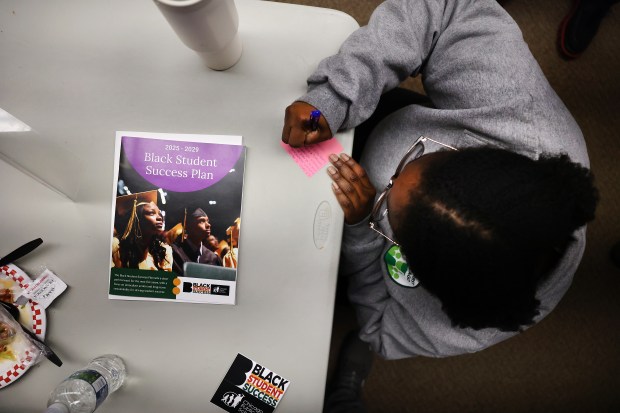
The community roundtable was the first in a series outlining the rollout of the district’s five-year blueprint to break down achievement barriers for Black students. Among other goals, the plan aims to close academic gaps, double the number of Black male teachers and reduce disciplinary practices for Black students.
Advocates who champion it argue that Black students, who make up a third of the student body, are uniquely positioned to fail because of long-standing racial inequalities and discrimination across the U.S.
But the plan came under federal scrutiny last year, when the U.S. Education Department opened an investigation into allegations of racial discrimination — part of a broader crackdown against DEI programming. After district officials refused to scrap the initiative, the agency pulled $8 million in unrelated federal magnet school grants from CPS.
Months later, the district is forging ahead.
“It has gained a lot of national attention, including from the White House. But like John Lewis said, ‘Good trouble,’” said Eugene Robinson Jr., the district’s inaugural director of Black Student Success, quoting the late civil rights activist and Georgia congressman.
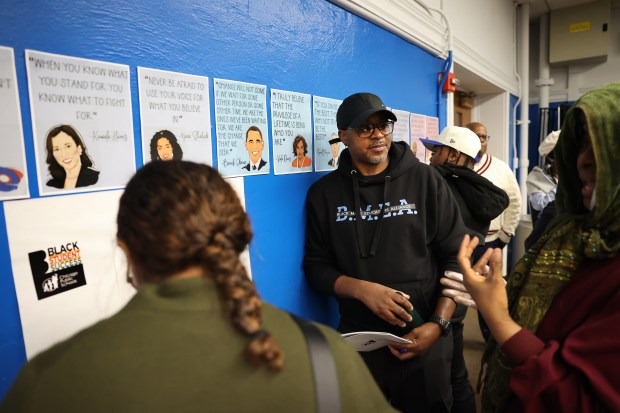
The roundtable was held at Wendell Phillips Academy High School in Bronzeville, which, Robinson noted, became Chicago’s first predominantly Black high school in the 1920s. The classroom walls were lined with quotes from influential Black figures, past and present, ranging from former President Barack Obama to W.E.B. Du Bois.
CPS officials discussed ongoing efforts to meet goals for Black students, though they shared few new specifics. So far, Robinson said, much of the work has focused on coordinating equity initiatives within each district office.
“There are two people on Black Student Success. There are 600 schools,” Robinson said. “There’s a lot of time that goes into it.”
Still, some efforts are making ground. The district received a $250,000 pilot grant to fund several initiatives under the Black Student Success umbrella, including a districtwide Black Student Union conference. The money will also fund a new Black Male Educator Pipeline and Retention initiative, focused on building affinity spaces for Black educators with mentoring and wellness programming.
CPS officially unveiled the plan in February 2025, though it has run into delays. Last month, the district reopened applications to the 14-member Black Student Achievement Committee — tasked with guiding implementation — despite originally planning to launch it in the fall.
Chicago Board of Education member Jitu Brown, who is chairing the committee, said at last month’s meeting that nearly 500 people had applied. A board spokesperson told the Tribune that the application window was extended “to support a robust candidate pool across a broad range of stakeholders.”
Kinard, the special education teacher, said she hopes to integrate the plan into her own teaching. She pointed to the work of the late Rev. Jesse Jackson, the celebrated Chicago civil rights activist who died last month.
“His legacy, I can see it embedded in the (plan),” said Kinard, who is in her 70s. “Not only will Black people, Black students, Black children benefit, everybody in the school district will benefit.”
The plan, a 46-page roadmap, aims to address persistent achievement gaps. Four-year graduation rates for CPS students have steadily climbed over the past two decades, reaching 84% in 2024, according to a December report from the To&Through Project. But Black male students continue to trail their peers, with a graduation rate of 77% last year, mirroring national trends.
And while college enrollment and completion rates have improved districtwide, Black students haven’t seen the same gains. In fact, 135 fewer Black graduates from the class of 2018 completed college within six years compared with those in the class of 2008, the To&Through Project found.
The plan also aims to boost a culturally responsive curriculum, including lessons on Black history and culture, and reduce out-of-school suspensions and expulsions for Black students by 40%.
Previous research has found that Black students are significantly more likely to be suspended than their peers. The district has since taken steps to reform its disciplinary policies, including removing school resource officers in 2024.
“I was a disciplinarian, but I taught you what to do so you didn’t end up in my office,” said attendee James Patrick, a former CPS principal who retired in 2007. “That’s how it should be.”
Patrick, sitting at the front table, scribbled notes on a notepad. “It’s all important. I’m just here to learn,” he added.
Across the room, 36-year-old Mark Anderson mused about the district’s support for transitioning Black students to college. Anderson, a CPS alum, recalled being so overwhelmed as a first-generation prospective college student that he almost didn’t complete the application process.
“We have to make sure that we don’t have children that go through the same barriers that we had to go through,” he said.
Federal pressures
The Education Department announced in April it was launching an investigation into the plan. It cited a complaint filed by Parents Defending Education, a Virginia-based group with a history of interrogating race-based policies. The complaint alleged that the initiative “violates Title VI by focusing on remedial measures only for Black students,” which CPS has denied.
The Education Department’s Office for Civil Rights investigates thousands of discrimination complaints each year, about a third of which are disability-related. But President Donald Trump’s administration has increasingly leveraged the office to probe DEI initiatives.
In September, the agency wrote in a letter to CPS leadership that the district had just three days to scrap the Black Student Success Plan and change policies supporting transgender and gender nonconforming students. Ultimately, the district refused.
In response, the agency withdrew $8 million in federal funding, part of the Magnet Schools Assistant Program. Chicago was awarded a $15 million, five-year grant under the program in 2024. As CPS charges ahead, district leaders said they will use money from special taxing districts to cover the funding gap.
The Black Student Success Plan itself has not been affected by funding changes, a district spokesperson said in a statement.
“As federal funding cycles change, CPS remains committed to protecting all student opportunities from the impacts of budget cuts and ensuring that strategic priorities lead to measurable success in the classroom,” the statement said.