
Recent Indiana Utility Regulatory Commission filings show that the Northern Indiana Public Service Company LLC overcharged more than 3,500 customers for their gas service.
The finding comes after months of NIPSCO customers expressing concerns about high utility bills, specifically with their gas delivery charges.
“It makes me upset,” said Terri Logan, a Hamlet resident. “I just feel like the more that we let NIPSCO get away with, it’s just going to get worse. … We need help now, and NIPSCO should not be allowed to continue overbilling us.”
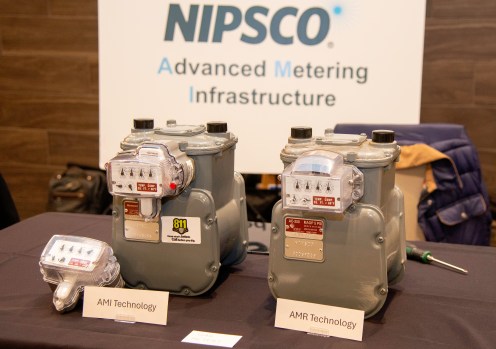
A recent filing into an IURC investigation into NIPSCO issues with its natural gas meters shows that the utility found more than 4,000 gas meters had registered the incorrect usage each month. NIPSCO discovered the issue in October 2024 when adding advanced metering infrastructure to gas meters, but it wasn’t reported to the IURC until November 2025.
According to the filing, 3,542 gas customers were overbilled for twice their actual usage. If someone’s usage was 10 therms of gas, the meter recorded 20 therms, according to the filing.
“They had the records, and they had the capability of going back and finding out what’s been going on,” Logan said. “I think NIPSCO should be held accountable for it. They are the ones who need to investigate it, and I think the IURC needs to be watching them.”
On March 6, NIPSCO uploaded three direct testimonies in the case with employees that explained the errors. Testimonies were from NiSource Operations Accounting Manager Chris Cubenas, NIPSCO Director of Major Projects John Sabotnik and NIPSCO Director of Regulatory Policy Robert Sears.
The filings also say that NIPSCO doesn’t know when the meter issue started, what caused it or if all meters were affected at the same time.
“There are multiple points in time at which the issue could have originated, including during manufacturing, original meter installation, retrofitting NIPSCO’s meters with AMI infrastructure, or at another unknown time or event,” Sabotnik said in his testimony. “It is also possible that it did not occur at the same exact time for every meter — meaning some meters could have had a manufacturing error, while the issue could have arisen at a different time for other meters.”
In a statement Friday, NIPSCO said that the utility proactively informed the IURC when it discovered “potential billing discrepancies affecting a limited number of natural gas customers.” It was not caused by or related to the AMI modules installation.
“To date, this issue is affecting less than 1% of NIPSCO’s natural gas customers,” the statement said. “For any customer who had been for more than actual usage, NIPSCO is providing a refund for 12 months of usage pursuant to IURC rules and regulations. For any customer who had been billed for less than actual usage, NIPSCO will not be seeking to recover for any prior usage. We are fully cooperating with the (IURC’s) investigation and have already taken steps to verify and correct any impacted bills.
“Customers do not need to take any action. NIPSCO is proactively communicating to our customers, both who were impacted and not impacted, and we will continue providing updates as we learn more.”
Ben Inskeep, program director for Indianapolis-based Citizens Action Coalition, said the organization learned about the error on March 6. On March 11, the Citizens Action Coalition petitioned to intervene in the IURC case.
The Citizens Action Coalition were intervenors in NIPSCO’s last gas case, and they were never told of the issue, Inskeep told the Post-Tribune.
“It was really startling to learn of this issue for the first time in March 2026, a year-and-a-half later,” Inskeep said. “We had dozens of meetings with NIPSCO in that intervening period … and they never told us about the issue, that they were aware of it and were trying to fix it.”
NIPSCO is still adding AMI to meters, Inskeep said, so he believes thousands of other customers are still being billed incorrectly. The utility plans to refund customers for one year of incorrect billing, even if they have been overbilled for years, Inskeep said.
According to the filing, no pattern has been seen with affected customers. Inskeep said it seems to be sporadic throughout NIPSCO’s service territory.
“There’s still many thousands of families that could be negatively impacted from an affordability perspective,” he added.
Manh Northwest Indiana NIPSCO customers are concerned with how high their gas utility charges are, with some being more than the charge for their supply. Delivery charges could also be impacted by this error, Inskeep said.
“My understanding is yes because the meter is registering double the usage to what was actually used,” Inskeep added. “The delivery charges are just a specific amount multiplied by the amount of usage that NIPSCO’s meter says you use. So if it says you used double what you actually use, you’re going to be paying double the delivery charges that are correct for your bill.”
In a previous statement, NIPSCO explained the delivery charges residents see on bills, saying that the charge covers the regulated cost of safely delivering gas to homes and businesses. Gas bills also include supply charges, reflecting the market price of natural gas, and NIPSCO “does not control or mark up the price of natural gas,” according to Post-Tribune archives.
Customers’ bills are structured through a per therm rate multiplied by the number of therms used, according to NIPSCO. In high usage months, including December, January and February, the bill increases because “the approved bill structure applies an approved delivery per therm rate to the amount of therms used,” and the bill increases because therms used increases.
Logan runs the “NIPSCO Monopoly Madness” group on Facebook, which has about 32,000 members who are concerned with their high utility bills. Logan also helped create the 2026 NIPSCO Energy Affordability Impact Brief, which examines residents’ bills in the last few months compared to a year ago.
Report authors plan to share its findings at a March 24 IURC investigative inquiry in Indianapolis. NIPSCO and four other companies will present on various topics, including how usage and rates lead to bills, the impact of growth on affordability, and short-term steps that can increase bill transparency and rising energy costs, according to the IURC. The inquiry will be from 8:45 a.m. to 3 p.m. at the PNC Center in Indianapolis, and it will be streamed on the IURC’s website.
“I’m hoping that when they meet with all the utility companies, that we get some straight answers,” Logan said.
Ahead of the March 24 investigation, Inskeep believes this discovery feeds into the public’s general concern of utilities.
“I think it really undermines the public trust in our utilities when we learn that they can’t even accurately bill us and accurately meter our usage,” Inskeep said. “I think it’s important for customers to let their elected officials know about this issue and to ask them to advocate on their behalf.”