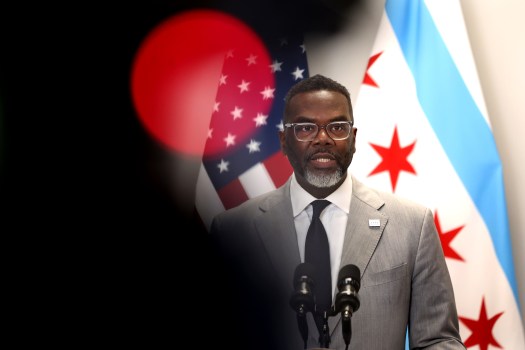
Mayor Brandon Johnson has been barnstorming wards around the city in his continued war of words with a City Council majority that rejected his proposed jobs tax on large private-sector Chicago employers late last year.
The mayor’s message has been clear: The city’s finances are a shambles (through no fault of his own, of course) and the budget that passed without his signature isn’t truly balanced. At a South Shore town hall in early February, attended by 5th Ward Ald. Desmon Yancy, who’s become part of the aldermanic opposition group, Johnson said the budget Yancy supported contained revenue sources “that the public has never seen or heard of before. That does bring some alarm.”
At a town hall meeting March 5 in Lakeview, the mayor was flanked by his budget director, Annette Guzman, who reiterated that the city is projected to find itself $163 million short of needed funds, which could cause a budget crisis by the summer.
Clearly, Johnson is still smarting from losing the budget battle last year even as he appears to gear up for a reelection campaign he has yet to formally announce. His political motivations with these town halls are apparent.
But aldermen and Chicago voters aren’t the only constituencies observing Chicago’s dysfunctional governance. Bond analysts and investors are watching, too. And what’s also clear is they don’t like what they see.
The city found itself in a particularly bad spot when it was forced on Tuesday — just five days after Guzman warned publicly of a budget crisis to come — to issue more than $500 million in taxable bonds, much of which will go for the cost of back pay owed to firefighters and mounting legal settlements. Chicago also wanted last week to issue nearly $300 million in tax-free bonds for capital needs, but delayed that move due to gyrating market conditions. Most other municipalities pulled their planned bond sales, too.
But, given that these bonds for operational costs were part of this year’s budget, Chicago had no choice but to go ahead with those. The price predictably was steep.
The interest rates the city will pay investors range from 5.9% to 6.3%, a city spokeswoman said. The median rate municipalities across the nation right now are paying on taxable bonds is only about 4.5%, according to experts. The premium Chicago is paying thanks to its poor credit and dysfunction is up to an extra 1.8 percentage points, which is a lot of money on $500 million-plus in debt.
We’ll find out next week the total in interest Chicago taxpayers will shell out over the next seven years or so on these securities when the city releases the final offering document on them.
Of course, two ratings agencies downgraded Chicago’s overall debt ratings heading into the sale, so that didn’t help. But the reasons for those downgrades — and the higher carrying costs being shouldered by city taxpayers as a result — include the mayor’s continued war with the council majority. Don’t believe us?

Among the factors Fitch Ratings cited in its release explaining its downgrade were “ongoing disagreements between the administration and the city council,” which “have impeded decision timeliness and the development of a credible and comprehensive plan to restore structural balance.”
Here’s what Concord, Massachusetts-based investment research firm Municipal Market Analytics had to say in a report last week: Chicago’s recent bond offerings are “motivated by fiscal stress, a coping mechanism. The city routinely uses debt to push out debt service payments for budget relief, fund capitalized interest, and pay operational expenses.”
To clarify: Those aren’t good things.
Matt Fabian, president of Municipal Market Analytics, told us the pricing could have been even worse given last week’s rocky market conditions. He described the city’s situation as “forced selling into a lousy market.” As to the mayor’s continued public battle with the council over a budget finalized more than two months ago? Fabian said, “That’s not constructive.”
No, it’s not. To say the least.
In less than a year, Chicago voters will go to the polls to elect a new mayor. Johnson, who remains deeply unpopular in public polls, could well no longer be mayor in a little over a year.
For the next 14 months, though, he remains Chicago’s chief fiscal steward. In his three years, he’s already presided over multiple credit downgrades. And he’s added substantially to the city’s towering debt stack.
No matter his ideological desires and his ire at a council that doesn’t trust him and won’t agree to his economically crippling taxes, his first responsibility is to do no more fiscal harm. As he continues to go ward by ward deriding the finances of his own city, the yields bond investors demanded last week to help bankroll the city’s budget suggest he indeed is doing such harm.
Submit a letter, of no more than 400 words, to the editor here or email letters@chicagotribune.com.