
In just a few weeks, it will be planting time. “Make soil improvement part of your planting plans,” said Sharon Yiesla, plant knowledge specialist in the Plant Clinic at The Morton Arboretum in Lisle.
That doesn’t necessarily mean digging in compost everywhere. Different ways of improving soil are appropriate in different situations, but they all have two aims: adding organic matter and making sure the soil has the right texture for plants to thrive.
In a gardening context, organic matter refers to some form of dead plants. It can include dried leaves, dead stalks from last year’s garden, grass clippings and the shredded wood we often use as mulch. If these materials are already partly decayed, they’re called compost.
Organic matter is food for the organisms that live in the soil along with plant roots: bacteria, fungi, nematodes, tiny insects and arthropods and earthworms. When they consume the organic matter, they will release the elemental nutrients that were stored in the plants’ tissues and make them available to your plants through their roots. “Organic matter feeds the soil and everything that lives in it,” Yiesla said.
At the same time, adding organic matter upgrades the soil’s texture. Good soil is made up of different-sized particles of minerals with plenty of spaces between them where air and water can flow to plant roots. Chunks of decaying organic matter, and the spaces made by the creatures that feed on it, make the soil lighter and more porous.
Here are some tips for spring soil improvement. Learn more at mortonarb.org/all-about-soil.
Learn about your soil’s texture: Pick up a handful of moist soil in your fist and squeeze. If the clump falls apart easily, it is a medium texture called loam or sandy loam, with relatively large particles. If it sticks together, the soil has a lot of clay, with many very fine particles. “Clay soil tends to hold water and drain poorly,” Yiesla said. “Roots can struggle to get the air and water they need in clay soil.” It’s common in the Chicago area. Adding organic matter will improve it.
Choose what to use: Compost, which has already been partly broken down by soil organisms, will release nutrients to the soil relatively quickly. Undecayed organic matter, such as shredded leaves, doesn’t have that head start, so it will take longer to have an effect.
In existing beds, spread it on top: Where perennials, shrubs and trees are already growing, there’s no need to dig. “It’s best not to disturb the soil if you don’t have to,” Yiesla said. Unnecessary digging damages the soil structure and severs plant roots. Instead, simply spread a layer about 1 inch deep over the surface, a practice called top-dressing. Soil organisms will consume the layer from below.
Mulch counts as top-dressing: If you maintain an undisturbed layer of mulch or leaves in your garden beds, you’re improving the soil continuously as it breaks down. “Still, an extra top-dressing with compost never hurts,” she said.
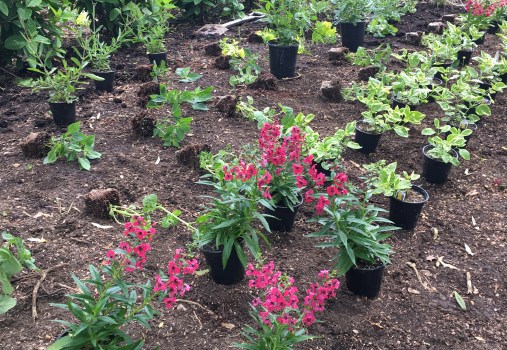
In new beds, dig in: The start of a new or renovated planting area is the only time you should dig compost or other organic matter into the soil. Before planting, spread a layer 4 or 5 inches deep over the planting area and use a shovel or fork to dig down about 8 to 10 inches, loosening the soil and mixing in the compost. “It’s better to amend the soil of the whole area than to add compost to individual planting holes,” Yiesla said. Once the new bed is planted, cover it with mulch.
Let trees stand on their own: When you plant a tree or shrub, refill the hole around the root ball with the same soil you removed when you dug it, rather than adding any amendment. That way, there will be no incentive for the roots to stay in the hole and they can grow out wide.
Give vegetables plenty of organic matter: Most edible crops are annuals, needing a major supply of nutrients to flower and fruit in a single season. Plentiful organic matter in the soil is essential for them to thrive. If you garden in the ground, dig in the remains of last year’s crops and add a healthy amount of compost before you plant. If you garden in raised beds, top-dress with compost. Use a light organic mulch, such as dried leaves, that will break down over the course of the growing season.
Get a soil test: A professional soil test can provide valuable information about the chemical properties, nutrients and physical properties of the soil in your garden. It involves collecting samples from several areas of the yard and sending them to a laboratory. Learn more at mortonarb.org/soil-test.
For tree and plant advice, see the online resources of The Morton Arboretum at mortonarb.org/plant-care, or submit your questions online at mortonarb.org/plant-clinic or by email to plantclinic@mortonarb.org. Beth Botts is a staff writer at the Arboretum.