
In David Henry Hwang’s prescient 1988 play “M. Butterfly,” the character of Song Liling, a beautiful Chinese opera singer and spy, deftly laid out the case against Giacomo Puccini’s 1904 opera, “Madama Butterfly,” one of the most recognizable titles in the repertory, by simply positing a reversal of the plot.
“What would you say if a blond homecoming queen fell in love with a short Japanese businessman?” Liling asks the ensnared French diplomat in love with her, or him. “He treats her cruelly, then goes home for three years, during which time she prays to his picture and turns down marriage from a young Kennedy. Then, when she learns he has remarried, she kills herself. Now I believe you should consider this girl to be a deranged idiot, correct? But because it’s an Oriental who kills herself for a Westerner – ah! – you find it beautiful.”
Just a year later, “Miss Saigon,” a musical set in the 1970s and also deeply entwined with “Madama Butterfly,” became a massive international hit by trading, in part, on that same inclination of Western audiences toward the objectification, or feminization, or fetishization, of Eastern culture. Thus, when it comes to “Madama Butterfly” itself, a familiar paradox has emerged for U.S. opera companies: It’s a boffo title filled with plush Puccini music that audiences still love to hear, and has an exotic narrative that still pulls on their heartstrings — but it’s also now deemed problematic enough to sink the ship of B.F. Pinkerton, the U.S. naval officer who falls in love with a very young Japanese geisha, Cio-Cio-San, or Madama Butterfly herself.
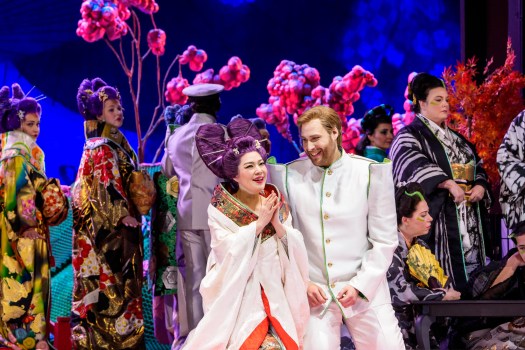
Director Matthew Ozawa’s production was first seen at the Cincinnati Opera in 2023 and opened Saturday night at Lyric Opera (home territory for Ozawa). It attempts to confront the opera’s problems by turning Pinkerton (sung in Chicago by the American tenor Evan LeRoy Johnson) into a contemporary gamer whose naval identity is an online avatar, and Madama Butterfly (played by Karah Son) into his virtual, “Ōkami”-like fantasy.
Indeed, the staging begins in Pinkerton’s urban apartment, the contemporary decor from the design collective known as dots reflecting a lonely man’s apparent love for Japanese anime and manga. (The screens that dominate the set had some issues on opening night.) Pinkerton dons his VR headset, old Nagasaki appears all around him, and off we go. No special equipment is required to view the actions of Pinkerton’s avatar as the marriage broker Goro (Rodell Rosel) engineers the match and Zachary Nelson’s Sharpless tries to warn him of dangers ahead, given the existence of Cio-Cio-San’s aggressive uncle, Bonze (Jongwon Han).
Throughout the design elements (costumes are by Maiko Matsushima and lights by Yuki Nakase Link), the modern world never fully leaves the stage. And, as the virtual events go from one level to the next, Pinkerton’s own marriage to an American wife (Alexis Peart) starts to deteriorate, and, like some other married American men, he comes to prefer his life online.
Ozawa has not re-written Giuseppe Giacosa and Luigi Illica’s libretto, nor added to Puccini’s score, conducted here by Domingo Hindoyan, notwithstanding such intense narrative intervention. That means the outer frame mostly is wordless, a common compromise in Shakespearean productions and not unduly bothersome here, although I didn’t always find it clear where the VR world began and ended — both spatially and chronologically and in terms of who can see what when. More importantly, the removal of a real relationship, so to speak, means a diminishment of poignance, immediacy, vulnerability and real-life stakes, unless you can buy that a virtual romance is just as intense as one in the real world, which is the case Ozawa wants to make and goes a good way towards making.
Indeed, at times, it struck me that this “Madama Butterfly” was, if anything, too cautious, too worried about its departures from the traditional (with the exception of the ending) that it often backed away from its own implications. But then appeasing tradition and upending it both at once, which certainly is the pragmatic philosophy of Lyric, always is a tricky matter.
Son takes a while to find her way emotionally into this version of Cio-Cio-San, and thus the Korean soprano, appearing at Lyric for the first time, is at her vocal best in Act 2, emotional engagement and vocal richness happily arriving in time for “Un bel dì, vedremo.” And, although the context is different, “Tu, tu, piccolo iddio!” retains its power in her hands. Nozomi Kato, who beautifully sings the loyal servant Suzuki, offers a quietly moving performance. Rosel’s many layers, vocal and otherwise, means that Goro is in this production is perhaps the most interesting and complicated character on the stage. A boundary-crosser, one might say, of any number of boundaries.


Pinkerton in this production never has the chance of deserving much empathy. After all, an opera audience is unlikely to look kindly on a VR world and certainly not on a man using it to substitute for his real-life marital problems. Given those stacked decks, Johnson’s performance struck me as admirable, his soaring tenor sounds splendid on “Vogliatemi bene” and “Addio, fiorito asil,” all the more notable given that Johnson has to sing of the agony of disappointing not so much a real woman as his own fantasy. Not so easy to pull off.
Of course, who is to say what is real and what is fantasy in any “Madama Butterfly” at any point in the opera’s history? The production will strike some as having one’s cake and eating it, or, if we want to mix metaphors, a bait-and-switch. But this is, to my mind, a consistently potent and challenging evening, which I mean as a compliment.
Ozawa’s ideas, and indeed the themes baked into this opera from the start, only are are amplified by the new American military excursion in a world far beyond this opera house’s walls; its depiction on our screens hardly that far removed from virtual reality. Aside from people really dying.
Chris Jones is a Tribune critic
cjones5@chicagotribune.com
Review: “Madama Butterfly” (3.5 stars)
When: Through April 12
Where: Lyric Opera of Chicago, 20 N. Wacker Drive
Running time: 3 hours
Tickets: $55-$434 at 312-827-5600 and lyricopera.org