
Indiana isn’t known for being environmentally friendly. In industrialized areas, brownfields abound. Smokestacks spew pollutants. But Kathy Sipple is working to gain recognition for pollinator-friendly habitats.
It took Sipple, of Valparaiso, a year to gain National Wildlife Federation recognition for Northwest Indiana – Lake, Porter, LaPorte and Starke counties — becoming the first multi-county region to do so. Now she wants Indiana to become the first state to be designated a certified wildlife habitat.
Sipple recently attended a Purdue Northwest event on sustainable development, with slides that showed how Indiana ranks on various environmental issues. “Of the 50 states, we’re in the bottom 10% in almost every one,” she said.
That’s one reason she’s so eager to have Indiana become the first state to be certified by the National Wildlife Federation. “Turn that on its head and be the first state to do something like that, I think it’s a source of pride.”
The federation’s guidelines aren’t oriented toward certifying an entire state. The metrics go up to 1 million in population. Indiana has about 6.7 million residents, so there’s some scaling up involved.
“We were already kind of blowing their minds with us breaking their mold,” Sipple said.
“Basically, the same thing that we accomplished here in the region, back in 2023, it took us one year to do it.” She’s hoping to accomplish the same for the entire state.
The Hoosier Habitats Challenge effort officially kicked off March 7 at an Indiana Wildlife Federation conference.
“We’ve already had people signing up on our form” at Earthcharterindiana.org/nwf, Sipple said.

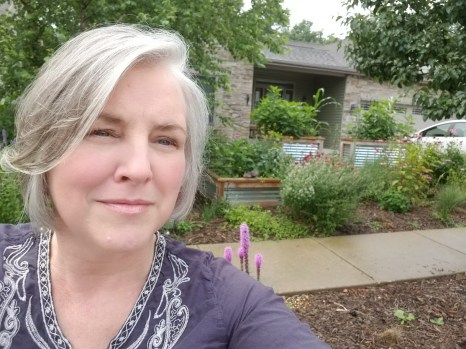
Sipple works “very part-time” as a resiliency coordinator for Earth Charter Indiana, which is leading the effort. Converting her own lawn to a native plant haven was a COVID-19 pandemic project. Neighbors would stop by and ask what she was doing, giving them a chance to interact with each other.
Native plants aren’t required for wildlife habitat certification, but they’re strongly encouraged. The plants have deep roots, requiring less water, and offer nourishment that wildlife depends on.
Environmentalists are concerned about an insect apocalypse in which species are disappearing at a rapid rate.
Leslie Shad, an Evanston, Illinois, environmentalist who formerly lived in Michigan City, led the effort for the National Wildlife Federation to certify Evanston as a wildlife-friendly city. She spoke during last week’s Green Drinks online meeting about insects disappearing.
“Now I can drive from here to Toledo, Ohio, and have four insects on my windshield. I know because I counted,” she told the environmentalists. “Yes, there are these charismatic bugs that are out there, but our whole insect kingdom may be going missing.”
“Pesticides and habitat loss are really taking a hit on birds,” with 3 billion fewer birds today than in 1970 – that’s 1 in 4 birds, she said. Chimney swifts, for example, eat bugs, so their population is declining.
Leave leaves, and leave seedheads and stalks, Shad urged. Mow less area and less often. “Don’t mow it; just let it be.”
Reduce light pollution. Use bird-friendly windows, too, Shad said. When the light level goes down, birds fly closer to ground and hit windows.
Shad and Sipple both stressed the need for native plants. Invasive species can take over a habitat, creating a monoculture that can harm wildlife.
“Lawn is more land use than corn, wheat and fruit trees combined, according to NASA,” Shad said. “We apply too many toxins. We apply and reapply, 10 times the farm rate.”
Reducing the need to mow reduces hearing damage and vibration injuries to lawn crews.
“Turf grass is our largest irrigated crop. That’s not the good news,” Shad said.
The Karner Blue butterfly is extinct in Indiana, unable to fly across a highway to reach wild lupine on the other side, Sipple said. The wild lupine that species depends on was getting choked out by invasives.
When Indiana became a state in 1816, that wasn’t the case. The state was about 85% forest at the time, with pockets of prairie and bison in the far western areas. Now, almost all the prairies are gone, and much of the woods, too. Wildlife corridors have been cut off.
The Indiana Wildlife Federation’s Wildlife Habitat Certified program is bringing attention to the need for wildlife-friendly habitats, which could lead to some of those wildlife corridors being recreated.
“I think it’s one of the smartest, well-designed programs I’ve seen for community organizing,” Sipple said. She’s working with Indiana organizations at the macro level in hopes they have deep roots in local efforts so more areas can become certified. Those all add up for the effort for statewide recognition.
After Northwest Indiana became certified, a friend near South Bend achieved certification for a four-county Michiana area, then seven more counties were added to the east. That brings 15 counties across northern Indiana certified, or 16.3% of the state’s 92 counties. That gives the statewide effort a good head start. Then add in other areas in Indiana that are already certified and others that will be.
Shirley Heinze Land Trust, which has 4,000 acres across Lake, Porter, LaPorte, St. Joseph, Marshall and Starke counties, achieved National Wildlife Foundation certification for its properties, Sipple said. The nonprofit is dedicated to restoring and protecting natural areas. Most of its nature preserves are open to the public. Volunteers help with removing invasives and restoring natural areas.
Sipple plans to get various groups to work together in what she calls coopetition. “You kind of want bragging rights that Valparaiso is beating Michigan City, but we all win,” she said.

She’s hoping to get large groups like the Indiana Wildlife Federation and Earth Charter Indiana reaching out to other large groups to get grassroots support from smaller and smaller organizations to get the certifications needed to amass large numbers for the statewide effort.
The National Wildlife Federation’s checklist recommends striving for 70% native plants, but doesn’t necessarily require them. Points are given for having at least three natural food sources for wildlife, things like seeds, native plants, nuts and cones, host plants for caterpillars, a layer of fallen leaves, insects, etc.
The habitat needs at least one source of clean water for wildlife to drink and bathe. That could range anywhere from a bird bath to an ocean.
At least two places for wildlife to find shelter from the weather and predators are also required. That could be mature trees, groundcover, rock pile or wall, brush or log pile, or others.
For wildlife to raise young, at least two places are needed. That includes host plants for caterpillars, mature trees, animal garden, dead trees or other areas where wildlife can engage in courtship behavior, mate and then bear and raise their young.
Points are also given for sustainable practices, with activities in at least two of four categories – soil and water conservation, controlling nonnative species, reducing pollution and reduce/reuse/recycle.
Once certification is given, it’s easier to obtain annual recertification, Sipple said.
Doug Ross is a freelance reporter for the Post-Tribune.