Notice your utility bill lately? At the end of the 19th century, Nikola Tesla had a vision of a world where electricity would be free as air. By 1950 and the advent of nuclear power, some believed that electricity would be too cheap to meter.
Tell those fantasies to today’s ratepayers. In 2025, Illinois electric rates jumped 15%, a roughly $200 increase over the year for the average household.
The driver of this increase has been the growth of energy-hungry data centers. There are already about 200 in our state and more than 80 proposed for construction. The largest data center in Illinois is scheduled for Yorkville and will require as much as 2 gigawatts of electricity, enough to power 30% of all the households in our state.
But there’s another driver for your electric bill: the clean energy cuts by President Donald Trump’s administration.
This “drill, baby, drill” president views climate change as a hoax and clean energy as a bureaucratic obstacle to profits. By eliminating federal tax credits for wind and solar projects — the two fastest forms of power to build and deploy — Trump and his followers have choked off the most affordable supply of new power to meet rising demand.
This scramble of demand over limited supply is reflected in the increased charges on your utility bill.
By terminating more than $8 billion in grants for clean energy projects and grid upgrades, the Trump energy policies have shifted the cost of these projects to consumers. Illinois is hit particularly hard as a hub for clean energy investment and a winner of hundreds of millions of dollars’ worth of these canceled grants.
With Trump eliminating these grants, where will the utilities turn for funds to expand production and upgrade the grid?
In 2025, Illinois electric utilities requested nearly $350 million in rate hikes. That comes from your wallet.
May I suggest an honest analysis of the electricity — and water — needs of these data centers, and in addition to the many quality-of-life issues, a reliable commitment by the developers that they will provide clean energy sources for their centers?
That’s the very least that Illinois ratepayers deserve.
— Sen. Dick Durbin, D-Illinois
Rename street as an honor
Now that the opening date for the Obama Presidential Center has been set, it’s past time for the city and the neighborhood to do their part.
The former president and his center deserve a better and more distinguished address than Stony Island Avenue. Since many visitors will arrive from out of state on the Skyway and exit at the 79th Street ramp, the wide street stretching north from that point to the center should be renamed President’s Parkway. What a fitting and deserved tribute to President Barack Obama!
Such a grand name would also elevate the image of surrounding neighborhoods.
— Charles D. Connor, Chicago
Bob Newhart statue at pier
I just finished a brief visit to Chicago, my fourth as a tourist from the United Kingdom in 20 years. For three of those visits, I was so pleased to see one of “Chicago’s sons” be honored with a seated statue at Navy Pier. I am of course talking about Bob Newhart, that master of comedy scenarios.
On my last visit, his seated statue, complete with associated bench, was located at the start of the pier entrance. I am sure there was a small plaque telling folks who he was. Last week, after a long walk to the waterfront, he was missing!
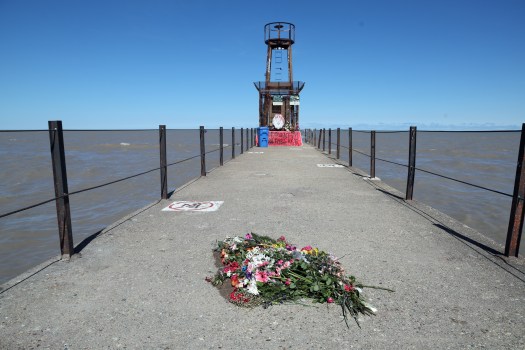
Fortunately, an inquiry got me the information that Bob is now sited all the way at the end of the pier, looking out to the lake. When I found him, several people were climbing over him and the sofa bench for photos. However, no information plaque is displayed.
I got the young people there to take several photos of me seated on the couch, and then I asked them who he was. They had no idea. I explained who he was, and they immediately looked him up on their cellphones.
Where he is sited now is unlikely to gain much attention, and even fewer people are likely to come across him, which is a shame. When the statue was near the entrance to the pier, almost everyone had to pass him, and an information plaque kept his story alive. I fear that with where he is now, with no information on display, he will fade, which would be such a shame. At least his name shown on the statue would ensure some longevity and not anonymity.
As Bob’s most famous psychiatrist sketch would have handled it: “Stop it. Just stop It.” Please let folks know what a great legacy he has left behind.
— John Viney, Cadoxton, Barry, Wales
More history on Cleveland
Thank you for printing the op-ed “Grover Cleveland and the lost art of saying no” (March 7) by Jacob Lane. Lane explains how President Grover Cleveland said no to congressional initiatives that were expensive and not specifically mentioned in the Constitution. He was a moral man who sought to do what was correct.
Lane mentions how Cleveland fought patronage and favoritism but fails to state that his predecessor, Chester Alan Arthur, actually helped codify the Civil Service Exam for federal employees. Also left out was the timely issue of tariffs. As a Democrat, Cleveland wanted them low so that consumer prices would remain lower and so that farmers could sell their crops overseas. Sound familiar?
He endured a severe economic crisis in his second term (Panic of 1894), which was partly caused by high tariffs, strict adherence to the gold standard and a farmers’ depression. Lane mentions the farmers’ struggle and how the president did not help them out. But there was no Farm Bureau yet, and the federal bureaucracy was tiny compared to what it would become in the early 20th century.
Finally, Lane leaves out the sticky issue of imperialism (expansion overseas). While we had a naval base and farmers in Hawaii, Cleveland was not eager to annex the set of islands. He felt that our treatment of their queen was deceitful and heavy-handed. But he did not fight the winds of change that eventually won over the anti-imperialists in this country.
I was glad to see a piece about a president that most Americans know little about. I had just hoped that it would have been a bit more in-depth.
— Jan Goldberg, Riverside
Ignoring mayor, governor
Jacob Lane’s op-ed was fascinating. His engaging opening about how Cleveland is mostly an answer in trivia games leads organically to Lane praising Cleveland for vetoing spending bills he thought wasteful. Indeed, Cleveland was admirable for not playing the usual Washington games. He used his veto pen to say “No.” Good for him.
But as is too often the case with this sort of highly focused essay, Lane ignores the action by Cleveland that is most important in Chicago history: his deployment of the Army to violently suppress the Pullman Strike of 1894. In that action, Cleveland ignored the mayor of Chicago, John Patrick Hopkins, and Illinois Gov. John Peter Altgeld, both of whom did not want federal troops on the streets of Chicago. Dozens of strikers were killed by militia members and federal troops.
It seems Hopkins and Altgeld’s resistance to federal troops doesn’t factor into Lane’s praise for the value of listening when someone says, “No.”
One upside, though: This action gives Cleveland another point for Lane’s trivia games. He was indeed the first United States president to serve nonconsecutive terms, but the second one, Donald Trump, followed his example by ignoring the “no” of Mayor Brandon Johnson and Gov. JB Pritzker to send armed federal agents into Chicago and its suburbs.
The death toll from federal government-sponsored violence is not as high as it was in 1894, but Trump has almost three more years in office to emulate Cleveland.
— Bill Savage, Chicago
Submit a letter, of no more than 400 words, to the editor here or email letters@chicagotribune.com.