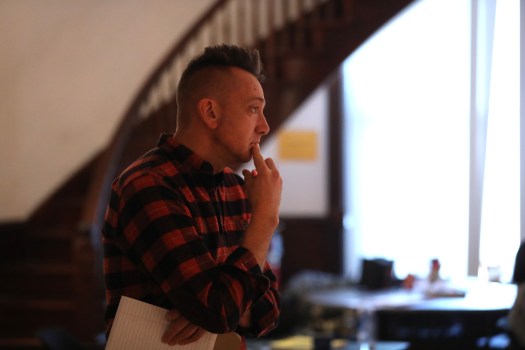


Matthew C. Yee, an ensemble member at Chicago’s Lookingglass Theatre Company, is one of the city’s most interesting artists. Craggily handsome, a skilled guitarist and both a lively writer and a charismatic actor, you could easily imagine him in “Yellowstone” or a Sam Shepard play. Yee is Chinese American and his manifest aesthetic to date in Chicago theater has been a boundary-crossing fusion of Chinese mythology, family storytelling and rock ‘n’ roll, all glued together with gobs of contemporary irony.
His strengths include a quizzical approach to the theater. “Open your snacks,” says the curtain speech for Yee’s latest world premiere at Lookingglass, “and contemplate your own existence.” Which I, for one, always like to do in the theater.
“White Rooster,” Yee’s latest project at Lookingglass, opened this past weekend. It begins with a ghost who lives in an attic and proceeds from there, with multiple stories. The play has its basis (Yee has said) in a story told by Yee’s great aunt, and it involves so-called “ghost marriages” arranged between two dead children, married by their grieving parents in the afterlife to ensure their happiness in the great beyond. Ghost marriages, or spirit marriages, are an ancient part of Chinese culture, dating back at least 2,000 years and usually coming replete with ritual gift-giving. Simply put, they are based on the assumption that an unmarried person would be lonely in the afterlife.
In secular terms, you could argue that their great benefit was (and is) as a balm for the living during times of bereavement with their inherent loss of control. Who would not wish their little lost ones to be happy after death? Who would not want to do everything they could to ensure that is the case?
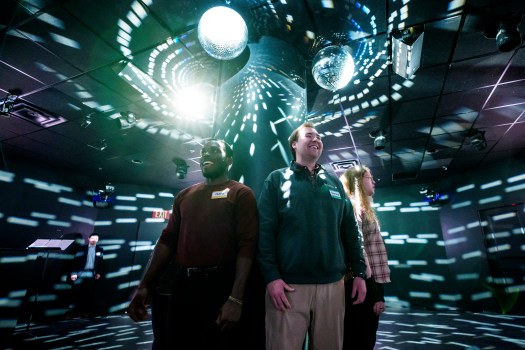
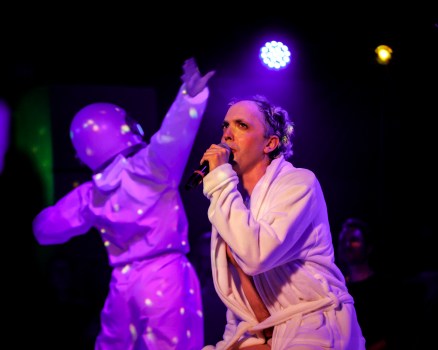
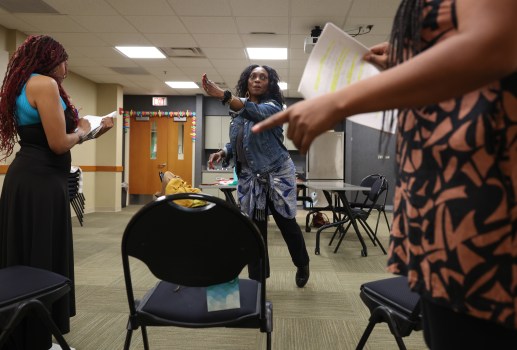
Yee serves as writer, co-composer and director of “White Rooster,” which centers on a young woman named Min (Sunnie Eraso) who finds herself pulled into this familial tradition, which comes with the involvement of the titular bird, mostly to her surprise. With live music and a notably distinguished ensemble cast that includes Karen Aldridge, Elliot Esquivel, Nik Kmiecik, Louise Lamson, Mark Montgomery, Noelle Oh, Reilly Oh, and Daniel Lee Smith, the piece uses a variety of staging techniques, including some cool shadow puppetry.
“White Rooster” will not be the easiest show to follow if you come in cold, frankly. That’s partly because the piece has so many strands — it needs a lot more work in terms of the rise and fall of dramatic tension, especially as it relates to the two acts. But that’s also because the performances are so heavily freighted with character, so to speak, that the humanity of the whole often gets shrouded in so many fantastical layers. You find yourself straining to understand and believe in what lies underneath — which is where the deeper treasure of the piece lies. The dial gets turned very far to the right in the early moments of the show and the energy tends then to come and go intermittently when the show would be better served by Min, the normative character, journeying through these rituals and coming to see their value, perhaps, as well as their cumulative propensity to trap.
It’s perfectly possible to marry Yee’s love of comedy (and his impulses in that direction can be quite deliciously whimsical) with a build that more explicitly carries the audience off on a voyage through a world that reveals itself only as they travel.
There’s a very potent show lying hidden here, I think, and the piece already has some beautiful visuals with a set from Natsu Onoda Power, costumes by Mara Blumenfeld and puppets by Caitlin McLeod. Most great theater is about transformation after death, at least in one way or another, and this new work could easily center on the questions we all ask ourselves: Is not a ghost marriage only a short step from the promise of eternal life at a funeral?

But that would mean some simplification, especially with an eye on Min’s emotional journey through this landscape of the strange of the wonderful. I had the sense at the performance I saw that the actors, all of whom are highly skilled, felt the need to sell what they were performing. Understandable, for sure, with any new work, especially one so heavy of symbol.
But I’d vote for replacing some of that with more direct and probing communication with an audience, helping us understand that rituals of marriage and death are mostly about trying to gain more control over massive change, some of which we instigate and some of which comes with the perviously unimaginable. Yee is an important Chicago talent who can do many things; I still think a separate director with an outside eye would have better served his work better here.
Chris Jones is a Tribune critic
cjones5@chicagotribune.com
Review: “White Rooster” (2.5 stars)
When: Through April 26
Where: Lookingglass Theatre in the Water Tower Water Works, 163 E. Pearson St.
Running time: 2 hours, 15 minutes
Tickets: $30-$89 at 312-337-0665 and www.lookingglasstheatre.org