

With the dust settling on the primary elections, the contours of November’s contests are already coming into sharper focus for the Illinois General Assembly.
While some of Tuesday’s winners are now gearing up for competitive general election battles on Nov. 3, many others may have already cleared their highest hurdle — thanks to favorable district dynamics, a lack of opposition, or both.
Across Illinois, the primaries served as both a proving ground and, in some cases, a decisive endpoint. In districts where one party dominates, a primary victory often all but guarantees a seat in the General Assembly. Elsewhere, however, the results set the stage for matchups that could determine whether Democrats keep supermajority control in both the House and Senate.
Several incumbents fended off challengers to secure another term, signaling stability in their districts. But a couple of races told a different story, with voters opting for change, unseating established figures and opening the door to new leadership.
Perhaps most notably, two veteran Illinois House lawmakers were defeated by primary challengers Tuesday night.
In one of the most striking upsets, deputy Republican leader Norine Hammond — a top figure in the Illinois House GOP — lost decisively to challenger Joshua Higgins in her downstate district. With 95% of the estimated vote counted, Higgins led by more than 25 percentage points, according to The Associated Press, dealing a blow to the party’s establishment wing and signaling potential ideological shifts ahead of the general election.
Higgins is aligned with the far-right Illinois Freedom Caucus, a group of downstate Republicans considered the most conservative in the legislature. As of now, he is a shoo-in for the House seat in the November general election, as the Illinois State Board of Elections website shows no Democrats have filed to run for it, and it’s a predominantly red district.
“This shows that hard work beats a lot of money,” Higgins said of his primary victory against Hammond, who has been in the legislature since 2010.
According to the State Board of Elections, Hammond had more than $486,000 in her campaign coffers at the end of 2025. Higgins had just over $22,600 at the end of last year. Bailey Templeton, Hammond’s other challenger who finished third in the primary with just under 10% of the estimated vote, raised no money through 2025, records show.
In addition to working in House Republican leadership, Hammond is also a point person for budgetary matters within the caucus. In a statement, Hammond thanked her family and her supporters and said serving as a state representative “has been one of the greatest honors of my life.”
”My driving motivation while in office has been to serve the people of western Illinois. I’ve stood up for our families, communities, small business owners, students, and taxpayers,” Hammond said. “I’ve taken on bullies like (Illinois’ Democratic Gov.) JB Pritzker, and I’ve never wavered on standing up for our rights and our values.”
On Chicago’s North Side, community activist Miguel Alvelo Rivera won the Democratic nomination for the House seat that’s been held by Democratic state Rep. Jaime Andrade since 2013.
Alvelo Rivera compiled 55.7% of the vote to Andrade’s 44.3%, according to unofficial results from The Associated Press.
“Tonight’s victory is a testament to the same spirit of solidarity that filled our streets last Fall when (federal immigration enforcement agents) invaded our neighborhoods, and our community came together to defend one another,” Alvelo Rivera said in a statement Tuesday night. “That same fierce love for our neighbors animated this campaign. As Northwest Side neighbors have proven again and again, when we stand together and act courageously, we win.”
During the race, Andrade blanketed parts of the North and Northwest sides with campaign flyers that tenuously — and falsely — tied Alvelo Rivera, an upstart progressive opponent to President Donald Trump’s immigration enforcement missions in the community, to supporting an expansion of U.S. Immigration and Customs Enforcement.

Andrade’s name also surfaced in the federal corruption trial of ex-Illinois House Speaker Michael Madigan, who was caught on a wiretapped recording discussing a way to help Andrade find a job for his wife, a lawyer who’d emigrated from Peru, when authorities were investigating Madigan’s alleged illegal dealings with utility giant Commonwealth Edison. Andrade was never accused of wrongdoing, but Madigan was ultimately convicted and sentenced last year to 7½ years in prison.
Andrade was backed by Illinois’ Democratic establishment, among other supporters, finishing 2025 with more than $146,000 in his campaign coffers, according to the State Board of Elections. Meanwhile, Alvelo Rivera finished last year with a little over $31,000 in his campaign account.
“Our community sent a powerful message: that our homes, our schools, our futures belong to us — not to billionaires, not to corporate Super PACs (political action committees), and not to the politicians who would rather take their money than stand with their people,” Alvelo Rivera also said in his statement.
Alvelo Rivera is now positioned to be the likely winner of the House seat in the November election since no Republican challenger has emerged in the largely Democratic district.
In a series of text messages, Andrade said he suspected he could lose the primary after legislative mapmakers left him in a reconfigured district. He said he called Alvelo Rivera to concede and thanked the nominee for giving him more time to spend with his children.
“I am at peace,” said Andrade, who also thanked House Speaker Emanuel “Chris” Welch for backing him. “I have my family, my parents are still alive. I’m free now to be a father.”
All 118 state House seats are on the ballot, in addition to 39 of the 59 state Senate seats, and some of these races have seen an infusion of money from corporate-backed political action committees. Both chambers of the legislature are controlled by Democrats, and by wide margins — 78 to 40 in the House and 40 to 19 in the Senate.

State Sen. Emil Jones III won the Democratic nomination for his Senate seat, staving off two challengers who ran against him after he faced federal corruption charges that ended in a mistrial before he agreed to admit to wrongdoing to avoid jail time.
With 93% of the estimated vote in, Jones won with 60.6%, while attorney Ahmed Karrar had 22.6% of the vote, according to unofficial results from the AP. Barber instructor and businessman Kenny Williams was in last place with 16.8%. The district spans a swath of Chicago’s South Side and the south suburbs.
“I’m humbly grateful,” Jones said when reached by the Tribune. “My constituents saw through the mess the feds tried to put me in.”
It was the first time in his 17 years in his state Senate seat that Jones, the son of a former Illinois Senate president, faced two primary challengers. He will likely face Republican Brian Skala of Crestwood in the November election.
Jones’ campaign for another term came after he’d fought a federal case in which he was accused of taking bribes from a red-light camera company executive in exchange for protecting the company from adverse legislation in Springfield.
The case ended in a mistrial last year, after which Jones entered into a deferred prosecution agreement that included admitting he made false statements to the FBI.
In the north suburbs, two Democrats vied for a state Senate seat that will be vacated by Democratic state Sen. Laura Fine, who ran unsuccessfully for retiring U.S. Rep. Jan Schakowsky’s congressional seat.
With about 99% of the votes tabulated, Patrick Hanley, who was endorsed by Schakowsky, defeated Rachel Ruttenberg, 51.6% to 48.4%. Hanley will likely face Republican Tom Lally in the November election.
Also endorsed by Schakowsky, National Guard member Demi Palecek won her primary race on Chicago’s North Side for an Illinois House seat to replace state Rep. Hoan Huynh, who also ran unsuccessfully for Schakowsky’s seat.
The Associated Press had Palecek winning the Democratic nomination for Huynh’s seat with 41.9% of the vote in a five-person race with 90% of the estimated vote tabulated.
“Today, the people of the (district) spoke loud and clear: it’s time to put the working class in the driver’s seat and reject corporate interests,” Palecek said in a statement Tuesday night. “We aren’t for sale. This victory belongs to every volunteer who made a call, knocked on a door, made a sandwich, or helped clothe a neighbor. Together, we looked at our community under pressure and said, ‘How can we get to work? How can we help our neighbors feel some relief?’”
She had $14,000 on hand at the start of the year, but since then, she received more than $100,000 from a political action committee co-founded by gun-violence prevention activist David Hogg, records show. Palecek had said in the fall she would refuse orders from Trump’s administration to assist with the administration’s immigration enforcement actions — and has since said she is “under investigation in the military” as a result.
Palecek is slated to run in the November election against Republican Terry Nguyen Le.
Also on the North Side, four Democrats in the Lincoln Park area competed in a primary to succeed state Rep. Margaret Croke, who is running for comptroller.
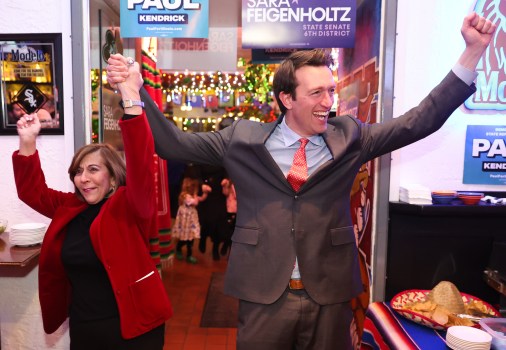
With 89% of the votes estimated to be counted, Paul Kendrick, who was endorsed by Croke, was declared the winner of the Democratic nomination for the seat with about 48% of the vote. He is one of four legislative candidates statewide benefiting from a PAC funded by Meta, the parent company of Instagram and Facebook.
The second-highest vote-getter in that race was Litcy Kurisinkal, a former Local School Council chair and human rights advocate who campaigned for then-Vice President Kamala Harris’ 2024 presidential run. She had about 23% of the vote.
Kendrick is set to likely face Republican Justin Kumar in November.
In another North Side legislative race, veteran Democratic state Sen. Sara Feigenholtz survived a primary challenge from community activist Nick Uniejewski, winning by a little over 11 percentage points with 89% of the estimated votes counted. Feigenholtz will likely hang on to the seat after the November election since no GOP challengers have filed in the race.
For a House seat on Chicago’s West Side and in parts of the western suburbs, four Democrats competed to fill the seat of state Rep. La Shawn Ford, who won his own Democratic primary in a crowded field for a congressional seat to replace retiring U.S. Rep. Danny Davis. No Republicans filed to run for Ford’s seat.
Shantel Franklin, currently on leave from her job as a legislative liaison in Attorney General Kwame Raoul’s office, won the Democratic nomination for Ford’s Illinois House seat after securing about 46% of the vote, with about 89% of the estimated votes counted. On Jan. 20, Franklin received a $25,000 contribution from Raoul’s campaign, followed by a $25,000 loan from his campaign on March 3. She ended 2025 with about $32,580 on hand.
Latonya Mitts, daughter of veteran Ald. Emma Mitts, 37th, placed second in the race with close to 26%.