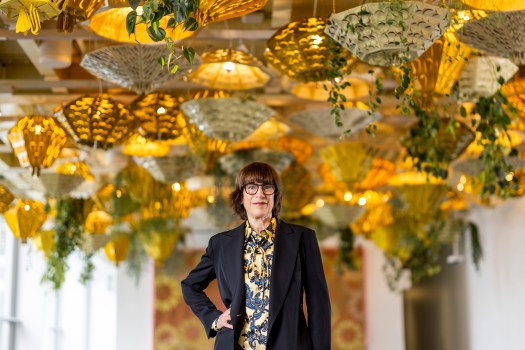

After nearly two decades as the director of the Museum of Contemporary Art, Madeleine Grynsztejn will be stepping down at the end of the year.
“I feel very ready to pass the baton,” Grynsztejn said. “I am full of gratitude for everything that I have been able to accomplish here with an unbelievably talented team of colleagues and an incredible board of trustees.”
Those accomplishments include being the MCA’s first female director. She also has the longest tenure in the role.
Since 2015, the MCA has committed to featuring and acquiring the work of as many women as men. “This is the only museum that I believe is doing this in the country,” said Grynsztejn. For context, “The national percentage of all museums collecting works of art by women is 11%. So we acquired work by female-identified artists at four times the rate of the national average. The data will make your head spin. Nationally, exhibitions by women artists is 14.9%. For us it’s 50%.”
That’s a conspicuous disparity. “Because it costs more money,” said Grynsztejn. “On the whole, women artists are less visible in the marketplace and, by extension, it’s harder to fundraise for them. Each exhibition needs fundraising behind it, so I have to do more fundraising for women artist exhibitions, but guess what? They’re more popular than the male artist exhibitions, that’s the irony.”
During her time as director, the building was renovated “with 13,000 square feet of free public space, including a space called The Commons that we put into the architectural heart of the building … to act as a space that bridges different perspectives. The emergency today is division and divisiveness, and we want to contribute to bridging perspectives through the lens of art and culture. Through dialogue and through art, that makes us see each other in a fuller perspective.”
For that reason, “because we’re a museum that believes in embracing and reflecting our community, I also undertook a Spanish-English initiative” — signage and placards are bilingual — ”because we want to serve Chicago and that is the only growing demographic.”
When asked about exhibitions that stand out over her time at the MCA, she noted the 2016 Kerry James Marshall retrospective for the Chicago-based MacArthur Fellow. “I am so proud that the MCA organized his first retrospective. He has been called the most important living American painter and this to me is parallel to what the MCA signals: The MCA is at once hyper-local — Kerry James Marshall lives in Bronzeville — and at the same time globally impactful.”
Other highlights she mentioned include the sculptor Doris Salcedo, David Bowie and Chicago artists Virgil Abloh and Nick Cave.
Next month, the museum will open an exhibit called “Dancing the Revolution: From Dancehall to Reggaetón,” that will explore the “visual, political and spiritual histories of dancehall and reggaetón through contemporary art.” And in the fall, the museum will feature six performers as part of an exhibit called “Slow Dance,” wherein the artists “reclaim forms of slowness that resist the contemporary demand to constantly perform, whether in the public sphere, on social media or in the workplace.”
“I love saying that the MCA is great at showing you what you don’t yet know you love,” Grynsztejn said.
The MCA also programs an annual performance series that takes place in its theater space, which Grynsztejn said will continue. “Last year, we secured a $10 million performance fund and that is an endowment that will continue our commitment to live arts, not only on our stage but in our galleries. We live in very hybrid times, online and on-site, and I think a return to looking at being a body — being an audience member but also looking at the bodies of dancers and performance artists — it returns us to being a little more human.”
Tribune contributing art critic Lori Waxman says Grynsztejn has been “one of the biggest forces in the contemporary art world of Chicago for the past 18 years. She has single-handedly ensured that the MCA kept with the times — in its building, in its politics, in its staffing, in its internal structure, and of course in the art that it has shown.”
The larger context for arts institutions right now is one in which government grants have been canceled and, in turn, there are more expectations on individual funders and foundations that may not be able to (or willing) to increase contributions.
“We are part of a field that is facing the same challenges every other museum in the country is facing and we are addressing them head-on,” said Grynsztejn. “But I can’t think of a tougher moment than what we faced during COVID-19, when we were literally closed for eight months, on and off. So we have faced challenges before and, frankly, as long as we are leaning into our principles, in good times and bad, we can be very clear about how to face these headwinds, whether they are political or fiscal or social. It also happens that we don’t depend a lot on government funding. But I do want to highlight that last June, we had one of the most successful benefit art auctions in the history of the field and we are still basking in the success of the Yoko Ono exhibition that closed two weeks ago and it was the best-attended show since before COVID. So we are leaning into our principles.”

The timing of her resignation is tied to a few milestones including her nearly 20 years in the job. “I’m also turning 65 next year. And maybe the most important milestone is that the museum will enter its 60th anniversary in 2027 and I think that calls for a moment of continued audacious energy with a new leader.”
Grynsztejn is bucking a broader trend across professions, in which those in top positions well into their 60s and 70s have been reluctant to create openings for the next generation to take over.
“I think it’s fair to say that we have all observed people sticking around longer than is useful in many parts of society and we have seen that it is not helpful,” she said. “I am so looking forward to seeing what the audacious energy of the MCA’s DNA turns into under a new leadership … (so) when I think about 2027 being the 60th anniversary, I would rather see the director on the dais who will take the museum forward for the next 20 years, rather than the director who very exceptionally brought the museum to this moment.”
According to an announcement from the museum, “the MCA Board of Trustees will undertake an international search for her successor” beginning this spring. Grynsztejn will remain in her post until a successor is hired.
As for her plans afterwards, she wasn’t ready to make any announcements but said she wants to “support artists more directly and on a larger scale in my next chapter.”