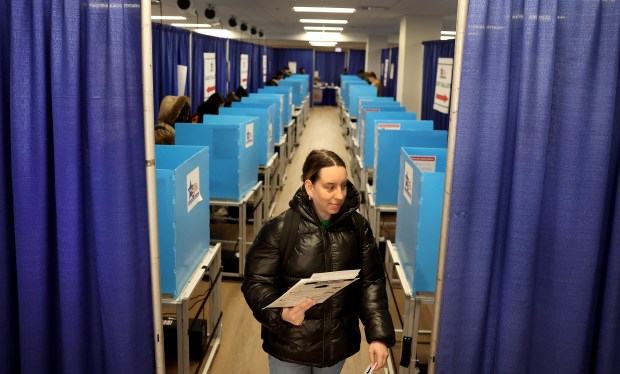
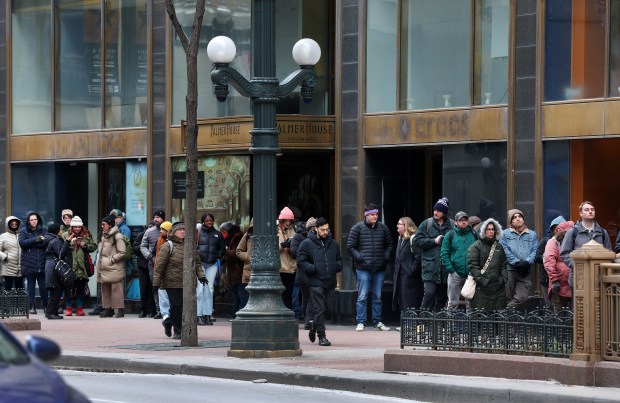
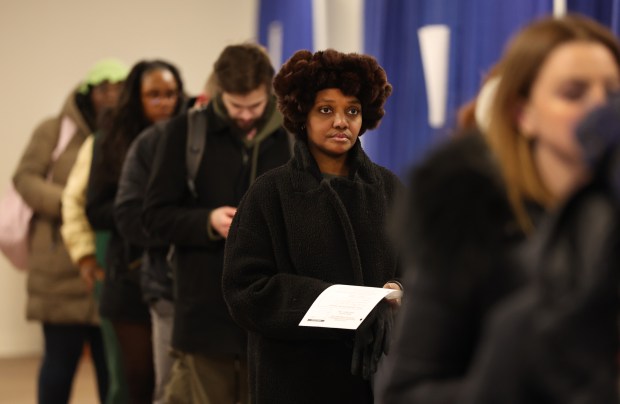
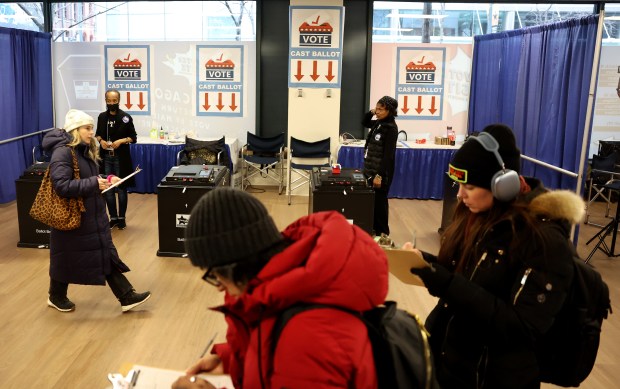
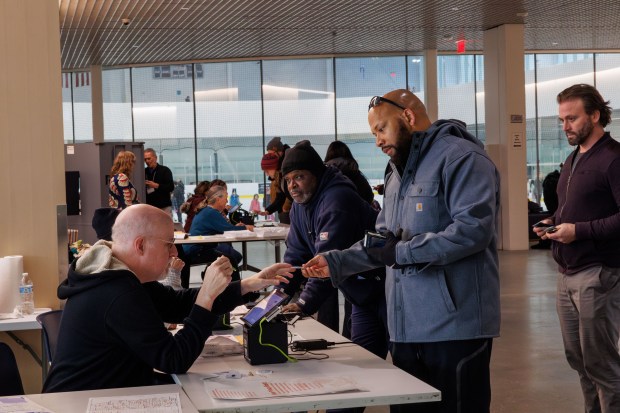
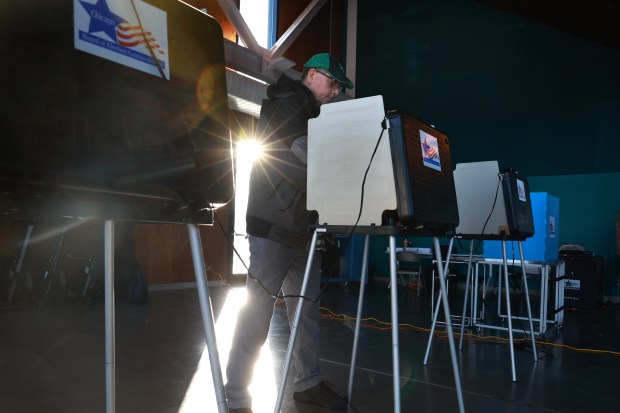
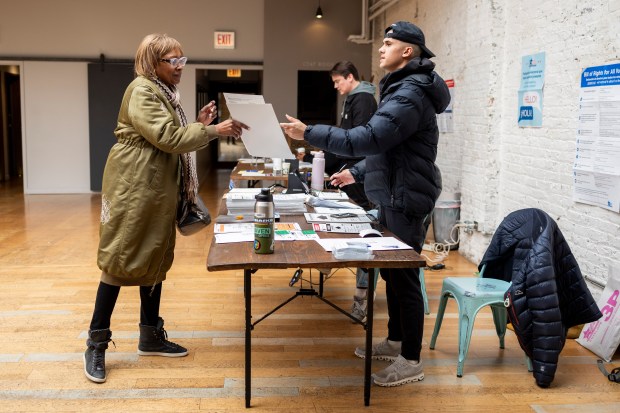

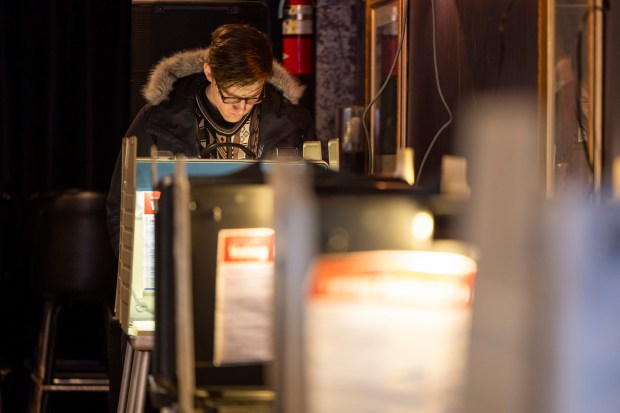
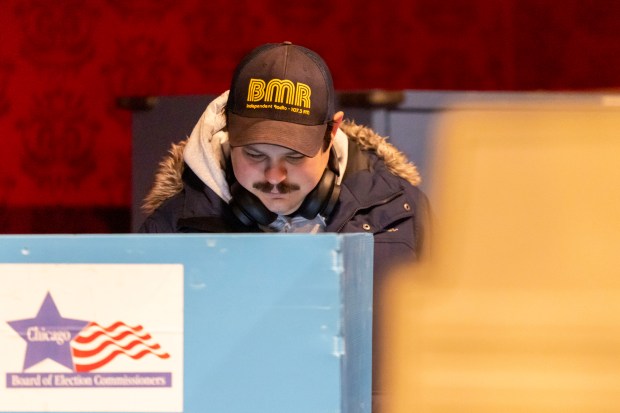
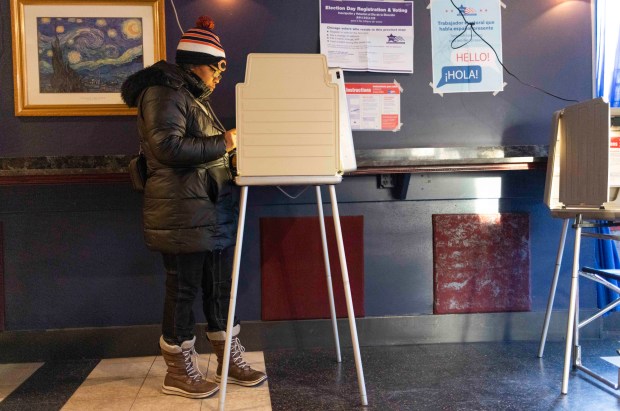

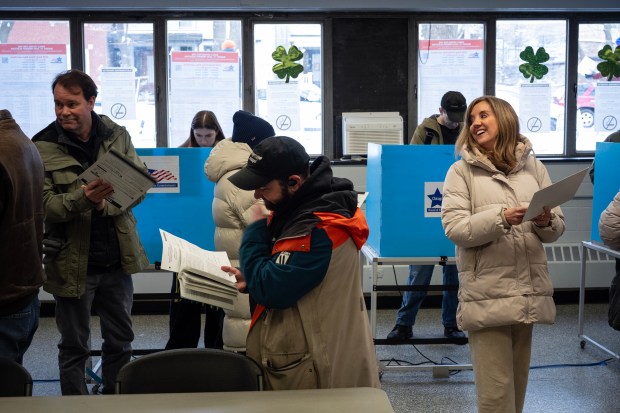
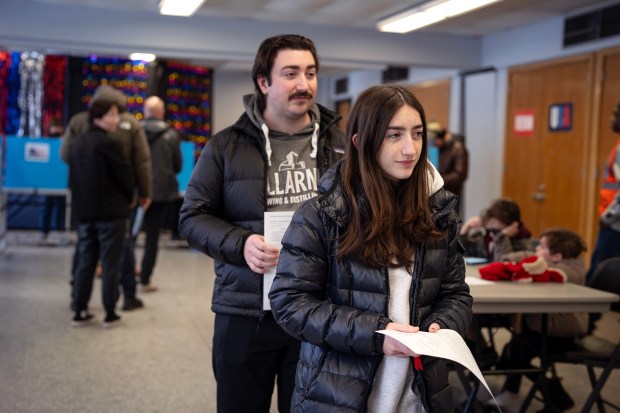
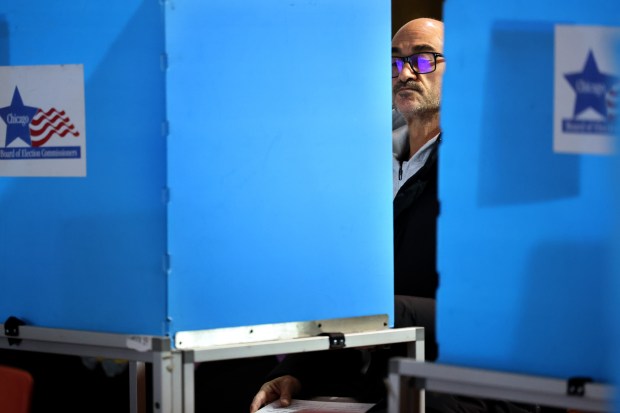


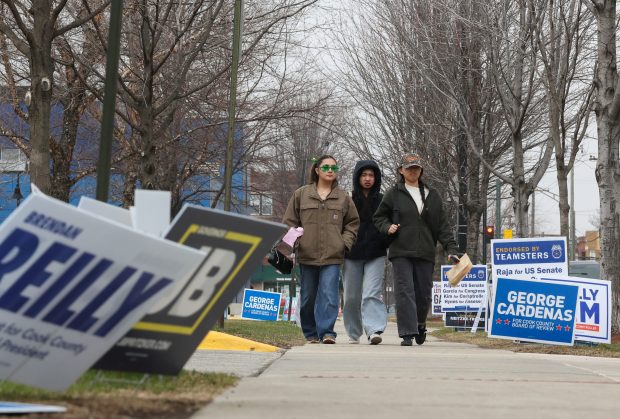
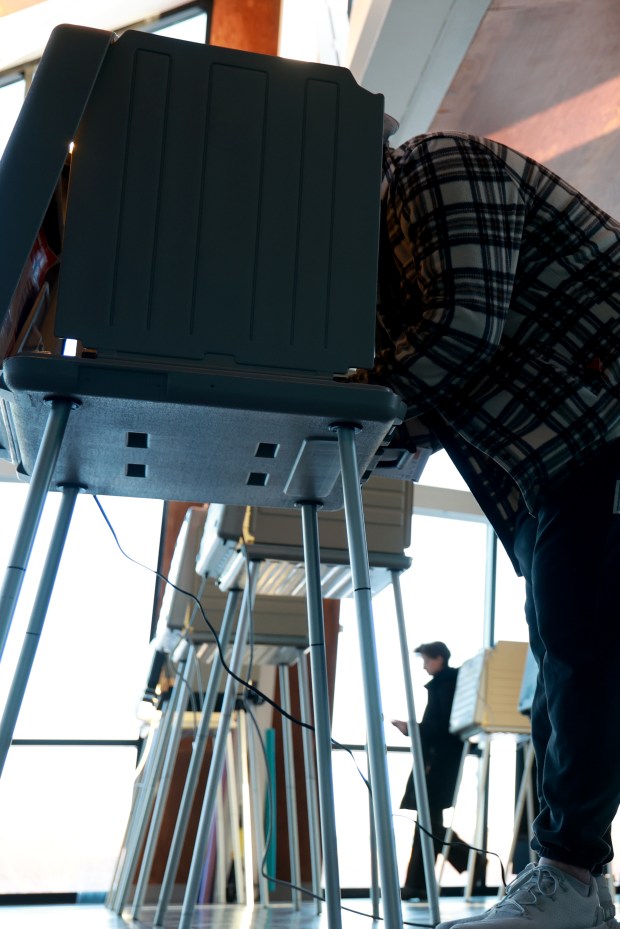


A historically high number of early ballots cast in Chicago helped offset the relatively low number of votes recorded at the polls on an unseasonable cold and windy Tuesday.
Voters who did make it to the polls Tuesday cited concerns around affordability and excitement over the state’s first open U.S. Senate seat in 16 years.
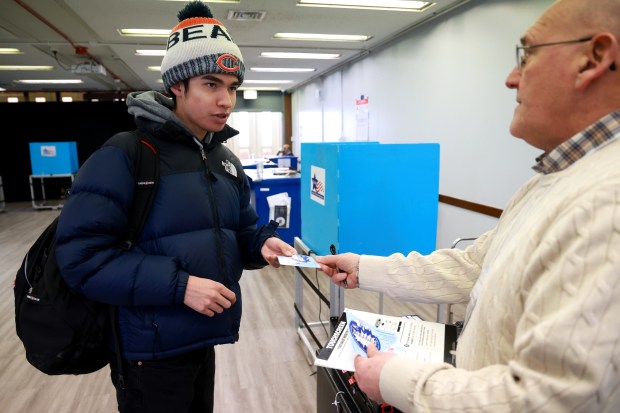
“I always felt it’s our duty as citizens,” said Mario Rodriguez, a 24-year-old financial analyst who voted Tuesday morning in the Loop. “There’s a lot of people who like to complain about stuff but don’t go vote for what they want.”
Unofficial results showed nearly 400,000 votes had been cast in Chicago by 7 p.m., boosted in large part by people voting before Tuesday at the polls or through mail-in ballots. The number of ballots cast prior to Election Day, including both in person and by mail, set a new record for a gubernatorial primary election, according to the Chicago Board of Elections. Moreover, day-of voting kept pace with the state’s most recent midterm primary in June 2022, which saw a city turnout of about 23%, said Max Bever, spokesperson for the city elections board.
Voter turnout in the primary hit at least 25%, and that doesn’t count any mail-in ballots that hadn’t yet been processed, Bever said in a statement released late Tuesday. Additional mail-in and provisional ballots will be counted on a rolling basis through March 31.
Bever said voting had gone relatively smoothly during the day, with only minor problems reported in some precincts and no public safety incidents reported.
At a West Side polling location, state Rep. La Shawn Ford, who is running to replace U.S. Rep. Danny Davis in the 7th Congressional District, was unable to cast his ballot for about 40 minutes after he was incorrectly informed he had already voted, according to a news release from his campaign. Ford called on election authorities to review the incident.
Bever said the city elections board had been in touch with that polling place and the campaign.
“Thankfully we learned that issue was resolved and no further issues have been seen at that precinct location,” he said.
Earlier Tuesday, Chicago Board of Elections Chairwoman Marisel Hernandez told reporters at a new voting supersite at 137 S. State St. that she was encouraged by the early voter turnout while also citing safety as a top concern.
Hernandez said around 400 police officers from different agencies had been on “standby” for a “smooth and safe Election Day today.”
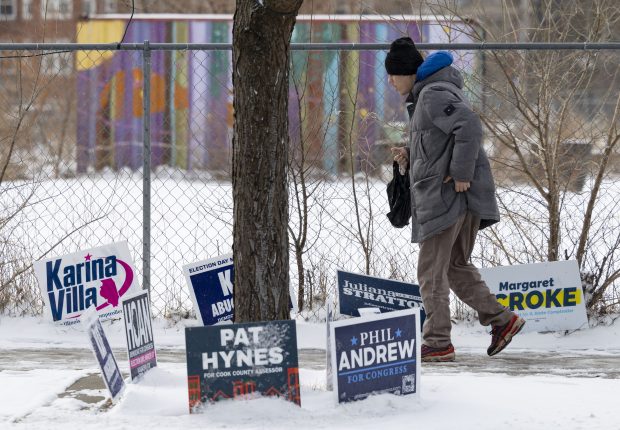
With snow still on the ground, voters faced unseasonably chilly weather as they trudged out to polling sites — especially those, like Rodriguez, who headed out early in temperatures of around 15 degrees.
“I think politicians in the city of Chicago have gotten comfortable in their spots,” Rodriguez said. “And I think it’s time for citizens to remind them today that they shouldn’t be comfortable. They have to earn their spot every election.”
By Tuesday night, the largest vote share in Chicago was achieved by voters aged 65 to 74, according to the city elections board.
More women than men had voted by then, with voting traffic generally increasing as the day went on.
A library branch in Bronzeville saw people of all ages walking into the polling booth. Buck Robinson, 54, came with his 7-year-old grandson to the polling station early to beat the line.
“Everybody’s vote should be counted,” said Robinson, who lives in the neighborhood. “That’s why I got up and came to vote.”
Gerardo Avitia said he is from Chicago but some of his family is not. It took years for them to get their citizenship and become able to vote, he said, which is partly why he came out to vote Tuesday in Bronzeville.
“A lot of people do a lot in this country to get into the process of actually being a citizen to vote,” he said. “So I don’t like to take that for granted,” said Avitia, 49, and a school counselor in the city.
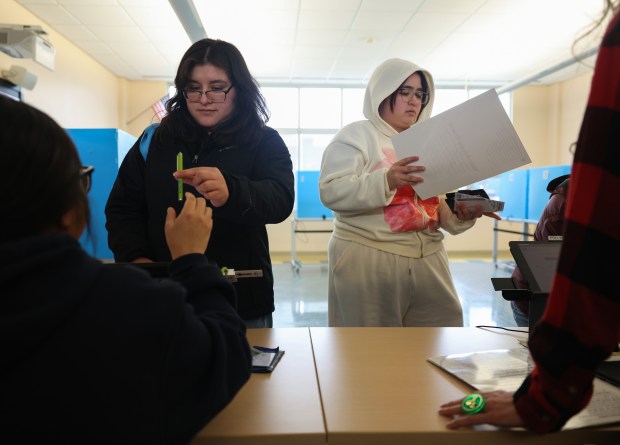
Workers at the West Chicago Avenue Library polling site in Austin told the Tribune they saw a steady flow of voters through the day.
Jeffery Twilley, bundled up in a red beanie and coat, said he’s a regular participant in local elections but this year, he was especially motivated to cast his ballot after the Trump administration’s policies over the past year left him feeling fed up.
“It’s like he’s bullying the people,” the 62-year-old Austin resident said. “Enough is enough. So I came out to try and make a change.”
The prospect of change is likewise what spurred married couple Neacy and Ronald Parks to vote, despite their busy schedules as semitruck and forklift drivers.
“I feel we need new people in office so we can see what’s the difference,” said Neacy Parks, 52, “so we can have something to compare it to.”
There wasn’t one race that galvanized the couple, they said, but rather the longtime Chicagoans are keen to participate whenever they can.
“Our vote counts. … If you sit at home, watch the news and they say this person got into office and you didn’t come out and vote, you can’t say anything,” Neacy Parks said. “At least we can say that, hey — we tried. And we gonna keep trying.”
As of Monday night, nearly 190,000 people in the city of Chicago had already voted either by mail or through early voting, according to the Chicago Board of Elections.
That’s more than 72,000 votes ahead of the early vote count in the same time frame during the primary election on June 28, 2022, during the last contested Democratic governor’s race.
In suburban Cook County, more than 108,000 people cast their ballots early as of Monday, exceeding early vote totals during the last two gubernatorial primaries in 2022 and 2018, according to the Cook County clerk’s office.
By Tuesday afternoon, Election Day turnout in suburban Cook County surpassed just over 91,000 ballots cast, county election officials told reporters at a midday news conference downtown. Four years ago, Election Day turnout totaled 189,000.
However, with record-breaking early and mail voting, deputy clerk of elections Edmund Michalowski ventured total votes this election would surmount the June 2022 primary. Early voting in suburban Cook closed Monday with more than 122,500 votes cast, exceeding early vote totals during the last two gubernatorial primaries, election officials said.
This year, for the first time, the county used a new analytics platform to track voter turnout and polling place operations in real time. Using the platform, officials said Oak Park, River Forest and Riverside had seen the highest Election Day turnout among registered suburban Cook voters as of early afternoon.
The Loop voting site grew busier as the beginning of the workday approached, with a steady stream of people pushing past revolving doors at the State Street facility.
Leon Paramore, 37, said he recently moved back to Chicago from St. Louis and made sure to register to vote for this primary, with issues like affordability top of mind.
“It’s important to know what’s going on, do your research, do your due diligence,” Paramore said.
He laughed when asked about the cold. “You gotta do what you gotta do,” he said.
Ann Klaus, a 37-year-old voter who works in human resources, cast her ballot on her way to work, with a particular interest in the U.S. Senate race.
“I wanted to make sure to vote in that election,” she said.
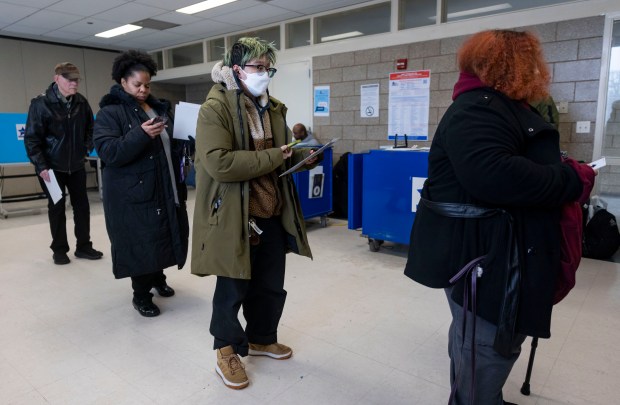
As 7 p.m. neared, a line of people vying to get their votes in before polls closed stretched down State Street outside of the city’s supersite downtown. Junayd Shakir stood at the back of the line, the 24-year-old student making a beeline for the polls following his shift at a local after-school program.
Shakir made voting a priority amid work and the brisk weather because to him, casting a ballot is a privilege.
“As an African American, you know, my ancestors fought for us to have this right, this privilege,” he said. “I guess I’m carrying on that legacy.”
In neighboring DuPage County, election officials announced that they were on track to see the highest midterm primary turnout in recent memory. As of 2 p.m., turnout surpassed just over 18%.
In downstate Champaign County, 15 polling locations were closed because of a shortage of election judges, reducing the options for people to vote. Judge shortages have plagued Central Illinois generally, an issue that Champaign County Clerk Aaron Ammons called “absolutely terrible.”
“All the polarization that we see in the political space right now … (is) creating a lot of angst for these election judges, and many of them just want to serve and do the right thing, and they don’t want to be bothered with some of the negativity and a lot of the polarization that’s taking place,” Ammons said, also noting that some election judges are also just getting older.
Jerry Walsh was looking to get voting out of the way quickly in the afternoon, but found himself part of a standstill line in a library in Urbana on the east side of Champaign County.
While Election Day in Champaign-Urbana has been without the large-scale disruptions of years past, Walsh found himself waiting 10 extra minutes due to “technical difficulties” related to a voting machine.
Walsh says he missed punch-card ballots. “I’m just an old-timer kind of guy…the modernization is not always working as well as you might think.”
Among the polling places with touchscreen voting machines were some of the most rural reaches of the county, like in far northern Urbana, where a polling place had been set up in the annex of a large shed that houses trucks and tractors.
Michael Wentzel, a graduate student voting at the Student Union, said he was personally pleased with the speed that lines moved Tuesday, and mentioned having to wait for three and a half hours to vote in the 2024 elections.
The St. Patrick’s Day primary day closed out a campaign season marked by furious fundraising and streams of mailers and television ads as candidates competed for several seats that haven’t been open in decades. More than $92 million has been spent in the U.S. Senate race and four open-seat contests for the U.S. House, according to political ad tracking firm AdImpact.
Voters across the state were choosing a new U.S. senator to replace longtime Sen. Dick Durbin, who created the state’s first open U.S. Senate seat in 16 years when he announced last April he would not seek a sixth term.
The race had been narrowed on the Democratic side to three top contenders among the 10 Democrats and six Republicans running: U.S. Reps. Raja Krishnamoorthi of Schaumburg and Robin Kelly of Lynwood and Lt. Gov. Juliana Stratton.
The Republican race for the U.S. Senate nomination included former Illinois GOP Chair Don Tracy; attorney Jeannie Evans; Casey Chlebek, who unsuccessfully sought the GOP U.S. Senate nomination in 2020 and 2022; Pamela Denise Long; Jimmy Lee Tillman II, and R. Cary Capparelli.
In one of the most closely watched House primaries in the country, voters were also choosing a replacement for retiring U.S. Rep. Jan Schakowsky in Illinois’ 9th Congressional District, which last saw an open-seat primary in 1998. In that race, 15 Democrats competed for the nomination, including Evanston Mayor Daniel Biss, state Sen. Laura Fine of Glenview and political commentator Kat Abughazaleh.
Candidates were also vying to succeed longtime U.S. Rep. Danny Davis in the 7th Congressional District, including Davis-endorsed state Rep. La Shawn Ford and city Treasurer Melissa Conyears-Ervin.
Four Republicans were vying to face Gov. JB Pritzker as he runs for his third term: former state lawmaker Darren Bailey, who lost to Pritzker by nearly 13 percentage points four years ago; Ted Dabrowski, the former head of the Wirepoints conservative activist organization; real estate developer and video gambling firm owner Rick Heidner; and DuPage County Sheriff James Mendrick.
Freelancer Aidan Sadovi contributed to this story.