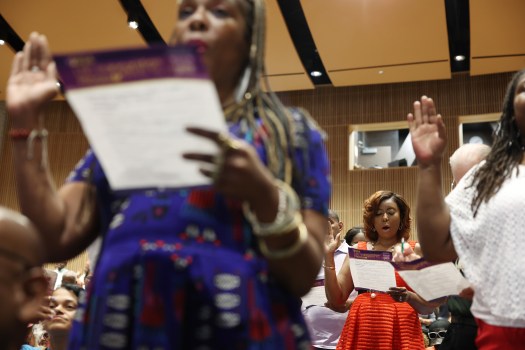

A different set of polls opens on Wednesday morning as Chicago Public Schools holds its local school council elections.
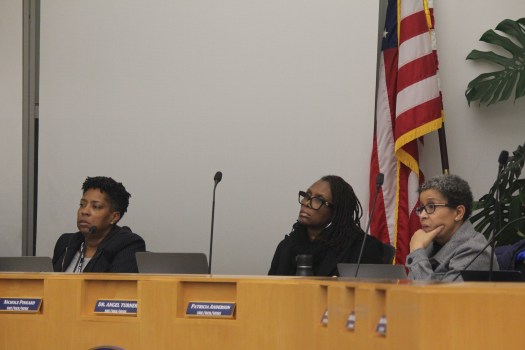
From selecting and renewing school principal contracts to approving budgetary resources and academic plans, members of local school councils play an important role in the country’s fourth-largest public school district.
LSC elections are held every two years, and with polls open from 6 a.m. to 7 p.m. at district schools, parents are encouraged to vote during parent-teacher conferences and report card pick-up on Wednesday.
Here’s what you need to know about this year’s election.
What are Local School Councils?
LSC’s sprouted from the 1988 Chicago School Reform Act, a landmark decision passed to address underperforming schools across the city. The hyper-local councils give parents, students, educators and broader community members an opportunity to get involved with school decision-making.
There are now more than 500 councils serving district-run schools across the city, each responsible for addressing its school’s specific needs.
Elected LSC members serve a two-year term, while student representatives’ terms last one year.
What is the composition of an LSC?
LSC’s are organized three ways.
A traditional LSC at a K-8 elementary school has 13 members — the school’s principal, six parent representatives, two community representatives, two teacher representatives, one non-teacher staff representative and one student representative. This is the case for LSC membership unless it’s a K-6 elementary school, which would not have a student representative.
Traditional LSC’s at high schools have 15 members, with three student representatives instead of one.
The other two councils, Appointed Local School Councils and Boards of Governors, are appointed by the Board of Education. These councils account for only 4% of LSCs in Chicago.

Can anyone run for an LSC seat?
While no experience or formal education is required, there are still unique requirements for parents, students, teachers and broader community members who would like to run for an LSC seat.
Parents, for example, must have a child currently enrolled in the particular school council they are running for and be unaffiliated with the board.
A community representative must be at least 17 years old, live within the school attendance area or voting district, and not be a parent of a child who attends the school.
Teachers must be employed full-time by CPS. They must also perform a majority of their duties at the school. Non-teacher staff representatives must have a full-time position that does not qualify as a teaching position.
Student members must be full-time high school or K-8 students.
Principals, whether interim or contractual, are automatically members of their school’s LSC.
Parents and community members may be seated immediately upon completion of their criminal background checks, with full voting privileges.
Individuals who have been convicted of certain felonies are either not eligible to serve until 10 years after the date of their conviction.
Who’s eligible to vote in a local school council election?
All community members, regardless of U.S. citizenship, with proof of residence within the school’s attendance area or voting district, can vote in the LSC elections. This includes parents, students and paid staff.
What are the voting rules?
All voters will need at least two unexpired forms of identification with their current address, such as a driver’s license, state ID or current utility bill. The residential address must be within the school’s attendance boundaries and the voting district.
Parent voters must provide additional identification or documentation that establishes themselves as the parent, legal guardian or temporary custodian of a child enrolled in the school.
Acceptable forms of identification are the student’s report card, student’s birth certificate or other legal documents and records.
Parents and broader community members can vote for up to 5 representatives, which includes any combination of parents and community candidates.
Teachers and staff can vote for up to two teachers and staff members.
Where are the elections held?
CPS has created an election map tool that allows voters to verify where they are eligible to vote by inputting your residential address.
You can find the map here.
What if a school’s LSC has vacant seats and no candidates to fill them?
Applications to fill vacancies are open throughout the year. However, if a vacancy occurs during a parent or community member’s term, the current LSC members can appoint someone for the remainder of that term.
Similarly, if fewer than the maximum number of members are elected at a regular LSC election, the council can appoint someone to fill the position.
In recent years, CPS has struggled to recruit applicants. Currently, only 74 of 511 councils are completely filled, according to the LSC members map. During the first elections more than three decades ago, 17,256 Chicagoans ran for positions.