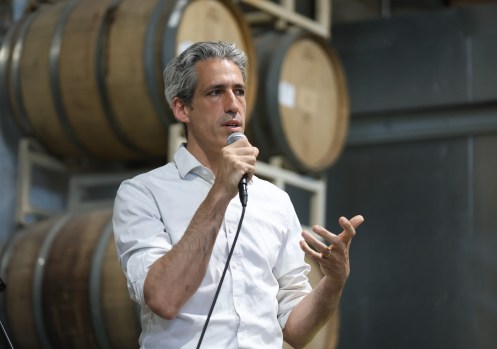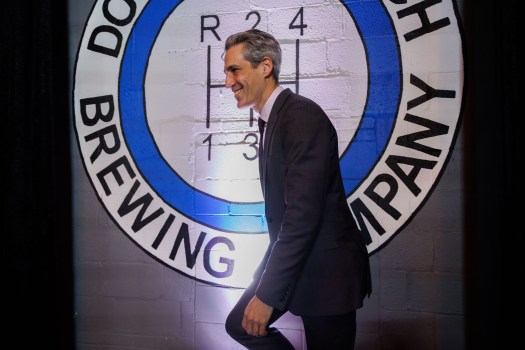

After Daniel Biss declared victory in the March 17 Democratic primary, the Evanston mayor is on a near-certain path to Congress in a historically blue district, many political analysts say.
But even as his path to represent Illinois’ 9th District in Washington clears, Evanstonians face a new question: Who will be the next mayor?
Biss was re-elected for a second term as mayor on April 1, 2025, a mere six weeks before he announced his candidacy for the U.S. House of Representatives.
With three years remaining on Biss’ mayoral term, if he’s elected to Congress in the general election this November, the city will need to seek a replacement – a process that may require a special election, according to city officials.
Illinois state law asserts that if the mayor’s office were to become vacant, the Evanston City Council is responsible for filling the “unexpired portion of the term,” per city code.
Based upon the timing of the vacancy, a special election will be held among Evanston’s nine City Council members, according to city officials.
Vacancies may occur as a result of death, permanent physical or mental disability, conviction of a crime, moving out of the city or, more commonly, a resignation.
Under state law, if a vacancy occurs with at least 28 months remaining in the term and at least 130 days before the next general municipal election, City Council members will appoint an acting mayor to serve temporarily until a special election or the next regular municipal election, which would be in April 2029.
If Biss wins his Congressional bid in the November 2026 general election, he would be sworn in as a member of Congress in January 2027.
In order for a special election to be held in April 2027, Biss would likely have to resign in November to clear the 130-day requirement required by city code.
When asked about his succession plans, Biss told the Chicago Tribune, “My intent is to resign from my position in time to trigger a special election that would occur in April of 2027.”
“I wouldn’t want to interfere with the Council making that choice, and I imagine we’re going to — now that we know the outcome of the congressional election — see more people expressing with some clarity whether or not they’d be interested in that.”
“I’m still the mayor of Evanston,” Biss continued, “a job that I take very seriously. We have unfinished business, especially around housing and zoning, work that I’m focused on making sure we see through.”
Selecting an acting mayor to serve in the interim (from roughly January through April 2027) ahead of a special election is largely uncharted territory for the Evanston City Council.
The last time this occurred was more than 50 years ago, when then-Mayor John Emery announced his resignation during a City Council meeting on June 1, 1970.
“About a year ago I began action looking forward to retirement because of personal and health reasons,” Emery wrote to Council members at the meeting. “Therefore, with deep regret, I announce my resignation as Mayor effective as of the close of Council meeting June 15, 1970.”
“For more than 25 years I have been active with many persons in various organizations concerned with the welfare of our City and I shall remember them with affection and appreciation,” Emery said.
In a City Council meeting on June 8, 1970, Evanston’s Corporation Council moved to recommend that the election of an acting mayor be held by “secret ballot,” in a form prepared by the City Clerk, according to archived meeting minutes.
Mayoral nominations would be made on the floor, without speeches, and then Council members would vote on a written ballot rather than a vote by roll call.
The candidate with a majority of votes would win, though there might be successive rounds of voting if a majority vote was not initially reached.
Putting the process to work, Ald. Peter Jans, 7th, was selected as acting mayor on June 15, 1970, over two other alderperson nominees.
As Biss eyes Congress in the months ahead, Evanston City Council members may once again face such a transition.
In November, Biss is expected to face Republican John Elleson, an Arlington Heights pastor who declared victory as the Republican nominee for the 9th Congressional district on March 17 with just under 50% of votes on the Republican primary ballot.
Elleson previously ran against incumbent U.S. Rep. Schakowsky in 2018, but lost by a margin of 73% to 27%.
Chicago Tribune reporter Olivia Olander contributed.