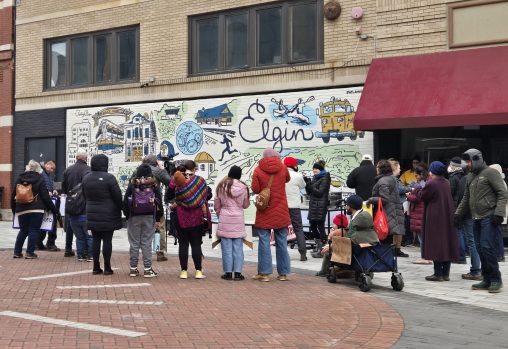
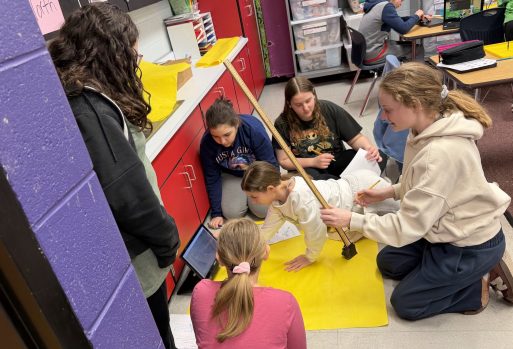

About 500 sixth-graders at seven U-46 schools are competing to predict the exact moment sunrise will appear Saturday in the middle of Elgin’s Chicago Street, marking the start of spring and creating a view not unlike the one seen at England’s Stonehenge.
The winning class will learn if they’ve earned bragging rights at the U-46 STEM Expo Saturday at Eastview Middle School in Bartlett.
Deb McMullen, the district’s science and planetarium coordinator, said the idea for an “Elginhenge” contest grew out of a sixth-grade Earth and Space Science lesson in which students study patterns in the sun’s movement.

“Those phenomena happen because of Earth’s tilt and orbit around the sun. On the spring and fall equinoxes, the sun rises almost exactly due east and sets due west. If a street or corridor of buildings happens to run close to that east-west direction, the rising or setting sun can appear to line up perfectly along that corridor,” McMullen said.
The name comes from Stonehenge, a prehistoric monument in England that experts believe was aligned with the movements of the sun and allowed users to determine seasonal changes.
There are similar viewings of equinox’s arrival in other cities, including “Manhattanhenge” and “Chicagohenge.”
McMullen said she noticed the sunrise’s alignment on Chicago Street near its intersection with Gifford Street as she’s been walking to work at the district’s Educational Services Center, observing how it moved into the center of the street as the start of spring or fall neared.
She mentioned it during a professional development session with sixth-grade teachers after someone asked Peggy Hernandez, former director of the district’s planetarium, about “henge” alignments. That led to the challenge and educators reaching out to U-46 Superintendent Suzanne Johnson, who made a YouTube video about it (www.youtube.com/watch?v=MMZ-ur_x3h8).
For the challenge, students are acting like scientists, analyzing maps of the Chicago/Gifford intersection, sunrise data and the direction the street faces, McMullen said. They’re also using digital tools like sky simulations to study how the sun moves near the horizon around the equinox.

From that information, student teams are developng models and evidence-based explanations to predict the exact time the sun will align between the buildings along Chicago Street looking east, she said.
“The spring equinox occurs around March 20 and 21, but the alignment can appear very similar for a couple of days on either side of that date, depending on local building placement and horizon elevation,” McMullen said. “Students are predicting the day, the hour and minutes they think the sun will appear centered between the buildings.”
While sunrise on those days will be about 7 a.m., McMullen noted that the “henge” viewing at Chicago and Gifford Streets could be 12 to 14 minutes after that, due to the slope of Chicago Street.
For the inaugural year, seven teachers volunteered to have their 20 classes representing seven schools take part in the challenge. The schools are Bartlett and Sycamore Trails in Bartlett, Clinton, Fox Meadow and Willard in South Elgin, Spring Trail in Carol Stream and Hilltop in Elgin.

“The students are loving it,” McMullen said. “They’re asking for more scientific challenges to solve, and the Office of K-12 Science & Planetarium and the U46 science specialists plan to deliver.”
Educators are planning to continue the alignment observation challenge at the Educational Services Center next year. They hope to add a “Community Henge” component to it, where schools and families can submit photos of the solar alignments they observe on the spring equinox from locations across the school district, making learning a hands-on experience for all.
“We believe that science is in the community. Part of why I walk to work is to show examples of science going on in our neighborhoods. Science is everywhere for people to explore and experience,” McMullen said.
Mike Danahey is a freelance reporter for The Courier-News.