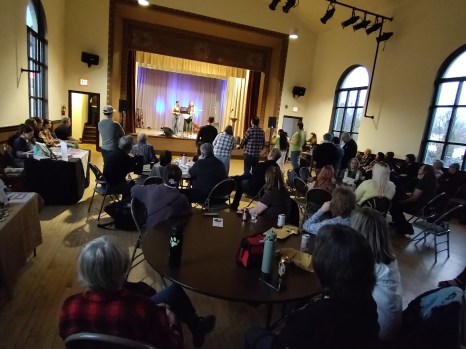
Few gathering spots in Chicago are as deeply rooted as The Hideout on Wabansia Avenue. Fewer still are as known for their loyal community and live music. The Hideout has had the same owners since it first opened under that name 30 years ago: Tim Tuten, a former Chicago teacher and member of the Obama Administration’s education team; his wife Katie Tuten, a former program developer for Catholic Charities in Chicago; and a pair of twins, businessmen Mike and Jim Hinchsliff. Indeed, even as its gray industrial no-man’s land of a neighborhood — straddling Lincoln Park and Bucktown, a block from the north branch of the Chicago River — grew increasingly gentrified, big-boxed and flanked by billion-dollar real-estate plans, this handmade-looking 19th century shanty weathered all change.
Until Thursday, when ownership announced they sold The Hideout.
The new owner is Teri O’Brien, a former Hideout employee who splits her time between Chicago and Nashville, where she launched a music career, performing as Americana artist Bronte Falls. Now that she owns a bar, she said, she’ll be in Chicago the majority of the time.
“I had a dream to open a music venue,” she said, “and so it’s wonderful to build on the legacy and community here — I am not looking to rebrand what has a wonderful brand.”
She worked at The Hideout for three years, starting as an intern, then as assistant to the talent buyer, then she wrote the newsletter, then she worked the front door. During that time, she recalls telling the Tutens that she wanted to own a place just like this one day.
“But still, when we started talking about a (sale) in the past year, and they seriously asked me, I was gobsmacked. I mean, I would not be human if I wasn’t intimidated.”
The Tutens declined to comment beyond a statement.
Tim said in part, “The Hideout will stay the Hideout. It will remain independent, creative and rooted in the community. … Teri knows our room, the people and our history, and she has the heart to carry it forward.” Katie, however, told Axios Chicago the recent death of Chicago artist Tony Fitzpatrick “really hit us hard and we realized we’re getting older.” The Tutens are in their mid-60s.
O’Brien declined to say how much she paid for the bar.
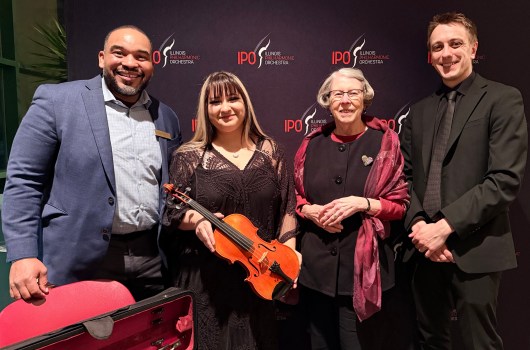
A classically trained violist who studied at the Berklee College of Music in Boston, O’Brien grew up in Glencoe with a significant legacy herself. Her grandfather, J.V. McCarthy, was a founder of the Chicago Mercantile Exchange; and the O’Brien family itself created R.J. O’Brien & Associates in 1914, today considered the oldest futures brokerage and clearing firm in the nation. “But I am not of that world,” O’Brien said. “I am a musician and I don’t speak the language. I can’t even tell you what that means.”
She reiterated what Tuten said about change. Mainly, there wouldn’t be any. She doesn’t plan to change a thing about the Hideout, which has long nurtured an eclectic mix of country singers, rock bands, stand-up comedy, dance parties, talk shows, cooking events and civics classes. Next month, Michael Che of “Saturday Night Live” does five shows; that’s followed with an absurdist variety show centered on spirituality.
O’Brien does, though, plan to create a local version of a female songwriting showcase she started in Nashville, plus a regular night devoted to acts that just moved to Chicago. She’d also like to bring back the Hideout Block Party, which ended in 2017 and for a while attracted acts like Death Cab for Cutie, Mac DeMarco, Wilco and Mavis Staples.
As for politics: Though the Tutens often ran their bar as a kind of activist and organizing hub, O’Brien said she isn’t comfortable talking politics — “but I do love politics are part of the Hideout.”
She purchased the venue after a particularly rocky stretch for the local institution, which closed at the end of 2022 after a former employee accused Hideout management of creating a toxic work environment and several performers canceled shows. Two months and one “equity audit” later, The Hideout reopened with new pledges to diversity and inclusion.
The episode came as a surprise to regulars who long understood the Hideout as an eccentric beacon of progressiveness and unpretentious incubator of emerging talent. Mavis Staples made a live album there. An upcoming HBO special from stand-up Ramy Youssef was shot there in January. Singer Neko Case worked there as a bartender. In 2018, when Sterling Bay announced a massive $6 billion real estate development in the neighborhood that would build new music venues run by promoter Live Nation, the Tutens founded the Chicago Independent Venue League, which soured many on those mega-plans, and have since been scaled back to a more residential focus.
All of that in a place that never takes down its Christmas lights, and began life itself as a residential home, then as a public house, then as an illegal Prohibition-era bar run by bootleggers.
Singer-songwriter Kelly Hogan was a bar manager there for years before she became a longtime fixture of Neko Case’s touring band. “No one quits the Hideout, you just go on tour” — that was the motto then. “The Hideout is where my heart lives,” she said. “It’s always been ‘arms open wide’ and ‘Hey kids, let’s put on a show!’ Like a big family — crazy, messy and fiercely loving. It’s a huge part of Chicago for me.” She hopes “the wild and giving spirit of the Hideout remains uncompromised.”
cborrelli@chicagotribune.com