


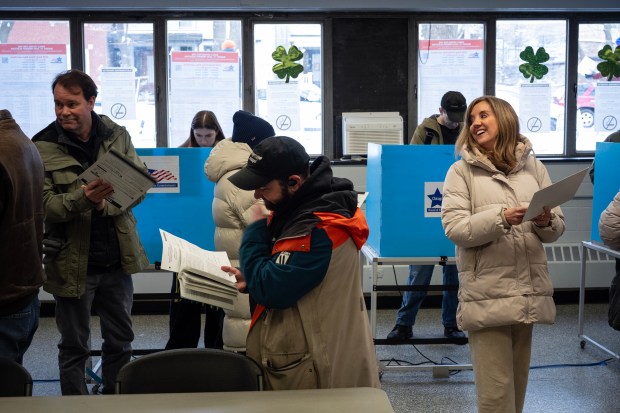
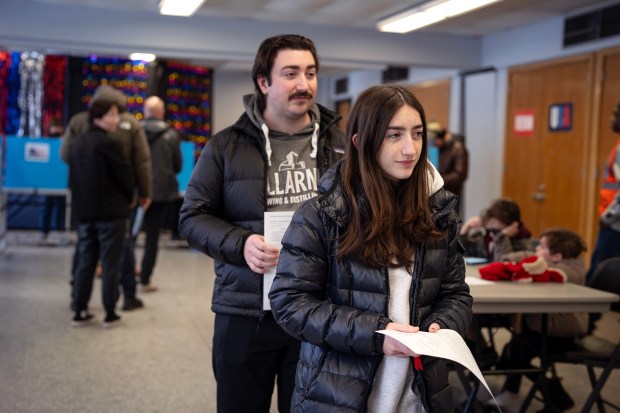
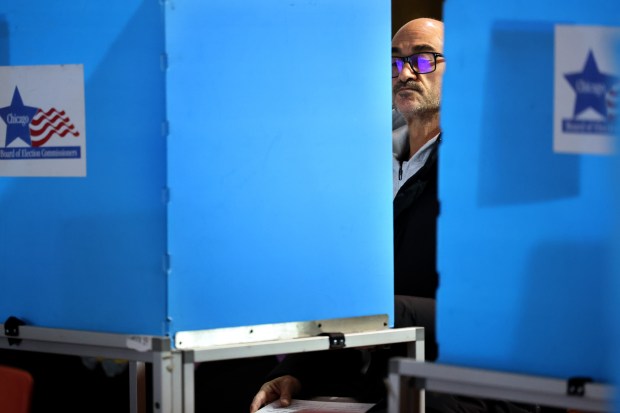

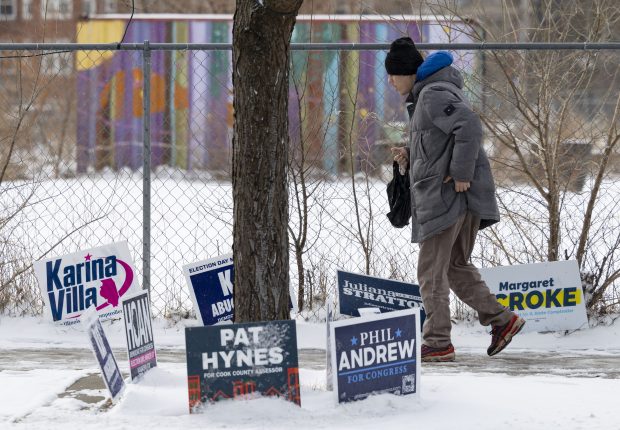



We had the opportunity in multiple Illinois Democratic congressional districts this primary to move forward from previously entrenched politicians. An opportunity for people to feel excited about voting again. Good for democracy, especially at this moment when belief in democracy might be wavering.
Many took the opportunity to enter the fray, often with compelling stories. A voter looking at their ballot had to hedge their bets on giving someone who represented their views a fair chance of winning, when there were multiple candidates they would have been happy to elect.
And then came the millions of dollars from outside. In some cases, cynically spent to split constituencies into voting down their chances of seeing someone of their liking win the seat. Whether it was the governor exerting his financial muscle behind candidates, shell groups serving as a front for larger unpopular national lobbies or people outside our state, this money had outsized influence in determining the outcome of our elections. Too many candidates with small but enthusiastic pockets of support were relegated to being spoilers.
There is a way to subvert the subversion of money as a dividing force in politics. It’s time for ranked choice voting in Illinois, so that people can joyfully select people whom they feel most inspired by and give themselves the options of their second, third and fourth choice if their first choice is not viable.
It’s time to pass SB2004 to enact ranked choice voting in our state.
— Mohiuddin Ahmed, River Forest
Reward consensus
In the recent Illinois primary, Democratic U.S. Senate candidate Juliana Stratton won with 40.1% of the vote. That’s enough under current rules. But about 60% of voters chose someone else, largely Raja Krishnamoorthi and Robin Kelly.
That’s not a broad mandate. It’s a divided result.
This race highlights a basic flaw in plurality voting. When similar candidates run, they split voters with overlapping views. The winner isn’t necessarily the most widely supported candidate but just the one who comes out ahead in a fractured field.
Ranked choice voting (RCV) offers a straightforward fix. Instead of choosing just one candidate, voters rank them. If no one reaches 50%, the lowest finisher is eliminated, and those ballots are reassigned based on second choices. The process repeats until someone earns a majority.
In this race, a little more than 18% of voters backed Kelly. Under the current system, their preferences stop there. Under RCV, they would likely determine which of the top candidates had broader support.
That’s the difference: Plurality rewards narrow leads; RCV rewards consensus.
Critics say RCV is more complicated. But voters already weigh multiple factors in every election. Ranking candidates is not an unreasonable ask, especially if it leads to outcomes that better reflect the will of the electorate.
Illinois has adapted its voting systems before. It can do so again. Because the real issue isn’t who won. It’s whether a system that allows a candidate to win with 40% truly represents the voters.
Democracy should aim for a majority, not settle for a plurality.
— Kenneth Corrigan, Chicago
Voters’ true preference?
The furthest left candidate will be our new U.S. senator. I am not sure Juliana Stratton is really the preference of the voters of Illinois. I wonder how ranked choice voting would have affected the outcome of the election.
— Bob Brauer, Petersburg, Illinois
Hypocrisy of Democrats
The March 19 editorial “Illinois Republicans aren’t just losing. They’re disappearing” perhaps wins the master of the obvious award. By their gerrymandering, the Democrats of Illinois have effectively disenfranchised thousands, perhaps millions, of conservative voters of this state. They wring their hands over the possible disenfranchisement of voters with pending federal voter-identification legislation; meanwhile, they have actually disenfranchised voters here and apparently with no remorse.
I voted on Tuesday, but it was with a sense of despair that my vote meant nothing in this state, due to the ridiculous district mapping.
— Paul Geddes, Rockford
Candidates ignored
In doing research on the Republican secretary of state primary election, I came to realize that the races that are not controversial or interesting get little to no coverage in the media, even though offices like secretary of state deal directly with the people just as much, if not far more, than the larger offices.
After going through research, I came to the conclusion that Diane Harris was the best candidate in this race. Her competitor didn’t match her 20-plus years of political experience, as well as her professional experience, but people may not have known that because this race was not well documented in the media.
How many other far more qualified candidates have gone unnoticed just because the media considered the race insignificant? How are people supposed to know who to vote for in the less big-ticket positions if the media won’t provide information on them?
For the sake of Harris and every other overlooked candidate, please consider putting out more information on every race, not just the “interesting” ones.
— Olivia Wallace, Mundelein
Daniel Biss’ victory
Daniel Biss has claimed victory in the 9th Congressional District Democratic primary. But beneath the headline is a far less triumphant reality: A little more than 70% of voters who cast ballots chose someone else. Put another way, only 3 out of every 10 district voters wanted Biss. That’s hardly a mandate.
This isn’t Biss’ first run at higher office. In fact, it’s his fifth. Or maybe sixth. Hard to keep track. Before becoming mayor of Evanston, Biss mounted campaigns for governor and multiple other offices, each time positioning himself as a progressive standard-bearer.
Most recently, he announced his run for Congress just days after being sworn in for a second term as mayor, a move that raised eyebrows about commitment and priorities with a basic question, the same one that led me to campaign against him when he was running for mayor after his failed gubernatorial run: Was Evanston ever really the destination or merely a waypoint?
With this recent election came a late-breaking controversy: a claim of an inappropriate past relationship with a university student surfaced in the final stretch of the race. Rather than meeting the moment with gravity, Biss issued an unapologetic apology, which read less like he was actually contrite and more like he was sorry it had come to light, categorizing the situation as “ill-advised.” Really? For many, his response felt dismissive, even tone-deaf, especially in an era when questions of power, consent and accountability demand serious reflection.
Meanwhile, back in Evanston, the record is difficult to ignore. Residents and business owners have watched as economic challenges deepen, with strained budgets, contentious policy decisions, poor planning and real estate moves, and a sense that the city is rudderless rather than driving toward a clear, sustainable future. Leadership matters, and so do results, or lack thereof, as the case may be.
And yet, despite all of this, Biss prevailed. It’s hard to separate that outcome from the influence of the Cook County Democratic Party and broader party machine, whose backing can still tip the scales in crowded primaries in which voter fragmentation is high.
Democracy is about more than winning the post, it’s about representing the people, and it’s particularly sad to me that now Biss has even more constituents to summarily ignore in his seemingly unending quest for political power.
When a candidate advances with less than a third of the vote, amid controversy and unresolved concerns about leadership, it’s fair to ask whether the system is working as intended or broken beyond repair.
— Lori Keenan, Evanston
Questions about Benton
Regarding the editorial “Speaker Chris Welch has an iron fist. It threatens to disenfranchise voters” (March 18): Incumbent Democratic state Rep. Harry Benton, who ran unopposed in Tuesday’s primary, will be on the November general election ballot. Without public explanation, House Speaker Emanuel “Chris” Welch stripped Benton of his committee assignments and revealed that he is unwelcome at caucus meetings. Benton, also road commissioner for Wheatland Township, is a political double-dipper; this also goes without a public explanation from Welch. It’s time for the speaker to speak up.
Benton is not the only General Assembly member to hold another elected office. Double-dippers collect two public paychecks and accrue double the public-funded benefits, such as pensions.
This information should have been included in the editorial.
— Bob Anderson, Wonder Lake
Submit a letter, of no more than 400 words, to the editor here or email letters@chicagotribune.com.