
March has been chilly so far in Chicagoland. But a looming bright spot for lucky families around here is the prospect of an imminent spring break trip somewhere warm. Alas, Washington political gamesmanship has arrived to harsh your mellow.
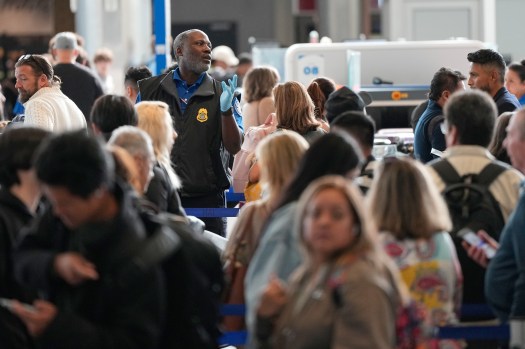
Images of security lines the length of football fields have cropped up in the news this week, as federal Transportation and Security Administration staff are working without pay due to Department of Homeland Security funding battles in the Capitol. That’s leading more and more staffers to call off work, which, in turn, is creating more and more chaos at airports. We heard tell of long lines at Chicago’s O’Hare International Airport Thursday morning, even at PreCheck.
DHS funding expired in mid-February after Congress failed to pass a new spending bill. The current TSA disruption stems from a partial shutdown of the DHS.
While fewer than 2% of TSA workers typically miss shifts, more than 10% of all TSA agents nationwide didn’t show up for work last Sunday, Business Insider reported. At Houston’s William P. Hobby Airport Tuesday, more than 40% of TSA workers called off. As more paychecks are missed, it will only get worse.
All of this is Exhibit A for why government shutdowns are a bad policy lever, whether you are a Democrat or a Republican. At a minimum, Americans expect the federal government to make sure the airports and land borders are functioning.
As one of the busiest travel periods of the year kicks into full gear, CEOs from major airlines such as United and American Airlines are speaking up.
“In these times when it’s hard to reach consensus on just about anything, it is significant that the vast majority of Americans want Congress to pay federal aviation workers, keep our National Airspace System secure and ensure travelers and packages can get to their destinations safely,” CEOs wrote in an open letter published March 15.
Indeed. We heard more along those lines when we met with executives from United Airlines earlier this week.
Industry group Airlines for America expects a record 171 million passengers to travel between March 1 and April 30, a 4% increase from last year. In anticipation, U.S. carriers have expanded capacity, adding about 2% more flights and seats.
Increased demand is a good thing. The government’s ongoing dysfunction is throwing a wrench in this bright spot in the economy.
The standoff in Washington centers on immigration enforcement, a complex and deeply contested issue. To be sure, enforcement reforms, as well as comprehensive immigration reform, are long overdue, and Congress should address these issues. But that debate is not the same as keeping airports secure and borders functioning day to day.
Lawmakers in both parties say they support funding core aviation security. Neither side, however, has made it a priority to fully shield these basic services from recurring budget fights. Democrats have offered a proposal to fund parts of DHS through September, according to the Associated Press, but Republicans prefer short-term funding for the entire agency. The result is that essential, largely uncontroversial functions such as TSA screening keep getting pulled into political standoffs over more contentious debates over immigration enforcement carried out by agencies such as ICE.
Basic government functions shouldn’t be bargaining chips. The problem needs to be resolved now.
Many countries structure airport security in ways that reduce exposure to this kind of political brinkmanship. In Canada, passenger screening is handled by the Canadian Air Transport Security Authority, an independent entity funded in part through a dedicated fee on airline tickets. In the United Kingdom and much of Europe, airports themselves oversee security under national standards, with costs built into ticket pricing.
The United States should move in a similar direction. Sooner rather than later.
Government reliability has been breaking down in visible, everyday ways, and when basic services falter, it’s usually the most vulnerable who feel it first. When SNAP disruptions threatened food assistance last fall, the consequences fell hardest on families already struggling to get by. Today’s TSA troubles are less severe but far more visible, affecting business travelers and families heading out on long-planned trips. The problem with this pattern of gamesmanship and dysfunction is that it tends to spread and repeat.
Effective governance means you cannot shut down airport checkpoints or leave customs posts understaffed at land crossings because of a political dispute. Americans have grown weary of ongoing dysfunction and an increasing inclination to deprive people of basic services in order to make a political point.
After a long winter and a seemingly endless barrage of bad news — from the Iran War to the ongoing affordability crisis to the constant vitriol spewing from our TVs this election season — Americans deserve a break. That should not have to include a three-hour wait in the security line.
Submit a letter, of no more than 400 words, to the editor here or email letters@chicagotribune.com.