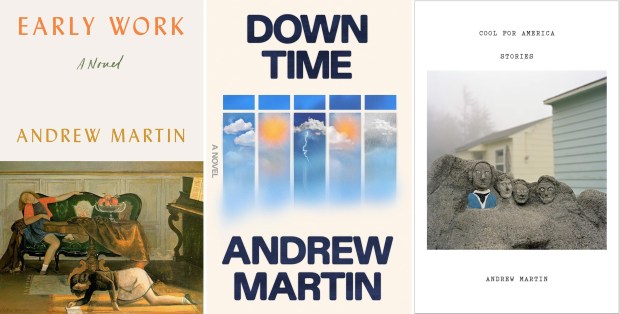

Clearly, I am a fan of the writer Andrew Martin’s books since I have now read all three of them, most recently his newly released novel “Down Time.”
And yet, if you asked me if I liked the books after having read them, or if I recommend them to others, I’m not sure I could give a clear or consistent answer. While reading his 2018 debut, “Early Work,” about a listless post-grad school wannabe novelist, I kept thinking, “this guy kind of sucks” and yet I couldn’t stop reading.
The stories in “Cool for America” (2020) feature numerous characters who you want to shake and just say, “Get a grip!” and yet, once again, I read them all.
“Down Time” maps similar territory, a group of interrelated characters in their 30s who seemingly have all the ingredients in place to live happy, fulfilling lives, but who are consistently thwarted by, basically, themselves.
I think Martin may be the greatest writer of the millennial generation writing about a particular (overeducated, white) slice of that generation. What that says about millennials or the world previous generations like mine have made for them is open to interpretation.
In the specific case of “Down Time,” there is an additional complicating factor to challenge these lives: the coronavirus pandemic
“Down Time” features Aaron, an alcoholic and addict (and writer), who serially crashes out, winding up in rehab, most recently reemerging into the life of his girlfriend, Cassandra. Cassandra’s ex, Malcolm, is holed up in New York with his partner Violet, a doctor who heads into her pandemic-ravaged hospital job every day while Malcolm basically mopes. Lastly, Antonia, once on the rise as a Harvard-employed academic on a path toward the tenure track, but who manages to derail, winding up in a much more contingent place.
“Down Time” is both a reference to the pandemic period of enforced isolation and relative non-activity and how the characters are feeling. The background hum for all of them is that these are characters from privilege, educated with apparent financial security, even as sources of income are not apparent.
Aaron and Cassandra have decamped to Aaron’s father’s house, where Aaron pines for Xavier, a fellow addict with whom he kicked off a torrid sexual relationship while in rehab.
Malcolm is a serious drag on the much more together Violet, but also spends his days rehashing his past infatuation with Cassandra. Antonia has also wound up with her family, including her grandmother, an irascible old woman who is both Antonia’s role model and perhaps chief antagonist.
The characters try drugs and sex and novel relationships to try to break themselves out of their torpor. Malcom and Violet lurch toward deciding to get married, a choice that seems beyond foolish, but also something I desperately wished would happen. Martin’s rendering of these people is somewhere between sincere and satirical and somehow this technique works. The novel is frequently funny, a skewed comedy of manners, but it is also unsparing.
Larry David had a famous mantra for “Seinfeld,” “No hugging, no learning.” The characters of “Down Time” are more than willing to hug, but they seem largely resistant to learning. They seem to exist without agency, governed by their addictions, their various mental illnesses, their inability to commit.
I sort of loathe them, but somehow, Martin brings an acuity to the moment-by-moment rendering of these characters that makes me care more about them than they seem to care about themselves.
They are incomprehensible to me, and also to themselves, but perhaps this is the truth that Martin is unearthing about these people in this particular time.
Book recommendations from the Biblioracle
John Warner tells you what to read based on the last five books you’ve read.
1. “The Pickup” by Nadine Gordimer
2. “The Dream Hotel” by Laila Lalami
3. “Year of Wonders” by Geraldine Brooks
4. “I Am Homeless if This is Not My Home” by Lorrie Moore
5. “All Things Cease to Appear” by Elizabeth Brundage
— Marie J., Wilmette
Angela Flournoy’s “The Turner House” is a book that has stuck with me for the decade since I first read it. I’m betting it sticks with Marie as well.
1. “Freedom” by Jonathan Franzen
2. “Oblivion” by David Foster Wallace
3. “Eat the Document” by Dana Spiotta
4. “Jennifer Government” by Max Barry
5. “Imagine Me Gone” by Adam Haslett
— Sam T., Winnetka
Usually, I have an easy time when a list is full of books I’ve read (as this one is), but for some reason, I’m feeling the pressure to get it right, and I’ve literally been thinking about this a day before committing. Here goes: “Catch-22” by Joseph Heller.
1. “Remarkably Bright Creatures” by Shelby Van Pelt
2. “Lessons in Chemistry” by Bonnie Garmus
3. “The Boyfriend” by Freida McFadden
4. “A Simple Plan” by Scott Smith
5. “The Wedding People” by Alison Espach
— Nancy M., Glencoe
Inspired by my choice of a classic for Sam, I’m dipping into the past for Nancy, “Endless Love” by Scott Spencer.
Get a reading from the Biblioracle
Send a list of the last five books you’ve read and your hometown to biblioracle@gmail.com.
John Warner is the author of books including “More Than Words: How to Think About Writing in the Age of AI.” You can find him at biblioracle.com.