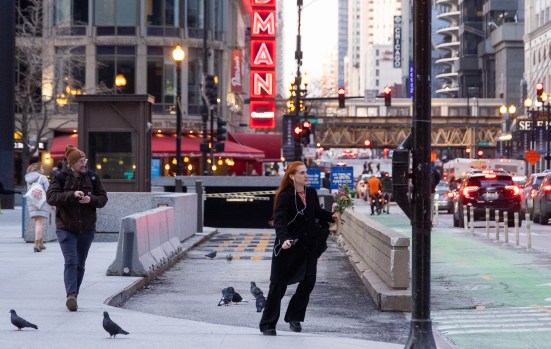

Liam Stanton writes that the Loop should be reimagined (“Chicago should stop waiting for the old downtown to return,” March 17). His ideas make a lot of sense; while I believe the Loop will continue to be a business center, with financial, legal and other offices, it makes sense that with all the changes, a full return to the office is unlikely.
I remember when I started working in the Loop in the early 1980s, my sister, who worked at the Hancock Center on Michigan Avenue, worried about me. She thought the Loop was grimy and unsafe. It was a bit grimy, but overall, I loved working right downtown. It was busy and crowded, and Stanton is correct that crowds bring safety and a vibrancy to any area.
I would add to his ideas the additional use of the Loop as a historical tour area. The Chicago architecture tours are great fun — and if they can make a romp through a cemetery a fun historical experience, think what they could do with the Loop and all of its history, restaurants, shops and bars (which don’t exist at cemeteries)!
Also, while theaters have generally struggled, Chicago’s theater district has nonetheless continued to hold its own. Possibly a satellite Goodman Theatre? Stanton talks about pop-up shops, restaurants, etc. — possibly pop-ups of popular shows that are not otherwise big enough to fill the larger stages downtown for a continuous run?
The Loop is a treasure and has so much to offer. Stanton is on the right track.
— Clare Connor, Chicago
Inspired by possibilities
Liam Stanton’s call to reinvent the Loop left me feeling very inspired about the possibilities for a better downtown. Giving Chicagoans more incentives to spend time in the Loop is a great way to write the next chapter for this beautiful part of our city.
As a proud local, I wish I spent more time in the Loop, taking in the river and world-class architecture. Stanton’s vision would give me reason to turn my aspirations into action.
— Will Brach, Chicago
The heart of the city
I appreciate the ideas for downtown expressed by Liam Stanton. This is the type of creativity and leadership Chicago needs to bring more energy back to the heart of the city while respecting our tight budget constraints.
— Robert Bach, Chicago
Tigerman a showman
Edward Keegan is right: Chicago should do more to preserve the legacy of Stanley Tigerman (“Stanley Tigerman’s last book preserves traces of the architect, but his legacy is in peril,” March 15).
Another example of Tigerman’s influence is the Educare school he designed at 5044 S. Wabash Ave., which was reviewed by the Chicago Tribune’s Blair Kamin in June 2000. Kamin noted that the early childhood center “provides a humanistic model for the pressing national problem of improving day care, not only for kids in the inner city but for their counterparts in edge city suburbs and elsewhere.”
Since then, this Educare on Chicago’s South Side has helped inspire the development of a nationwide network of Educare schools. You’ll find Educares in suburban, rural and Native American communities in addition to other urban areas. Though designed by other architects, each of the high-performing, well-evaluated Educare centers reflects a measure of Tigerman’s wit and whimsy.
Tigerman himself was a showman. Soon after the first Educare opened in March 2000, I coordinated a WGN-TV interview with the architect at the center. Just before the TV crew arrived and set up, I mentioned to Stanley, “You must be very proud of this building. This morning, I saw these little kids let go of their parents’ hands to race inside.” A few minutes later, once the TV cameras were rolling, Stanley answered the interviewer’s first question, then smiled with a twinkle in his eyes and added, “You know, you hear all the time how the kids are racing to get in here because they love coming here so much.”
— Michael Burke, Chicago
We don’t need Waymo
I keep reading that Waymo has started mapping streets here in preparation for the presence of its autonomous vehicles. To which I ask: Why? What problem do autonomous vehicles solve? Some techie’s ego, “Wow, look at what I can do”?
I ride a bicycle — a lot. I don’t want to be on the same street as a moving autonomous vehicle. Despite state law allowing street riding, many main arteries have no bike lanes. We are told by Waymo that the vehicles are safely running on computer software. To which I will ask: How often have we all used computers that didn’t function as expected?
We also know that artificial intelligence is not always correct. Now we are going to trust our safety to the same randomness?
No thank you. If the goal is to eliminate impaired driving, we have ride-share, taxis, public transit, walking — and reliable friends.
— Jim Halas, Norridge
A smart cardinal
A millennium ago, my family took the easiest known route to beautify a Chicagoland neighborhood: Cater to generations of brilliantly colored indigenous cardinals. When they would return from their southern winter quarters just about now, we’d welcome them with their favorite cuisine: shelled peanuts. They’d fly onto our rear porch, sound their distinctive call and out we’d come bearing nuts. Smaller, nondescript sparrows and wrens steered clear rather than risk attack by the larger cardinals.
The system worked great, excepting the start. The first redbird among these generations was a gentle soul we dubbed Mr. Peepers. Initially, he operated as all subsequent customers would, broadcasting his arrival with song. But while later males never hesitated to shoo other alerted birds from food intended for themselves, he allowed smaller birds to dart in and swipe our offerings. This delayed his feeding and cost us many peanuts.
Eventually, Mr. P solved our mutual problem himself. He began perching quietly on the kitchen windowsill and then pecking at the screen. The minor noise was lost outdoors, but with inner windows slightly ajar, the “bonk bonk bonk” echoed throughout the house. The only attention this attracted was the humans with food.
Ingenious. Our friend deserved to be the state bird.
— Tom Gregg, Niles
Submit a letter, of no more than 400 words, to the editor here or email letters@chicagotribune.com.