
Here’s a look back at what happened in the Chicago area on March 22, according to the Tribune’s archives.
Is an important event missing from this date? Email us.
Front page flashback: March 23, 1946

After posting an ad listing the property as available, the War Assets Administration handed over the 1,080-acre site to the city of Chicago — while keeping 200 acres to be used by the U.S. Army for storage.
The city began condemnation proceedings to acquire the additional property — which included 2,300 lots, 63 farms, a small cemetery, a golf course, county school land and two county schools — needed to build out the new airport.
Vintage Chicago Tribune: How O’Hare became a ‘first in the nation’ airport
The city passed an ordinance in 1947 expanding the footprint for the site, now called Chicago Orchard (Douglas) Airport, to 3,280 acres.
The airport was annexed by the city 10 years later, which allowed officials to establish a police force and other services — including construction of a new water main.
Weather records (from the National Weather Service, Chicago)
- High temperature: 83 degrees (2012)
- Low temperature: Minus 1 degree (1888)
- Precipitation: 1.13 inches (1993)
- Snowfall: 3.4 inches (1993)

1941: The U.S. Army put out a call on March 22, 1941, seeking Black volunteers on a “first-come, first-served” basis for the 99th Pursuit Squadron — its first Black unit of the Air Corps. Enlistment requirements were for Black men aged 18-35, unmarried and either a high school graduate or holder of a journeyman’s rating in a trade.
Vintage Chicago Tribune: The city’s groundbreaking Black aviators
Training for pilots and ground crew took place starting on March 24, 1941, at Chanute Field in Rantoul before the graduates were transferred to Tuskegee, Alabama, in June 1941. That location would provide the elite fighter pilot group with its famed name — the Tuskegee Airmen. Despite the relocation, a November 1942 Tribune story said the unit was “conceived by Chicagoans, taught in part by Chicagoans, and includes more than 100 Chicagoland youths.”
Its first flyers were scheduled to depart for World War II efforts in October 1942, but were unexplainably held back despite the completion of their training.

1952: Tiny Hebron — with an enrollment of about 100 — beat Quincy 64-59 in overtime to win the Illinois high school boys basketball tournament title game in Champaign.
Hebron’s water tower is painted like a basketball in the team’s honor still today.

1958: Marshall beat Rock Falls 70-64 in Champaign to become the first Chicago team and first predominantly Black team to win the state boys basketball championship.

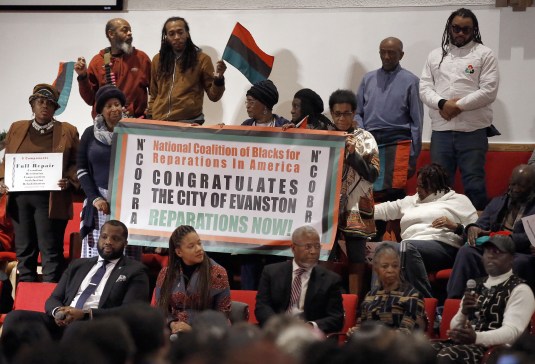
2021: Evanston became the first city in the United States to make reparations available to its Black residents for past discrimination and the lingering effects of slavery.
Officials in the suburb said the initiative, which had been in the planning stages since 2019, is designed to address the discriminatory housing policies and practices faced by Black residents. The $10 million program was funded through marijuana sales tax revenue along with some donations.
Want more vintage Chicago?
Subscribe to the free Vintage Chicago Tribune newsletter, join our Chicagoland history Facebook group, stay current with Today in Chicago History and follow us on Instagram for more from Chicago’s past.
Have an idea for Vintage Chicago Tribune? Share it with Kori Rumore and Marianne Mather at krumore@chicagotribune.com and mmather@chicagotribune.com