America turns 250 years old in just a few short months. There will be celebrations, community service projects, volunteer drives, patriotic events — all worthy ways to mark this milestone. But as a proud Chicagoan since the 1950s, I believe there’s another powerful way to honor our nation at this moment: by protecting the history that shapes Chicago’s identity and binds it to the broader American story.
As a citizen and retired lieutenant colonel in the Army and Army Reserve — and a colonel in the Illinois Army National Guard — I know firsthand how urgent the world can feel. The pace of today’s crises and headlines can make it seem like we don’t have the bandwidth for anything beyond the present moment. In that context, historic preservation can be dismissed as sentimental, optional or even indulgent.
But in reality, preserving our past is one of the most future‑focused investments we can make. It builds community, strengthens local economies, gives our children a sense of place, enhances safety, and enriches daily life with beauty and meaning. It is about continuity, pride, and belonging — the very fibers that hold a city together.
I admit I’m biased. I fell in love with Chicago through its architecture. One of my earliest memories is standing with my father on the Michigan Avenue bridge during a summer festival, watching the lights reflect off Tribune Tower and the Wrigley Building as the river rolled beneath us. I didn’t know the names of those buildings at the time, but I knew they mattered. They felt grand, permanent, protective — like guardians of a story I was just beginning to understand.
Every longtime Chicagoan has a memory like this. Maybe it’s visiting the Monroe Building with family, climbing the Art Institute’s iconic steps or taking in the skyline from a boat tour on the Chicago River. Our landmarks are the physical record of both our city’s history and our own personal histories.
And while these emotional ties can be hard to measure, the practical reasons for preservation are equally compelling.
Sustainability is one. Restoring existing buildings is overwhelmingly better for the environment than constructing new ones. Research from the National Trust for Historic Preservation’s Preservation Green Lab found that new construction — even energy‑efficient construction — can take decades to offset the carbon emitted during the building process. Retrofitting historic structures is not just nostalgic; it’s responsible.
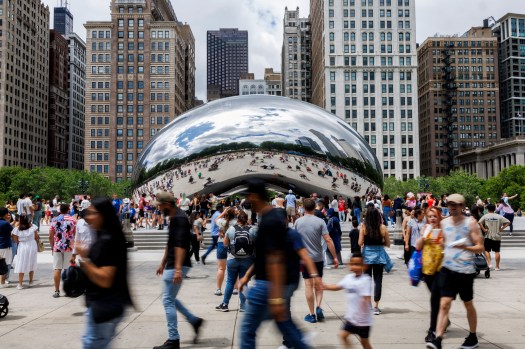
Tourism is another. People don’t visit Chicago for new high‑rise apartments. They come for Wrigley Field, Willis Tower, our historic districts, Prairie‑style homes and Frank Lloyd Wright masterpieces. According to Choose Chicago, tourism generates roughly $20 billion for our city — and our architecture is a signature part of that draw.
The conclusion is clear: When we reinvest in the city’s history, we strengthen Chicago economically, environmentally and socially.
As our nation reaches its 250th year, let’s celebrate by giving something meaningful back to Chicago. Think of a historic place that matters to you — a building, a block, a neighborhood — and consider how you might help preserve it.
There are outstanding organizations leading this work and in need of volunteers. Preservation Chicago and Landmarks Illinois remain invaluable protectors of our architectural heritage. The Chicago Art Deco Society Preservation Committee is a perfect fit for those drawn to the city’s artistic legacy. Additional groups worth supporting include the Frank Lloyd Wright Trust and the Chicago Architecture Center, both of which depend on community engagement to sustain their educational and preservation missions.
Preserving buildings is not just sentimental work, it often requires serious restoration. One of my jobs was as a Brigade Chemical Corps officer in the Illinois National Guard. Among our responsibilities was decontaminating people and equipment after exposure to hazardous materials. In some ways, restoring a neglected building is similar work. Structures, like people, can fall into disrepair and even become a health and safety hazard if they are ignored for too long. At a certain point, they must be fully restored or they begin to deteriorate beyond saving. Yet when we invest the effort to preserve them, buildings can endure longer than virtually all living things — carrying our shared history forward for generations.
If you want to thank this great city — or leave something lasting for those who come after us — there is no better way to make an impact. You don’t need to feel patriotic to care about your neighborhood. You just need to care about your neighbors, your ancestors, your friends and your family — the people who loved this city enough to protect its stories and pass them on.
Let’s honor them, and honor America, by continuing that work.
Retired Lt. Col. Jennifer N. Pritzker is founder of the TAWANI Foundation and Pritzker Military Foundation.
Submit a letter, of no more than 400 words, to the editor here or email letters@chicagotribune.com.