A couple of years ago, I was at a party when someone asked, “Why do you stay in Chicago?”
This person was from some smaller, gentler town and was perplexed by my dedication to a place that freezes in winter, boils in summer and, if you’re lucky enough to own a home, pummels you with property taxes.
I could have answered that I stay because Chicago is home. Because I have a community of people who make my life meaningful. Because I can walk or bike along that great, blue lake and marvel at the skyline, even as I wish there were fewer pooping geese to share the view.
I didn’t say those things. Instead, a thought landed on me with the force of revelation, and ever since it’s been my shorthand for why I live here: “I stay because Chicago is a complete city.”
Complete doesn’t mean perfect. It just means this city has some of everything. It contains every variety of person and weather, an astonishing array of languages, food and art. It’s huge yet neighborly. It’s a place that keeps you in touch with the full range of human joy and struggle. Chicago challenges you to think beyond yourself.
And it’s full of people dreaming of ways to make it better. Which leads to today’s question: What do you want Chicago to look like, to be like, in 2050?
2050.
That distant year will arrive faster than you can say, “Already?” I’ll be 96. In other words, old enough to know that my Chicago dreams could use input from people likelier to be alive when 2050 comes. So the other day, I took a walk.
Outside Lincoln Park High School, I stopped a group of juniors on the sidewalk. Could they even imagine the year 2050?
They laughed and cried, “No!”
Still, they could dream.
This essay is part of a series developed in collaboration with World Business Chicago wherein accomplished authors envision what Chicago could and should look like in 2050.
“Free transit,” said Christian Dunaway, who, like many of the students, depends on public transportation to get to school.
“Better schools,” Alex Rossi said.
“Cheaper housing,” Yaphett Owens said. One of his close friends had moved to Indiana because Chicago rent was so expensive.
Maxwell Elliott had a dream shared by generations before him: “We need to start unsegregating the city.”
I wrote their dreams down in my notebook, said thanks and walked on.
Heading south, I passed multimillion-dollar “mega-mansions” built in the past two decades. Love ’em or hate ’em, they show how much can change in a quarter of a century if powerful people want it.
A few blocks later, though, I entered territory that shows how slow change can be.
“I would like to get rid of all this trash and broken glass,” Sandra Rollins said, when I asked for her 2050 dreams.
We were in the remains of what was once the Cabrini-Green housing project. Cabrini’s high-rises were demolished years ago, but the mixed-income wonderland that was supposed to rise from the rubble has been slow to happen.
Rollins, 62, lives in Cabrini’s two-story row houses, the only buildings that survive, though most of them are boarded up. She raised four children here.
“All my kids are in Texas now,” she said, leaning on her metal walker, “except one, who’s in heaven.”
In recent years, Rollins has dreamed of moving into an elevator building — her row house has stairs — but says she’s been stymied by Chicago’s public housing bureaucracy.
As for these row houses? She waved toward the closed apartments across the street.
“This is a waste right here. They should open these up.”
As we said goodbye, I added her dream to my list: a better public housing system.
I walked on. Presto. Chicago changed, again.
I passed high-rise “luxury” apartments, an Italian furniture store, salons offering pedicures, Botox, cosmetic gynecology. Pretty soon, I was in the bustle of Michigan Avenue.
Despite rumors to the contrary, downtown Chicago is far from dead. The giant Harry Potter store and Starbucks Reserve Roastery were mobbed.
But there was no avoiding the empty storefronts. Big signs in the windows felt like cries for help: FOR LEASE. FOR LEASE. FOR LEASE.
In my notebook of dreams, I jotted: Get more people to move downtown, close to shops, arty stuff. More green space.
I walked on until I reached Millennium Park.
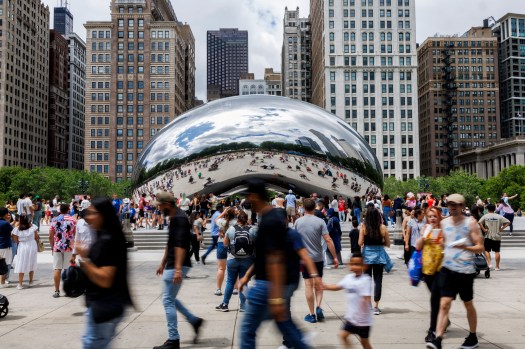
If ever there were proof that a dream can transform a city, this is it. A quarter century ago, the park rose from the site of a dirty railroad yard. Now, people come from all over to play in the fountain, listen to live music, take selfies at The Bean. It was on a street next to The Bean that I met a 37-year-old woman named Maricela. She was taking orders from the window of a taco truck.
“Grow more business,” she said when I asked for her 2050 dream, then added, “And more police surveillance.”
She explained that she lives 10 miles southwest of downtown, and someone smashed the window of her minivan.
Maricela’s parents brought her here from Mexico when she was 6 years old. The recent immigration crackdowns have scared her. She says they’ve traumatized her kids. Still, she likes Chicago and thinks it’s a great place for her children.
She paused to raise a cup of a foamy white drink — “Horchata!” she called to a customer — then turned back to me.
“The future,” she said, sweeping her hand toward the city, “is here.”
I wrote that down in my notebook of dreams.
In my notebook, I’ve collected many other dreams: More public bathrooms. A train that runs north to south on the western side of town. A citywide recreation trail that connects all of Chicago’s neighborhoods.
Impossible dreams? If you don’t dream, you won’t do. Besides, this is fun to talk about.
Talking about our dreams for Chicago is a way to connect with people, to fortify our faith in each other and the possibility that Chicago can be closer to complete.
Ask your friends for their 2050 dreams. Ask a stranger.
Let yourself believe: The future lies here.
Mary Schmich, a Pulitzer Prize-winning former Chicago Tribune columnist, is host of the podcast “Division Street Revisited.”
Submit a letter, of no more than 400 words, to the editor here or email letters@chicagotribune.com.