Imagine discovering that someone else lives at your exact address — 15 miles away.
One person lives in Chicago in the 6900 block of North Ashland Avenue. The other lives in Chicago in the 6900 block of South Ashland Avenue. Their homes share the same street name in the same city, but they exist in neighborhoods shaped by very different histories — North Ashland largely white and affluent, and South Ashland predominantly Black and long disinvested.
When these two residents meet and walk through each other’s neighborhoods together, the differences between North Side and South Side become visible almost immediately: housing conditions, neighborhood resources, commercial activity, safety, even the presence of trees.
But their conversation reveals something deeper. Segregation in Chicago did more than determine where opportunities accumulated and where they did not. It also prevented our social networks from being as diverse as the city.
In my multimedia project Folded Map, I introduce Chicago residents who live at the same address but on opposite ends of the same street. I call them map twins. When they meet and walk through each other’s neighborhoods together, the invisible lines that divide our city become glaring.
These encounters reveal with striking precision that Chicago’s disparities were not accidental. They were built into the very geography of the city.

Lines were drawn — through policy, finance and law — that determined where investment would flow and where it would be withheld. Over generations, those decisions reshaped entire neighborhoods, determining which corridors would attract capital and which would steadily lose it.
And when a city directs opportunity so unevenly, the results eventually become visible in its architecture. Chicago’s skyline is not just a symbol of ambition. It is a monument to where the city chose to concentrate its wealth and build its future.
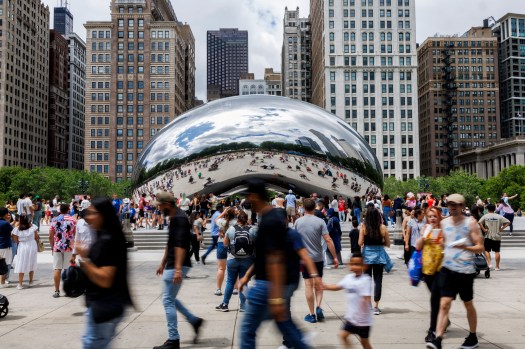
From Willis Tower to the shimmering glass towers along Lake Michigan, the skyline tells a story of aspiration and possibility. Chicago invented the skyscraper. The city protected a public lakefront that remains the envy of cities around the world. It transformed an underused rail yard into Millennium Park.
But when we look at Chicago’s skyline, we are seeing only half the story. Because there is another skyline — one Chicago never built.
This essay is part of a series developed in collaboration with World Business Chicago wherein accomplished authors envision what Chicago could and should look like in 2050.
Not necessarily a skyline of glass towers along the lakefront, but one that could have risen across neighborhood commercial corridors throughout the city’s South Side. A skyline of apartment buildings, theaters, department stores, restaurants, cultural institutions and thriving small businesses anchoring vibrant neighborhood economies. This kind of skyline grows from stable homeownership, local investment and communities able to build wealth over generations.
For much of the 20th century, many Chicago neighborhoods were on exactly that path, such as Englewood. At 63rd Street and Halsted — an intersection in a neighborhood where many tourists, transplants and Chicagoans today are told, “Don’t go,” because it’s dangerous — once stood one of the busiest commercial districts in the entire city.
At its height in the 1950s and ’60s, the corridor rivaled the energy of the Magnificent Mile. Theaters, department stores, restaurants and local businesses lined the street, drawing shoppers from across Chicago. But this corridor was slowly drained of resources by the very policies that structured Chicago’s growth — stripping wealth from Black families while preventing investment from returning to the neighborhood.
For decades, discriminatory housing policies — including redlining, racially restrictive covenants and predatory land-sale contracts — systematically extracted the very wealth from Black families that fuels neighborhood investment. Black Chicagoans were largely denied access to federally backed mortgages that helped white families build equity in homes across the city’s North and Northwest sides. Instead, many were forced into exploitative land sale contracts that offered none of the protections of traditional mortgages. Families paid inflated prices. They accumulated no equity. And if a single payment was missed, they were evicted.
This system drained enormous amounts of wealth from Black neighborhoods — wealth that could have sustained thriving commercial corridors, supported local businesses and contributed millions in tax revenue to the city. Over time, the consequences reshaped entire landscapes. Commercial districts declined. Buildings were demolished. Businesses closed. Homes were abandoned.
What we see today in many neighborhoods on Chicago’s South and West sides — the vacant lots, the disinvested corridors, the aging housing stock — is the physical imprint of policies that redistributed opportunity and investment across the city.
But cities are not fixed. They are built — and rebuilt — by the choices we make. No decision is final.
Across Chicago’s South and West sides, residents, community organizations, artists, historians and local leaders are working to reclaim the stories and possibilities embedded in these neighborhoods. They are repairing homes, preserving history, supporting local businesses and imagining new futures for long-neglected corridors.
My Folded Map project is one effort to reconnect residents of a city that has lived divided existences for generations.
These efforts remind us that the skyline Chicago never built is not just a story about the past. It is also a question about the future: What kind of city does Chicago want to become?
What would it look like if the neighborhoods long denied investment finally received it — not as charity, but as long-overdue repair?
And what might Chicago look like in 2050 if the city committed to ensuring that opportunity could rise everywhere — not just along the lakefront?
Because when we look beyond the skyline we celebrate, we begin to see the skyline that could still emerge.
Not just downtown. But across the entire city.
And if Chicago is willing to confront how its geography was shaped, it may finally begin to build the city it was always capable of becoming.
Tonika Lewis Johnson is a Chicago-based photographer and social justice artist. She was the recipient of a MacArthur Foundation “genius grant” in 2025.
Submit a letter, of no more than 400 words, to the editor here or email letters@chicagotribune.com.