
Returning from the dead, an aspiration devoutly to be wished by the living and the bereaved, permeates opera and theater. Billy Bigelow gets to come back in “Carousel.” In “The Flying Dutchman,” the captain seeks redemption in love. And in Christoph Willibald Gluck’s “Orfeo ed Euridice,” Orpheus journeys to the underworld to bring back his wife. Of course, there is a rule to be followed.
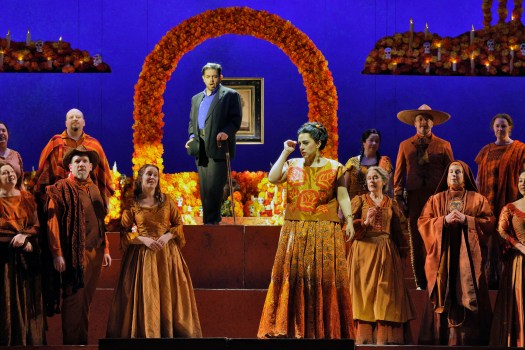
“El último sueño de Frida y Diego,” the contemporary, Spanish-language opera now at the Lyric Opera of Chicago from Gabriela Lena Frank and Nilo Cruz, begins in 1957 with the noir-clad figure of Diego Rivera, the famously tempestuous Mexican painter and muralist, sung here by Alfredo Daza, standing at the grave of Frida Kahlo (Daniela Mack) on the Day of the Dead.
The designer Jorge Ballina, whose work has not been previously seen at Lyric, imagines this location, both physical and temporal, as a portal drawn from traditional Day of the Dead iconography but also from the artwork of both Kahlo and Rivera. Rust-toned and evocative of a desert sunset that must have seemed especially apropos when this opera premiered in San Diego in 2022, the opening vista, which is filled with the ensemble of celebrants costumed eclectically by Eloise Kazan and lit with shimmering luminescence by Victor Zapatero, is absolutely gorgeous.
Rivera is still alive but morose; Kahlo, his much younger wife and fellow artist, has been dead for three years, having expired at 47 following a life of near-constant pain. The opera, which will receive a new production at New York’s Metropolitan Opera later this year, imagines a scenario where a skeletronic Catrina, Keeper of the Dead (Ana María Martínez), a figure envisioned by Rivera in his work, helps a reluctant Kahlo decide to return to life for a day.
Her old lover, Kahlo sees, is hurting and a return will mean the chance for her to paint again, free from pain. But just as Orpheus was told he could never look back at Eurydice, so Kahlo is admonished not to touch Rivera; a mere caress, she is told, will return her to the anguish of her bodily struggles.
So. She has to focus on the art, not the man.
What is most striking at first is how deftly the opera, directed here by Lorena Maza, avoids straight biography and the probing of the famously tempestuous relationship between these two great Mexican artists (who married, divorced and married again), presumably to avoid going back over territory overly familiar from stage and screen, “Frida” and all. Rather, the librettist Cruz (best known for his Pulitzer Prize-winning play “Anna in the Tropics”) looks at the relationship through a prism both expressionistic and magical realist, merging the artistic outputs of these two humans with their environments, both living and, well, dead/undead.
The plus side of that choice is to broaden the thematic scope, that’s for sure, and to forge an experience that is strikingly immersive and enveloping. The minus, for me at least, is to depersonalize these iconic figures. Often, when an opera house wants to hear them sing about their feelings, the libretto looks outwards to an external narrative context or some other kind of dreamy frame. Take, for example, a moment when Daza’s stopped-up Rivera is trying to decide what to paint, showing the artist’s human vulnerability — his own plaintive voice gets subsumed by the question being asked from outside. But that’s clearly a deliberate choice, perhaps on the reasonable ground that there has been more than enough tabloidification of these two without a new opera adding grist. Instead, Cruz and Frank create a counter-tenor character called Leonardo (Key’mon W. Murrah), an actor who impersonated Greta Garbot in life and now wanders fabulously through the Day of the Dead, adding to a formidable collage and functioning as a kind of avatar for art itself.

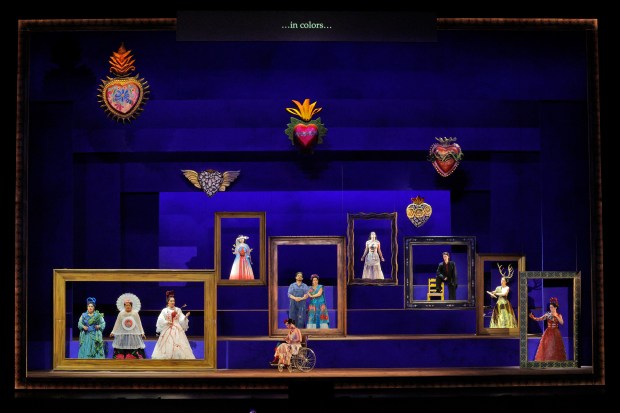
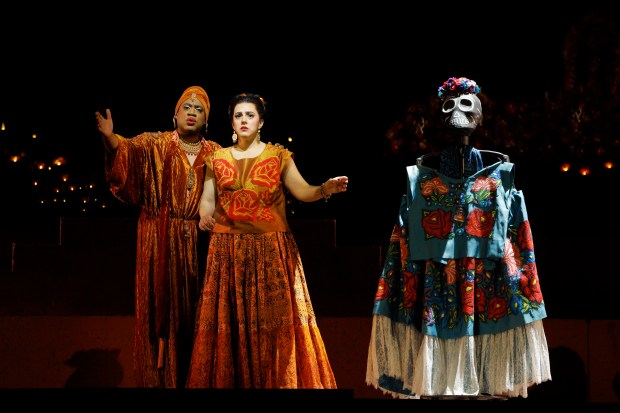
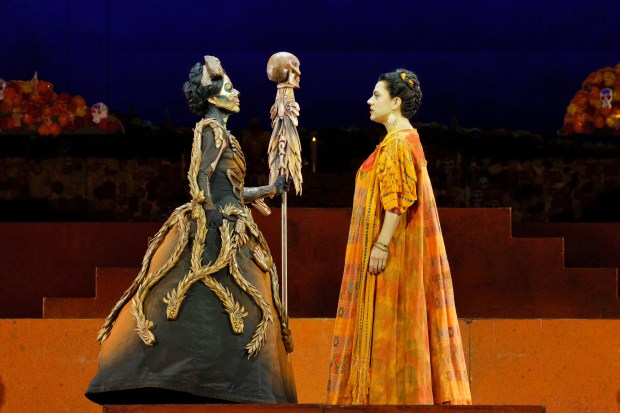
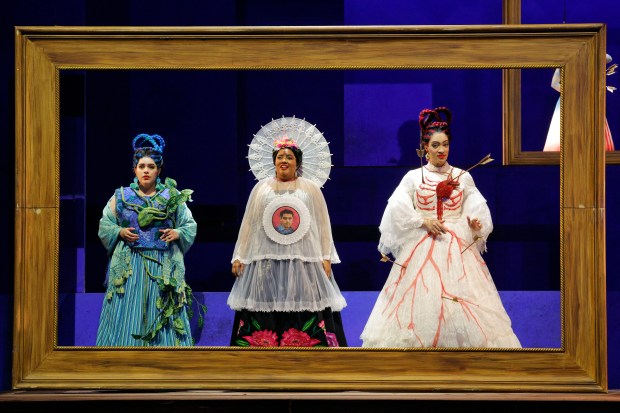
Frank’s music, conducted zestily here by Roberto Kalb, is really something to hear. Educated at the University of Michigan, Frank is the child of a Lithuanian Jew and a Peruvian mother, and thus it is perhaps unsurprising how subtly and melodically she fuses traditional orchestral instrumentation with such warm instruments as the marimba, central here. You feel like you are listening to something both unique and yet remarkably organic; it not as if the folkloric has been globbed on, if you know what I mean. Frank’s musical vocabulary, especially as instruments like harp, xylophone and mariarchi-like brass are added, is frequently transfixing. One might close one’s eyes for a second and listen to all of its sometimes spooky colors, picking them out like little jewels, somehow both culturally specific and universal. You are unlikely to have heard quite the like.
Lyric Opera’s ‘El último sueño de Frida y Diego’ goes beyond Fridamania
This emphasis on the whole means that the two leading performances are to some degree subsumed by the whole and should be appreciated in that context; Mack vocally captures Frida’s longing as well as her ambivalence about a potentially painful return to life, while Daza evokes Rivera’s weariness and, more importantly, captures the complications of an artist trying to work through loss, an experience familiar to many. The two performers did not seem especially connected, emotionally, and there is not so much sense of mutual need. But then that is really not the point of an opera interested not so much in a pair of famous painters, even if that is the initial draw, but in the mortality of artists, the way in which the corporal and the psychological impact their work and the vivid, cumulative tapestries they come to both to create and inhabit. Especially after they are dead.
Chris Jones is a Tribune critic
cjones5@chicagotribune.com
Review: “El último sueño de Frida y Diego” (3.5 stars)
When: Through April 4
Where: Lyric Opera House, 20 N. Wacker Drive
Running time: 2 hours, 20 minutes
Tickets: $58-$379 at 312-827-5600 and lyricopera.org/frida