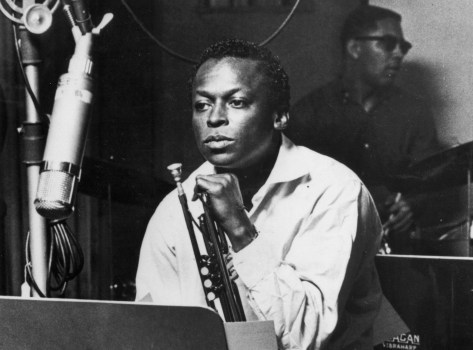

Miles Davis may have been one of the world’s most celebrated jazz bandleaders at the time, but he didn’t know what to expect — I mean, really didn’t know what to expect — when his “second great quintet” arrived in Chicago for a late December 1965 engagement at the Plugged Nickel club in Old Town.
For one, he didn’t know that on the flight to Chicago, wunderkind drummer Tony Williams, a Chicagoan who had turned 20 that month, made a suggestion to his bandmates that could be considered brilliant, inspiring and/or mutinous. The quintet had recorded its first album — the boundary-pushing, all-originals “E.S.P.” — earlier in 1965, yet continued playing live sets dominated by standards, as audiences expected at the time. Tired of performing the same songs in the same ways, Williams instructed pianist Herbie Hancock, tenor saxophonist Wayne Shorter and bassist Ron Carter to make “anti-music” on stage instead.
“He wanted us to promise that during our sets at the Plugged Nickel, whatever anybody in the band had expected us to play, we would play the opposite,” Chicago native Hancock recalled in his 2014 memoir “Possibilities.” So, for instance, when the music seemed to be surging toward a climax, it would grow quiet — and when it felt like it was slowing down, it would roar to life. “Some people have suggested that Tony was trying to sabotage the band by doing this, but really he was only trying to sabotage our comfort level, to break us open again.”
No one told Davis — who was working himself back into physical shape after undergoing hip surgery in April and breaking his leg in August — about this change in approach. And no one told the band that the club would be outfitted with microphones because Columbia Records intended to record the sets for eventual release. At that point, Hancock wrote, he wondered whether they should proceed with their experiment, but Williams was steadfast: “Hell yes. Let’s do it.”
The result is considered one of jazz’s legendary live engagements, and all seven sets performed on Dec. 22-23 can be heard on “The Complete Live at the Plugged Nickel 1965,” a 10-LP/eight-CD box set spiffed up and rereleased earlier this year by Columbia. The recordings were previously available in similarly configured LP and CD sets on the Mosaic label back in 1995.
This new release ties into the larger Miles Davis 100 campaign marking the centennial of the trumpeter’s birth on May 26. Symphony Center is presenting a “Miles Davis at 100” program March 27, featuring Cuban pianist Gonzalo Rubalcaba playing a solo piano tribute to the composer/bandleader, plus a performance by Unlimited Miles, a sextet led by keyboardist John Beasley.
Vince Wilburn Jr. not only played drums with Davis in the 1980s but is also his nephew who works on the late musician’s rerelease campaigns. Wilburn grew up in Chatham and has vivid memories of his mother’s brother’s visits to the South Side.
“When my mom would get me a haircut, get me a new outfit. I knew Uncle Miles was coming to town,” Wilburn said in a recent conversation from Italy.
Davis grew up in East St. Louis, Illinois, and “loved coming to Chicago,” Wilburn said, so it was logical that he would choose the city for the band’s Christmastime 1965 shows. Wilburn actually saw Davis’ band play the Plugged Nickel, though having been born in 1958, he was too young to recall many details.
“It was super small, from what I remember,” Wilburn said of the club, which was located at 1321 N. Wells St. “It was the bar; I think the stage was right there. So it’s very intimate.”

Former Tribune jazz critic Howard Reich, writing about Mosaic’s Plugged Nickel box set in 1995, noted that the long-ago-shuttered club “had all of 10 tables and could hold a standing-room-only crowd of 100.”
So those clubgoers were close to the musicians, and vice versa.
“Whenever I glanced into the audience, I saw what looked like confusion on people’s faces,” Hancock recalled. “They knew something was happening, but they weren’t sure what. So they just kept on drinking cocktails and smoking cigarettes, and we kept on playing as the recorders rolled.”
What those audiences heard — and what listeners to the box set can hear now — is “a new musical language as it is being created and refined,” Reich wrote. “Though Davis clearly was following Ornette Coleman’s lead in pushing past traditional chordal vocabularies, he and his band were doing so with an elegance and a sonic beauty all their own.”
Wilburn said he would have conversations with members of the quintet, such as “Uncle Ron” and “Uncle Wayne,” about playing with his actual Uncle Miles.
“Ron Carter said they were like in a lab, and Uncle Miles was the head chemist,” Wilburn said. “And they were just trying new formulas every night. So they would always play the unexpected of what was supposed to be played. It’s like living on a tightrope. That’s what Uncle Wayne used to say.”
Part of what is striking about this music is how differently the band would play the same song from set to set, such as the equally experimental yet wildly contrasting takes on Frank Loesser’s “If I Were a Bell” kicking off the first sets of each night. Davis may be the marquee name, but he gives the other musicians plenty of room to take the reins, with Shorter in particular a dominant presence.
Reflecting on the Plugged Nickel performances today, Reich said they’re ripe for rediscovery.
“Though so many of Miles Davis’ recordings are justly revered, his ‘Plugged Nickel’ sessions have been unjustly overlooked and underappreciated,” the jazz critic said. “For on these recordings, we hear Davis and colleagues not just reviving standard tunes but inventing new ways of addressing them. Even today, the ‘Plugged Nickel’ tracks sound fresh, daring and alive — indispensable documents of a visionary artist in the moment of discovery.”
Davis’ musical evolution kicked up a notch after the Plugged Nickel gigs, as he and that quintet continued pursuing their more open-ended approach on the 1966-68 albums “Miles Smiles,” “Sorcerer,” “Nefertiti,” “Miles in the Sky” and “Filles de Kilimanjaro.” The mesmerizing “In a Silent Way,” from 1969, launched Davis’ electric period, with such head-spinning classics as “Bitches Brew,” “Jack Johnson” and “On the Corner” to follow.
By the time Wilburn began playing with Davis on the 1980 comeback album “The Man with the Horn,” the drummer’s job was to hold down more of a funk beat rather than to play with the innovative abandon that Williams brought to the table. Wilburn now covers more of that 1960s and 1970s exploratory ground in Miles Electric Band, an all-star Davis alumni ensemble that will play Pritzker Pavilion in Millennium Park on Sept. 5, Wilburn said.
The Miles 100 campaign will continue as well, with packages of live and previously unreleased material on the way, Wilburn said. He hopes that listeners will approach the music in the same spirit of adventure that the late trumpeter did.
“Whichever period of Uncle Miles’ career that you dig,” Wilburn said, “just be open.”
Mark Caro is a freelance writer.