
The wildest thing about the deadly March 10 storm that wrecked Lake Village and Aroma Park, Illinois can’t be proven, but it likely will still make the history books.
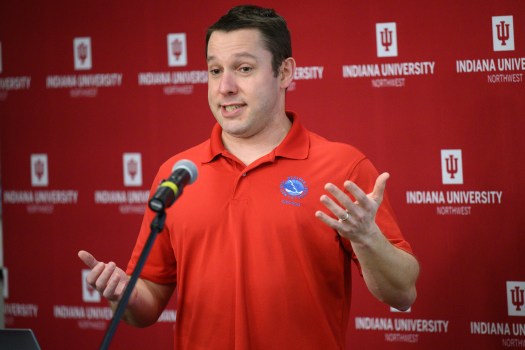
The EF-3 rated storm, which killed a Lake Village couple, will be remembered for its destruction, National Weather Service Meteorologist Ricky Castro said after a presentation he gave at Indiana University Northwest Thursday evening. But the record-holder of the storm was its hail, of which the largest chunk measured in at eight inches in diameter, he said.

Unfortunately, the giant offender wasn’t brought to a refrigerator in time to preserve it for measuring, but with other hailstones averaging six and seven inches, the agency will likely certify it as a record, Castro, who works out of the NWS’ Romeoville office, said; that size hail isn’t normal in the first place, but this early in storm season is unheard-of.
“The hail was most unusual because March is less volatile (in terms of storm intensity),” Castro said. “To get a storm of that magnitude is more likely in Tornado Alley than here.”
The Lake Village storm was also different in that it was a “wedge” storm, which is wide and often associated with EF-4 and EF-5 scaled tornadoes, he said. What makes them more dangerous than a “funnel” storm is that there are cells within the main wedge cell wreaking their own havoc.
“Severe storms can change very quickly and produce microbursts as well,” Castro said.

Castro, who came to talk about the Lake Village tornado and all things storm-related on behalf of Lake County Homeland Security and Emergency Management, gave attendees a crash course in preparing for the Midwestern storms that are becoming more intense as years go by.
An important part of the equation, he said, is not giving weight to the lingo and instead paying attention to the colors and numbers on the radar before deciding how to proceed in a storm.
“We’re not the sole proprietors of scaling terminology, but when you look at it, an “enhanced” chance is not worse than a “moderate” chance,” he said. “If you’re confused, look at the numbers: 1/5, 2/5, 3/5, 4/5 and 5/5.”
Castro also recommended that people grab themselves a battery-powered weather radio as well as making sure their cell phones are set to broadcast Weather Emergency Alerts. While not 100% foolproof since storms don’t discriminate against radio towers, they could be helpful if the power goes out.

If you live in a mobile or prefab home, Castro advised to get out and find a safer dwelling at the tornado-watch level and to not rely on a municipal siren system because each municipality could have a different metric for when to sound the alarm, and if the storm’s within 10 miles, you may not have enough time to react. And for those who’ve been taught to seek the lowest point they can find if they’re trapped outside, don’t do that, he said.
“Low points can fill up quickly with water, and we’ve found people drowned,” Castro said.
Lake County Homeland Security and EMA Executive Director Robert Walker said Thursday’s presentation was the second the agency has hosted for people. The storms are getting worse, so people need to start taking them seriously.
“We have to learn from these incidents, especially to help underserved people,” Walker said. “How’re we going to deal with heat again and the weather going from this to that? And we have to get our politicians to figure out their parts, too.”

Walker’s wife, Rosemary Walker, said she ordered herself a weather radio as she was listening to the presentation. She may not have understood all the jargon Castro used, but she was able to follow along.
“We have cameras all around our house, so I watch the trees, and I kind of know how to look at the radar and see if something’s coming our way,” Rosemary Walker said. “I do worry about our aging population and how they’re able to protect themselves.”
Michelle L. Quinn is a freelance reporter for the Post-Tribune.