
Questioning by U.S. Supreme Court justices fell along partisan and ideological lines Monday during oral arguments in a case that could upend mail voting practices in Illinois and more than two dozen other states over whether ballots cast by Election Day can be counted afterward.
The case brought by the Republican National Committee challenges a Mississippi election law that allows ballots cast by Election Day to be counted up to five days afterward. Illinois election law is more generous, permitting ballots postmarked or attested to by the voter as cast by Election Day to be counted for two weeks afterward.
The dispute turns on competing readings of the U.S. Constitution, which assigns states authority over “the times, places and manner of federal elections” but grants Congress the power to override those rules. That authority has taken on renewed relevance as President Donald Trump and Republican allies press for the Safeguard American Voter Eligibility, or SAVE America Act, which is stalled in the U.S. Senate.
Each side in the case before the high court agreed that Congress has the authority to regulate elections, starting with the 1845 law that set a uniform date for selecting presidential electors as the Tuesday after the first Monday in November.
Scott Stewart, Mississippi’s solicitor general, defended the post-Election Day ballot-counting law, saying Congress did not block the counting of late-arriving ballots with its uniform election date.
“The Election Day statutes adopt a simple rule — states must make a final choice of officers by Election Day. That is the plain meaning of an election,” Stewart said. “If Election Day must be what it was in 1845, that takes out much more than the ballot receipt laws of 30 states today. It dooms absentee voting, modern methods of voting, the secret ballot and more.”

“The key,” Stewart argued, “is that the Election Day is the day by which a final choice electorate-wide must be made. It can’t be made after that day by voters or the electorate as a whole. But individual selections can surely be made before that day because there’s still no final choice until you have an electorate-wide deadline.”
But Paul Clement, a prominent conservative election lawyer arguing for the RNC, said there was an “unbroken historical tradition” running from “at least 1845 to 1914” with no state having a ballot receipt deadline other than Election Day.
“If we’re going to do original public meaning and, yes, Congress could fix this either way. However you decide this case, you’re not going to have the last word. Congress is going to have the last word,” Clement told the justices. “But if we’re going to take original public meanings seriously, I think the reason Congress hasn’t revisited this is because it doesn’t have to.”
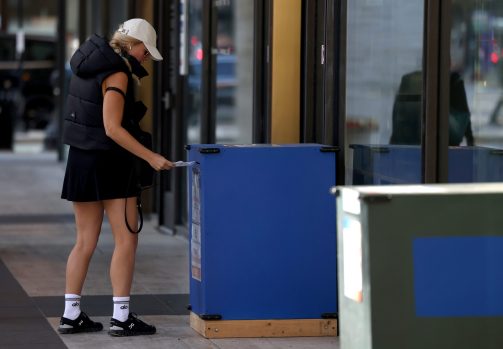
Clement noted that the main Chicago post office, “when all the other polls close in Illinois or every other state,” is “still open till midnight.”
“Now I’m not here to say that there could ever be voting fraud in Chicago,” he said as some justices chuckled, “but there’s the possibility that there’s a four-hour window where people could go get their ballots, absentee ballots, postmarked after all of the returns are in, and they know that” could “turn the result.”
Justice Samuel Alito acknowledged the court doesn’t “have a whole lot to go on here” except the phrase “Election Day” and historical practice.
“We don’t have Election Day anymore. We have election month or we have election months. I mean, the early voting can start a month before the election. The ballots can be received a month after the election,” Alito said.

Alito and other members of the conservative-led court questioned whether it should act “for the purpose of combatting fraud or the appearance of fraud.” They noted some friend-of-the-court briefs favoring overturning the law argued that “confidence in election outcomes can be seriously undermined if the apparent outcome of the election on the day after the polls close is radically flipped by the acceptance later of a big stash of ballots that flip the election.”
But Stewart, the Mississippi solicitor general, replied that “there has not been much of a showing about actual fraud from post-Election Day ballot receipt.”
“You know if Congress has not spoken to something, especially in this context where states are expressly empowered to regulate these things, that’s a big point in favor of letting states continue to do so, as they have for a century,” Stewart said.
Justice Sonia Sotomayor said, “If there is a policy question to be had, the entities to decide that are the states and Congress, not the courts. And absent a law, in federal law, that suggests that absentee ballots must be received by a certain time, there’s no explicit requirement of that.”
And Justice Ketanji Brown Jackson contended Congress was “obviously aware” of states’ post-Election Day ballot counting and “they have not spoken to it” and “have not specifically precluded it.” If lawmakers believed the 1845 statute settled the issue, she suggested, they would not now be considering legislation that would sharply limit mail voting.
Arguing for the RNC, Clement said a ruling for the Republicans would not affect early voting and would apply only to federal general elections, not state primaries. But such a decision could create a dual system of voting policies and practices for the primary and the general election. He also said existing federal laws protect the counting of late-arriving ballots from military personnel stationed overseas.

States across the nation have expanded vote-by-mail options, largely due to concerns raised during the COVID-19 pandemic. In Illinois and elsewhere, it has become a powerful get-out-the-vote tool as Trump has encouraged Republicans to vote in person on Election Day and has claimed, without proof, that mail voting is rife with fraud.
The SAVE America Act pending in Congress would require proof of citizenship to register and identification to cast a ballot, while also restricting mail voting in federal, state and local elections. Despite Trump’s support, its prospects for passage in the Senate have been held up by Democratic threats of a filibuster that the GOP majority can’t break.
Clement, a former U.S. solicitor general during Republican President George W. Bush’s administration, also represented the conservative legal organization Judicial Watch in the Mississippi case. He’d also represented downstate Republican U.S. Rep. Mike Bost in another case before the high court, which overturned lower court rulings and found Bost had standing to proceed with a federal legal challenge to Illinois’ post-Election Day ballot-counting law.
A ruling in the Mississippi case is expected as soon as June, and Clement said “there’s plenty of time” for states to adapt to the high court’s decision before the Nov. 3 general election.