
With debate underway at the federal level about legislation that would require stricter voter registration rules, Kane County, too, has joined the conversation about providing proof of United States citizenship in order to register to vote.
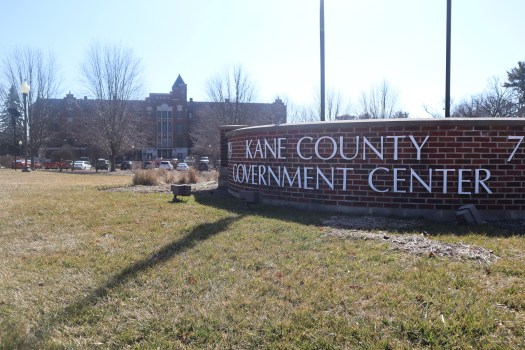
Last week, at a meeting of the Kane County Board’s Public Service Committee, a measure expressing support for the federal Safeguard American Voter Eligibility Act was floated — but ultimately got shot down by committee members.
The Safeguard American Voter Eligibility Act — also known as the SAVE America Act — would require Americans to prove they are United States citizens before they register to vote and to show identification at the polls, among other things, according to the Associated Press.
Last week, Senate Republicans launched a discussion of the legislation, which has the backing of President Donald Trump, who has said Republicans need the legislation to win in the November midterm elections. It passed the House of Representatives earlier this year, but is expected to eventually end in a failed vote by the Senate.
Federal law already stipulates that voters in national elections be U.S. citizens, but the proposed legislation would lay out strict new requirements for voters to prove their citizenship status. It would also create new penalties for election workers who register voters without proof of their citizenship, and it would require states to share voter data with the Department of Homeland Security so federal officials could screen for voters present in the country illegally.
Democratic lawmakers have been staunchly opposed to the legislation, saying it would disenfranchise millions of American voters who don’t have birth certificates or other documents readily available — both Democrats and Republicans.
The measure floated in Kane County essentially expresses support for the stipulations of the federal legislation, and for a similar bill approved by the House last year that sought to clamp down on fraudulent voting, particularly among non-citizens.
At the board’s Public Service Committee meeting on March 19, several residents spoke critically of the board’s consideration of the measure, including League of Women Voters of Central Kane County Co-President Patti Lackman.
Lackman, noting that it is already illegal for non-citizens to vote in federal or state elections, said requiring documentation proving citizenship “is unnecessary and seeks to divide us.”
“It simply creates another barrier to voting,” she said, pointing to groups like married women and other Americans who have changed their names and those who lack physical documents like birth certificates or passports.
Board member Jarett Sanchez, the Public Service Committee chair, indicated that the measure had been brought forward by board member David Young, and, in introducing the discussion, said it is important to have “conversations on important issues that can be divisive, that people have big disagreements on, and allow whatever the truth amongst the people is to rise up.”
The idea of some sort of proof of citizenship requirement in order to vote gained some traction among a few board members.
Noting that he thinks it’s unlikely the federal legislation will pass, board member Jon Gripe said he appreciated that the conversation was being facilitated in Kane County, and pointed to other countries’ voting requirements.
Board member Clifford Surges said he is “not in full-on support of this particular item,” but said he’s previously brought forth a similar question about how a voter’s citizenship can be verified when casting a ballot. He indicated support for some mechanism for proving citizenship, comparing it to things like flying on a plane or gun control.
Though acknowledging that it “might seem over the top,” Surges said he doesn’t think “the thought process or the expectation of being able to prove citizenship is unworthy.”
Young, who brought forward the measure, defended it by saying that registering to vote currently requires “absolutely no proof that you have to be a citizen.” While it’s “definitely true” that someone in the United States illegally voting will be deported, Young said, there exists a “loophole that you can … easily get around.”
Other board members, however, were more opposed, with Anita Lewis, for example, saying she was “disappointed in this board that (they’re) even talking about this.”
“Here at Kane County, we have a lot of things that we should be dealing with — we have budgets, we have our jobs, we have economic development, we have mental health,” Lewis said. “And we’re here putting forth a resolution about a federal act that has not even been voted on yet.”
Board member Michelle Gumz took a somewhat different tone about the discussion.
“The democratic norm is to allow the opposition to share what they think,” Gumz said.
But she remained critical of the measure itself.
“The principles of Republican ideals is small government,” Gumz said. “This is not small government. … This is a MAGA bill.”
Gumz also said that the federal bill, if passed, would “shift costs … to your local government” in the sense that the county would likely have to enforce the legislation without receiving additional funding to do so.
“I’m tired of looking for the monster under the bed,” board member Verner Tepe added, calling the measure “nothing but a waste of time and (an) attempt to put things on the agenda that have nothing to do with running the county.”
Gripe said he was likely going to vote against this particular measure, but noted there have been other examples of the county board in the past voting on measures that he “didn’t think were the county’s business,” but that he still voted on them because “that’s what these people deserve.”
“When we start saying, ‘Well, you know, this isn’t something that I’m passionate about, so we’re not going to talk about it,’ that’s a big mistake,” Gripe said.
Responding to some of the pushback, Young suggested that the matter is not a state or federal issue but is “about us participating in Kane County.”
As discussion went on, Gripe suggested the resolution could be amended to “make it less about the SAVE Act and more about … doing the right things in Illinois.”
But Sanchez, saying he was not in favor of resolutions that are “essentially just symbolic,” suggested the matter could instead be taken up with the county’s lobbyist.
Ultimately, the measure failed to secure the needed support from the committee, with Young voting for the measure, Gripe and Surges abstaining, and Gumz, Lewis, Tepe and Sanchez voting against it.
The Associated Press contributed.
mmorrow@chicagotribune.com