
Just days after U.S. Immigration and Customs Enforcement officers flooded into the Chicagoland area as part of last fall’s 64-day immigration raid, Operation Midway Blitz, Skokie Village Board members moved swiftly to amend their village code.
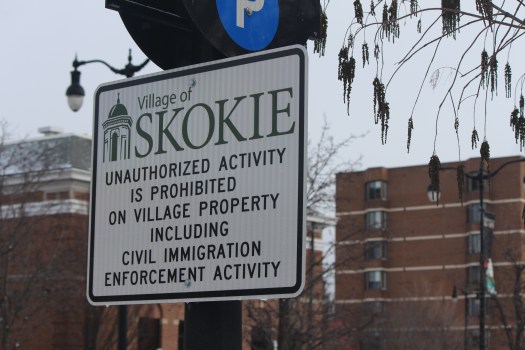
After dozens of protesters rallied outside Skokie Village Hall urging action to rein in ICE, the Village Board unanimously voted on Nov. 3 to codify their stance on immigration operations.The amended code clarified to village residents and the public that ICE agents were prohibited from using any village-owned property for civil immigration enforcement without a proper warrant.
With a resurgence of fear among residents that ICE could resurface in Chicago and the north suburbs months after their departure, the Village Board has moved in recent weeks to discuss a new ordinance, one meant to “answer questions that were still left hanging,” Trustee Gail Schechter told the Pioneer Press at the March 16 Committee of Whole meeting.
As the primary supporter of the draft ordinance, Schechter has also said in prior Board meetings that the legislation would provide Skokie police with additional guidance on how to respond to federal immigration officers if and when they return to the area.
But the Skokie Police Department has reservations about the ordinance, a position Chief Jesse Barnes made eminently clear at the March 16 Committee of the Whole meeting alongside Deputy Chief Denise Franklin and Deputy Chief John Oakley.
“We as a Village and a police department have the responsibility to make sure that we do not enact ordinances, policies, procedures that are going to put our people in either civil peril or criminal peril,” Barnes said at the meeting.

“In this situation, impeding a federal operation can result in a prison sentence, being charged criminally [or] federally… impeding an operation would potentially trigger us having to put someone on administrative leave,” Barnes added. “If they’re convicted of a felony in the condition of their duties, they would lose their pension and ultimately their career.”
Barnes clarified in a formal response memorandum to the Board that as an accredited agency, the Skokie Police Department’s policies and procedures are vetted by “external accreditors to ensure compliance with industry best practices and state and federal law.”
In the draft ordinance, Barnes said at least 15 of the Skokie Police Department’s existing policies will be affected.
The department’s 1,400 page policy manual is meant to be “broad,” Barnes said in the memorandum, to provide guidance for officers who handle hundreds of different kinds of calls and services.
“We feel strongly that our current policies, along with state law, adequately address how our staff should interact with federal agents conducting immigration enforcement,” he wrote.
Rather than through the adoption of a new ordinance, the memorandum recommended additional guidance be provided through an updated “comprehensive training bulletin” as a reference for local law enforcement.
Barnes wrote that he has worked with the department to “prepare such a bulletin ” and compiled the documents needed for trustees to gain a more thorough understanding of police protocol.
Skokie’s Corporation Counsel Steven Elrod addressed apprehension over the ordinance by reaffirming Barnes’ position.
“My concerns, from a legal perspective, is that the ordinance does set individual police officers up for conflict at a constitutional and statutory level,” Elrod said.
“There are provisions of this ordinance that would be in violation of the Supremacy Clause, and I think that there are provisions of the ordinance that would be in violation of the Illinois Trust Act.”
The Supremacy Clause, written in Article VI, Clause 2 of the U.S. Constitution, clarifies that federal law takes precedence over conflicting state or local laws.
In this case, having a clause that utilizes terms like “shall” and “will” imposes an obligation to local police to take action in instances in direct conflict with several tenets of constitutional law, Elrod added.
“I don’t want to dissect the ordinance, it was done, I know, in great, extreme good faith, and so I appreciate that. But I also am just tremendously impressed with what already exists in our books that the ordinance was attempting to get at,” he said.
Sections of the draft ordinance direct local law enforcement to take explicit action while arriving at the scene during or after federal immigration enforcement.
Section 8, one of the more disputed clauses, orders that local law enforcement “must respond, intervene, document, or take action” regardless of “federal authority, interagency courtesy, federal supremacy claims, or directives from federal agents.”
Other sections specify that if local law enforcement officers witness or are informed of conduct by federal agents that “appears to constitute unlawful or excessive force,” local law enforcement should take “reasonable steps within their lawful authority” to prevent the federal agents from causing ongoing harm, including verbally directing them to provide justification for their actions, recording their responses and recording their use of force through body-worn cameras.
“The Village has appointed a full-time professional Village manager to handle the day to day operations of the public works department, the fire department, and, as we’re talking about here, the police department,” Elrod said. “It would, in my opinion, be inappropriate for the Village Board to ordain or to adopt the law, an ordinance, directing the police department how to act.”
Neighboring cities including Evanston and Chicago have established their own “ICE-free zones” following city-wide federal immigration raids last fall, but the resolutions are largely symbolic given the establishment of the Illinois Trust Act, which prohibits local law enforcement from aiding federal immigration officers in civil arrests.
Following the Board’s discussion, several Skokie residents voiced their own concerns surrounding how local police can respond to protect residents’ rights.
“When Broadview started being guarded by state and local police, that again eroded trust in local law enforcement. We did not receive any notification if Skokie police officers were deployed,” said Christopher Whitaker, a Skokie resident.
“There are events that have been out of the Skokie Police Department’s control, and I sympathize with this situation,” Whitaker added, “but because of these actions, trust has eroded with the police departments. That’s not just here, that’s everywhere…if you can’t protect us, then clear the streets.”
Mayor Ann Tennes concluded the meeting by confirming the Board’s intention to work with Barnes and the Skokie Police Department on several “communication pieces,” in relation to the proposed ordinance, in addition to sending letters to the Village’s federal partners to describe the situation, asking them to “step up.”
A date for future Board discussion on the proposed ICE ordinance has not yet been determined.