
The city of Aurora has adopted strict new regulations on data centers, which set standards around energy and water use plus noise and other emissions.
The regulations were approved by the Aurora City Council after roughly four hours of public comment and discussion at a meeting on Tuesday, ending a months-long pause on data center and warehouse developments in the city.
Previously, Aurora categorized data centers as warehouses so had few restrictions around them, but an influx of data center proposals along with residents’ concerns about existing facilities prompted the city to stop accepting new applications until new rules could be developed.
Under the city’s newly-passed rules, future data centers will be held to strict energy efficiency, water efficiency and noise emission standards, plus will be required to produce a number of studies and reports around these issues. Unlike before, City Council now has the ability to approve or deny proposed data center developments.
All data centers within Aurora, including those already built, will be required to submit annual reports around power use, water use, noise and the storage of biometric data. Aurora currently has five data centers within city limits, with another five in development, according to a city news release about the new regulations.
“These innovative ordinances will help establish significant safeguards for our residents and the environment moving forward,” Aurora Mayor John Laesch said in the city news release.
As Aurora has been researching and developing these regulations, which the press release called “first-of-its-kind,” similar conversations have been happening at the state level.
The POWER Act, which has some similarities to Aurora’s new regulations, was introduced to the state legislature earlier this year. In the city’s news release, Laesch urged the state to follow Aurora’s example and pass the Act, which he said will “assist Illinoisans who are suffering from high electricity bills, while helping to enhance quality of life for communities across the state.”
The Illinois Clean Jobs Coalition, which helped introduce the POWER Act, applauded Aurora for “setting the bar high.”
“Unfortunately, these protections are not uniform statewide,” the organization said in its own news release. “Every community across the state deserves protections that make Big Tech pay their fair share, protect our water and keep pollution out of vulnerable communities.”
The Illinois Commerce Commission also recently approved a proposal by ComEd that requires higher deposits from data center developers to protect against projects that fall through.
Meanwhile, artificial intelligence companies are threatening to take their most advanced data centers elsewhere if the state doesn’t weaken certain privacy laws that Aurora has now duplicated through its new regulations.
Battles around specific data center developments have also been playing out across the Chicago suburbs in recent months.
In January, the Naperville City Council rejected a proposed data center development through a similar process to what Aurora has just put in place. Earlier this month, the Yorkville City Council approved a controversial data center after several hours of meetings. And last week, Joliet approved what is set to be the state’s largest data center.
Each of those projects saw significant pushback from local residents.
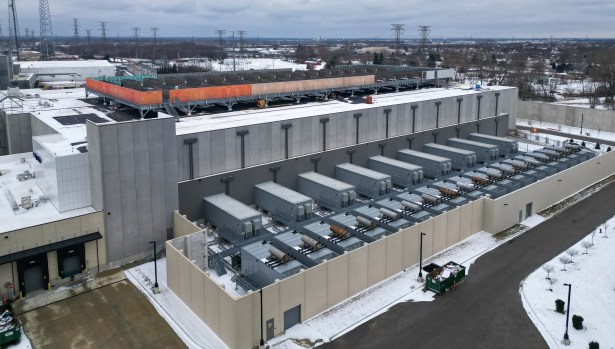
Although Aurora officials have said the regulations are the most strict in the state, and among the strongest in the country, residents who have spoken at recent city meetings called for them to be even stronger. Some of these people live near the existing CyrusOne data center, located at the corner of Eola and Diehl roads on Aurora’s far East Side near Interstate 88, which has been at the center of complaints around noise.
Residents’ advocacy around this issue is one of the reasons Aurora has been working to create these regulations, city officials have said. Although the new rules don’t directly address residents complaints about the existing data center, the city and CyrusOne have been working together to deal with the ongoing noise issues.
Repairs made to that data center in April required the use of backup generators for many days straight, which caused consistently loud noise in the surrounding area that residents called “unlivable” and “horrible.” Since then, CyrusOne has been regularly meeting with residents and working toward mitigating the noise from those generators and from rooftop cooling units that residents say are also having an impact on their quality of life.
Permanent measures have been put in place to block the sound from the backup diesel generators, which are tested regularly and used during power outages. Temporary measures were put in place for the rooftop chillers, with permanent solutions planned to be completed later this year, company officials said at a community meeting in mid-January.
And, in October, the city of Aurora signed an agreement with CyrusOne that set a timeline for the company to continue addressing residents’ noise concerns.
The ongoing sound issues at the CyrusOne facility were frequently mentioned during discussions of the newly-approved data center regulations, not only by residents impacted but also by city officials, although the latter tried to not directly name the company.
Several amendments to strengthen the regulations based on residents’ concerns were proposed by Ald. Shweta Baid, 10th Ward, who represents the area that currently holds all of the city’s data centers. She failed to convince the other aldermen of her proposals.
One of Baid’s proposals, which was to mandate data centers be built no less than a half-mile away from residential and other sensitive uses, would have likely created legal challenges for the city, according to staff. Aurora Chief Development Services Officer John Curley has said that the regulations proposed by city staff were the most strict they could possibly be, and at least as strong as other communities’ restrictions, while still being legally defensible.
Under the newly-adopted rules, only a handful of places in the city could even qualify for data center development, Curley said on Tuesday.
Although some Aurora residents have called for the city to outright ban new data centers from coming to the city, that is against state law, Aurora Corporation Counsel Yordana Wysocki has said. So is creating such tight restrictions that a certain type of development is effectively impossible to build within city limits, she previously said.
The city’s Planning and Zoning Commission recommended that the regulations limit data centers just to the city’s heaviest industrial areas, but city staff pushed back against the idea, saying it would effectively ban data centers because of required setbacks from residential areas. Baid made a similar proposal at Tuesday’s City Council meeting, but it was not included in the final regulations.
The Aurora City Council did, however, unanimously vote to strengthen noise limits beyond what staff originally recommended.
Under the new rules, data centers will not be allowed to produce sound louder than 56 decibels during the day or 46 decibels at night, as measured at the facility’s property line, and the city would require data centers monitor their sound around the clock. Staff were proposing the limit be 59 decibels during the day or 49 decibels at night, which they had already made stricter than what had originally been recommended earlier in the process.
The regulations also do not allow data centers to install roof-mounted chiller units within 1,500 feet of residential, educational or hospital uses. Similar space requirements are set for ground-mounted chillers and backup generators, which will need to be at least 1,000 feet away from residential, educational or hospital uses.
These distances are at least double what city staff have found other communities to require, Curley has said.
With the approved setbacks and minimum noise limits, Curley expects the noise to be 32.5 decibels at nearby residential lots during the day and 22.5 decibels at night, he said on Tuesday. His presentation showed these daytime levels to be roughly equivalent to a quiet rural area, while nighttime levels would be at the sound level of a whisper or rustling leaves.
But, as Curley and residents have pointed out, that sound could be constant and could be compounded by other noise in the area.
Under the new regulations, both chiller units and generators will be required to have sound walls around them, similar to what is now built at the CyrusOne data center. Plus, rooftop generators will not be allowed, and limits were placed around generator testing.
Incoming data centers will be required to do sound studies and modeling at several points in the development process. This will include a baseline sound study before anything is built on the site, a sound modeling study showing that the planned data center will not go over maximum sound levels and a study of the sound the data center actually produces once it is built.
The city will have control over when and how these tests are done, Curley said, and additional studies will be required if the data center sees major renovations or adds new sound-producing equipment.
Strict limits were also set on data centers’ vibration emissions, which also have reporting requirements. Residents living near the CyrusOne data center have said they could feel vibrations within their homes that they believed were coming from the facility.
If a data center is shut down and the building is set to become something else, the data center’s owner will be required to remove all obsolete equipment like chillers and generators from the site.
The regulations will also require new data centers to meet certain energy efficiency levels, to provide energy modeling reports before they can be approved and to follow a number of established energy codes.
Plus, new data centers will be required to either have renewable energy generation on-site, enough to power 25% of the facility at peak demand, or battery storage with the capacity to power up to 50% of the facility for 15 minutes, which is to stabilize the energy grid and help during brownouts. If neither are possible, data centers can simply buy renewable energy credits.
As for water, the regulations set a similar efficiency standard to energy usage and ban evaporative cooling using drinking water. Modeling and ongoing reporting around water usage will also be required.
While performance regulations around water, electricity and noise only apply to new facilities, all data centers within the city will be required to submit annual reports around these three issues. Aurora’s current data centers have agreed to comply with these annual reporting requirements, city officials previously said.
Aurora has also put in place what is basically a copy of the state’s Biometric Information Privacy Act, which are the privacy restrictions that some in the data center industry are pushing for the state to weaken.
While Aurora’s rules don’t add to what is already protected under state law, they do create local protections in case the state repeals its restrictions, Aurora Director of Sustainability Alison Lindburg has said. Like the annual reports, these privacy protections will apply to all data centers in the city, new and existing.
Some penalties are built into the proposed regulations, but Curley has also said that new data center developments, as a part of the approval process, will be required to enter into agreements with the city that set fines and make it easier for the city to enforce the proposed provisions.
Along with the data center regulations, which are included within two new chapters to city code plus changes to both zoning and building codes, city staff also used the opportunity to make some comparatively minor changes to the warehouse regulations. Since data centers used to be classified as warehouses, something the new rules change, warehouse developments have also been largely paused as city staff developed the regulations.
The Aurora City Council near-unanimously voted for all four parts of the regulation package. Baid was the lone vote against certain parts that she proposed changes to.
With the package now approved, the city’s 180-day moratorium on data center and warehouse developments has ended. That temporary pause was put in place by the Aurora City Council last September and was set to expire on Tuesday, but city staff did have the option to extend it 30 days if needed.
Now, Aurora is willing to work with data center developers to encourage “responsible growth that balances economic development goals with a continued commitment to protecting residents and the environment,” city officials said in a news release.
rsmith@chicagotribune.com