
Hammond and Michigan City are practically siblings, their mayors told attendees at a sold-out breakfast event Wednesday.
“I’ve always felt a real close kinship with Michigan City,” which is demographically similar, Hammond Mayor Thomas McDermott Jr. said.
“I call him my brother mayor,” Michigan City Mayor Angie Nelson Deuitch said.
“I’m still a baby mayor. I’m only in my third year,” she said. “I have a great relationship with several mayors that I kind of bounce ideas off of.”
McDermott is in his 23rd year as mayor, the longest-serving of Hammond’s 20 mayors, including his father.
“Hammond is the anchor on the west side, and Michigan City is the anchor on the east side” of Northwest Indiana, Nelson Deuitch said.
“Whatever works for Hammond works for Michigan City and vice versa,” Nelson Deuitch said. “This is really about Northwest Indiana and the region being what we are and making sure we have our own identity.”

“Hammond, we see as a great partner,” Michigan City Economic Development Corp. Executive Director Clarence Hulse said. “That’s the future of the region, the north side of the region.”
“Architects, developers, investors, they’re excited,” Hulse said. “I’m excited for what’s happening in my community. I’m excited for what’s happening in the whole region.”
Building a Chicago Bears stadium in Hammond could be a game-changer, and not just for Hammond.
“I think eventually you’re going to see Chicago Bears living in Porter County on the lake right there,” McDermott said. “This project is going to affect all of us in Northwest Indiana.”
Once the Bears pull the trigger, other Northwest Indiana communities will benefit.
The Bears could bring 2,000 permanent jobs to Northwest Indiana, he said.
“Can I have a practice field over here?” Nelson Deuitch asked.

Gary and Portage also made a pitch for the Bears, but state officials put the ball solidly in Hammond’s court.
“Everybody said Michigan City should make a pitch. I said, I’m not wasting my time. That’s not going to happen,” Nelson Deuitch said. Instead, she started thinking about the practice field and other facilities the Bears might need.
McDermott is convinced the Bears are choosing Hammond over Arlington Heights.
“The Bears had already made their mind up before most of the public found out about it,” he said.
No residents would be displaced by the new stadium, but some businesses would.
Businesses have called City Hall to ask what the heck is going on after state officials started saying they were buying out their businesses, McDermott said. That’s the first he had heard about it.
McDermott expects Chicagoans to be surprised and impressed by the quick access to a Hammond Bears stadium. “It’s domed, and it’s mid-December, and there’s 65,000 people in there.” They won’t have far to walk from the parking lot, either.
He expects the Bears stadium to kick off an influx of Illinoisans coming to Northwest Indiana. “It’s going to be a steady drumbeat for that going forward.”
McDermott said if he could tell his younger self something, it would be to act nicer to the people calling the shots downstate. Six months after he said something unflattering about Gov. Mike Braun, the Bears opportunity arose. “The governor shook my hand and said we’re business partners on this,” McDermott said.
In three months, the Republican supermajority and Democratic superminority came together and did in three months what Chicago and Illinois couldn’t accomplish in three years, McDermott said.
The Bears noticed how fast all this came together for Hammond’s proposed stadium.
Others in Illinois notice, too.
Hammond’s influx of businesses comes from Illinois, where they are disgusted with high taxes. They’re surprised by how accommodating Hammond is, McDermott said. “We try to impress them with how business-friendly we are.”

That’s also true with other communities in Northwest Indiana, he pointed out, so competing with other region communities is much more difficult.
“Is it worth it to displace these businesses to bring the bears to Northwest Indiana?” McDermott believes it is.
“I’m not afraid to make mistakes. I’m a baseball player,” and missing 70% of the time can still land a player in the Hall of Fame, he said. “When you miss, you’ve got to keep on swinging.”
“Sometimes it blows up spectacularly, but we’re making decisions,” he said.
Northwest Indiana Regional Development Authority President and CEO Sherri Ziller served as moderator for the event.
McDermott was a skeptic 20 years ago when the RDA was formed, he said, but not anymore.
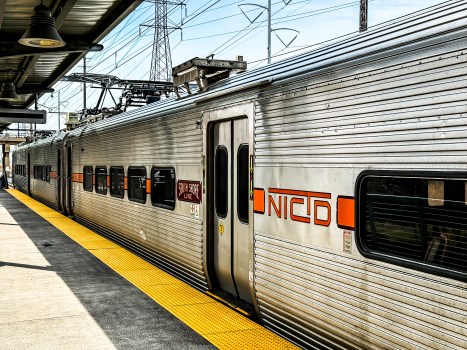
The RDA doesn’t include LaPorte County, but it helped bring Hammond and Michigan City closer together with the $1.5 billion expansion of the South Shore Line, both the Double Track NWI project between Michigan City and Gary that opened last year and the Monon Corridor project to run trains on a new route between Hammond and Dyer. That service begins Tuesday afternoon following a VIP-only inaugural run.
With that complete, Hammond will build a downtown train station using its own money, separate from the Monon Corridor project that brought the new Hammond Gateway Station as well as others along the north-south route formerly known as the West Lake Corridor, McDermott said.
That station will serve residents of The Banc, a residential conversion of the former Calumet Bank building. The project was so popular that it was 100% occupied in just 60 days.
Nelson Deuitch expects the same quick occupancy rate for the Franklin, the new $101 million residential and mixed-use building going up around the 11th Street Station that opened last year.
“If we could replicate that project, I would snap my fingers and do it immediately,” McDermott said.
Robert Flaherty, of Flaherty & Collins, which is developing the project, said his firm is open to developments elsewhere in Northwest Indiana. The 300 units at The Franklin won’t even make a dent in the need for more housing here, he said.
The Franklin is expected to be completed in mid-August. It features a commercial space on the first floor for a restaurant and residential units on the remaining floors.
The restaurant is intended to be a benefit to the community, not just a rent generator, Flaherty said. It’s still too early to have a firm commitment on the restaurant that will open there, he said.
That building is transforming Michigan City’s skyline. It’s also part of the downtown transformation taking place there.
“We’ve had a declining population since I was here in ’80,” Nelson Deuitch said.
There were charettes and other events regarding plans for the city, but residents were skeptical. “Really, what was happening was a lot of locals weren’t involved in this thing.”
“The pivot was COVID for us,” Nelson Deuitch said.
She was on the city’s Redevelopment Commission when the new 11th Street Station was proposed. “It took us to lead from the back to the front to make sure Michigan City got something better than just a parking garage.”
Slowing down the project led to the Flaherty & Collins project at the corner of Franklin and 11th streets.
That’s not the only downtown change. The city also converted Franklin Street from one-way to two-way traffic.
“Ignore social media” and naysayers, Nelson Deuitch said. “There were hundreds of comments. ‘This is stupid.’ ‘This is awful,’” but the outcome was a more vibrant downtown. Restaurants are thriving in the wintertime, unlike previous years.
“I love your city’s downtown,” McDermott said.
McDermott recognized the need to address traffic on Hohman Avenue, the main north-south thoroughfare downtown. Traffic was using downtown as a shortcut, zipping through at 45 mph. “The first thing we had to do was dramatically slow down traffic,” he said.
“We had to break that habit,” McDermott said. “I think that’s one of the biggest steps we had to take right off the bat.”
Hohman is getting a makeover, with medians and parking along the medians as well as the outer edges of the road. That should make it easier on foot traffic downtown, McDermott said, than to cross the road when traffic is zooming past.
“We’re proving to people you could live in downtown Hammond. You could potentially shop and play in downtown Hammond,” he said.
Back in the day, the LaSalle Hotel was a flophouse, just about the only place for downtown residents. Now that building is being converted to a more typical residential structure, McDermott said.
Development in the two cities is going gangbusters.
“We’ve had to restructure. We’re going through a growing pain right now in our planning department,” Nelson Deuitch said, because the demand for services is so strong. “That’s a big deal for a city our size, to have 3,000 (building) permits a year.”
Among those permits is a data center.
“I think Michigan City is prime to be in the middle, in the mix of that,” Nelson Deuitch said. The data center will be built in a brownfield, which she believes is the ideal location.
To attract light industry, the city just created a new industrial park. Creating the infrastructure for development is critical, she said.
Between Michigan City and South Bend, large data centers are being built. Nelson Deuitch wants Michigan City to provide the housing for those workers.
“I love data centers,” McDermott said. “Most of us have a smartphone in our back pocket. I daresay some of you are on the internet right now.”
“This is part of the American spirit, to continually improve, to get better,” he said. Hearing the drumbeat of no more data centers, “that’s maddening to me.”
Hobart will grow because of Mayor Josh Huddlestun’s decision to allow Amazon to build a data center there. “He may lose his job next year,” McDermott said, but he pulled the trigger because it’s the right thing for Hobart.
“That’s not the American spirit,” to stop building, McDermott said.
For Michigan City, the data center will offer a big financial boost, just like it will for Hobart.
“What an opportunity for a place that’s been open land for so long, to go from $25,000 to $1 million,” she said.
Loudon County, Virginia, is the wealthiest county in America because of the plethora of data centers there. Shut the phones and internet off and see what happens, she said. “We’d be a third-world country.”
Nelson Deuitch wants the city’s downtown to expand as far south as U.S. 20. Tonn & Blank acquired the Marquette Mall property and could bring new vitality to that site, she noted.
“I wish there wasn’t a question mark on timing” on the closing of Indiana State Prison, on the city’s northwest side, and NIPSCO’s Michigan City Generating Station becoming available for redevelopment.
“That’s part of the long-term plan on doubling that transit development district,” she said. The city is still finishing a prison study, funded with READI dollars. “That place is a money pit, and it’s a blight on our city,” Nelson Deuitch said.
NIPSCO is planning to shut down its coal-fired power plant. “I would love to take that part of the property now,” the west side, for better access to the lakefront, she said. “Our national park is a jewel. People don’t understand the impact of the people coming to the national park.”
Michigan City could better serve as the eastern gateway to the national park with that NIPSCO land, she said.
The NIPSCO land and the prison site together are 200 acres. Closing the prison would make the site ripe for redevelopment.
“In an urban city, that’s impossible. 200 acres,” McDermott, mayor of a landlocked city, said.
Doug Ross is a freelance reporter for the Post-Tribune.