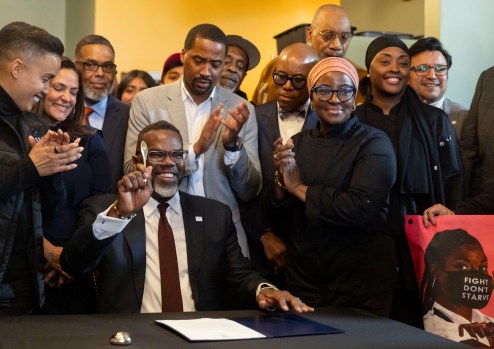


When Mayor Brandon Johnson pulled out his silver veto pen once again on Wednesday — this time to strike down the City Council’s plan to freeze scheduled minimum wage pay raises for tipped workers — he promised a fight.
Standing before supporters inside a restaurant in the Woodlawn neighborhood less than a year before his expected run for a second term, Johnson sounded like a candidate as he not only urged residents to call aldermen, relatives and even the governor to back him up but also cast himself in stark political terms as the city’s “organizer-in-chief” and a defender of working-class Chicagoans.
“I will not allow our progress to be put on pause. I will not allow us, as a city, to compromise what workers deserve. We will fight to preserve the raises of tipped workers,” Johnson said.
Passed in 2023, the “One Fair Wage” ordinance, which gradually eliminates the city’s subminimum wage for tipped workers, was a key political win for Johnson and one he’ll undoubtedly use as a cornerstone success story should he run for reelection. Last week, aldermen voted 30-18 to freeze the ordinance’s implementation, citing rampant concerns from many restaurant owners that the hikes were significantly harming their businesses.
With Johnson’s veto — the third he has made in less than two years, after the city went nearly two decades with none — the mayor and backers of the “One Fair Wage” ordinance are slated for a showdown against a City Council majority fiercely backed by the Illinois Restaurant Association.
But to overturn the veto, the mayor’s opponents will need at least 34 aldermanic votes, four more than last week’s count and a larger-than-it-looks challenge in a council increasingly defined by hard-set sides.
Still, Ald. Samantha Nugent, the chief City Council proponent of the freeze, said Johnson’s veto could trigger some of her colleagues to reconsider their stance.
“By no means is this a shoo-in for being veto-proof. I think it’s pretty close right now,” said Nugent, 39th. “I think we should try to fight it. … This veto completely ignores what we’ve heard from workers and small businesses.”
The subminimum wage was set at $9.48 an hour when aldermen passed the increase in a 36-10 vote in 2023. At all times, employers have been required to make up the difference between the lower rate and the city’s minimum wage when tips do not make up the difference.
After the first two planned pay increases, the subminimum wage is now $12.62 an hour, roughly three-quarters of the city’s $16.60 hourly minimum. It is set to rise again in July and fully match the minimum wage in 2028.
The fight ahead is just the most recent manifestation of stiff aldermanic opposition to Johnson and, the mayor says, proof of an ongoing battle between the city’s wealthiest residents and the working class he says he represents.
But to opponents of the ordinance promising to overrule Johnson’s veto, the freeze is simply an effort to save restaurants and jobs.
“We were getting a lot of calls from independent restaurants basically saying, ‘I can’t make payroll. It’s rough out here,’” Illinois Restaurant Association President Sam Toia said. “If you don’t have weekday business, when you’re in the restaurant business … mandated labor costs coming out of City Hall, it’s going to really put you out of business.”
As the two sides battled in Chicago, they also opened a second front in Springfield, where Illinois Restaurant Association-backed legislation passed the House Labor and Commerce Committee by a 22-4 vote. The bill would prevent Chicago and other municipalities from setting tipped-wage regulations for workers and instead allow only the state to set those guidelines. The bill, which had bipartisan support and opposition from a handful of Democrats, is now eligible to be called for a full vote in the House, though it’s unclear if or when that will happen.
“It does not repeal any minimum wage. It does not change the law in that regard. It does not legalize anyone paying anyone below the minimum wage. It does one thing and one thing only: It determines who regulates gratuity allowances as part of the hourly wage rate in the state of Illinois,” said state Rep. Curtis Tarver, a Democrat from Chicago’s South Side and the lead House sponsor of the bill. “(The bill) simply says that this is something that should be decided at the state level with one uniform rule.”
Back in Chicago, Toia urged supporters to make their own calls to try to override Johnson’s veto.
Nugent, who cited her experience working for around a $2 tipped wage at Denny’s as a college student, argued the 2023 pay increase ordinance was “well-intended” but not backed by sufficient research. It has led to “hundreds of neighborhood restaurants closing,” she said.
“Along with the jobs they provide, and those restaurants that are remaining, they’ve been forced to cut hours and cut jobs,” she said. “They’re hurting the very people that this mayor claims he wants to help.”
Johnson argued that Nugent’s claim was backed by “little to no evidence.”

Both sides have cited federal numbers to back up their arguments but that data is imprecise, leading to a lack of clarity about whether the original One Fair Wage ordinance has been a success or a failure.
Johnson said Wednesday afternoon that Chicago has seen an increase in retail food establishment licenses and a jump in the renewal rate since the tipped wage first increased in 2024.
The claim relies on an imprecise tool: The licenses are required for all establishments that sell, serve or store perishable food, including convenience stores, concession stands and candy manufacturers — not just restaurants.
The city issued 508 permits for on-site dining in 2025, roughly as many as the 511 issued in 2024, according to data from the Department of Business Affairs and Consumer Protection. Both sums are below pre-pandemic totals. The city issued 612 in 2019.
Johnson also cited the city’s record-breaking tourism last summer. “Chicago’s hospitality sector is thriving like never before,” he said.
Questioned about data from his organization, Toia said Chicagoans can instead look to the business corridors in their neighborhood for proof that restaurants are struggling amid the required pay raises.
“Your eyes do not lie. Look at all the empty storefronts throughout all our commercial streets,” he said.
Toia reiterated that workers who earn the subminimum wage are guaranteed at least the city’s minimum wage and often make more when tips are factored in. When their combined wages and tips are below the minimum, restaurant owners are required to pay them the difference.
But even if the required pay bumps add “a little weight,” the raises are needed and deserved, argued Carmella Coq’mard-Muhammad, owner of the Let’s Eat to Live soul food restaurant in Woodlawn, where Johnson signed his veto.
“Being able to pay my employees a wage that they can live off of, it will allow us to make our community a decent, clean and safe place to live,” she said.
Aldermanic allies standing with Johnson criticized their opponents for not finding other ways to support businesses struggling with inflation, high gas prices and other issues they blamed on President Donald Trump’s policies.
For his part, Johnson argued the city’s subminimum wage workforce was largely made up of women of color. They have long counted on these preplanned raises, he said.
“Could you imagine the City Council taking up a vote to roll back the wages that we promised and declared in a contract?” he asked. “If you can’t imagine that, then why, in God’s name, would we ever attempt to roll back an agreement that we made to Black and brown women?”
Johnson, the son of a preacher, also paraphrased a Bible verse: “Woe unto the rich who have denied the wages to the workers.”
Then he told the crowd: “The Bible says, ‘I hear the cries of the workers,’” Johnson said. “I hear what our Lord and Savior hears, and that’s the cry of the workers, and that’s why I’m proud to stand here to resist every single attempt to undermine workers in this city.”
Johnson’s effort to tie his veto fight to a broader rich-versus-poor struggle showed how he views his recent experiences at City Hall, where aldermen have repeatedly fought his plans, most notably in a grueling budget battle that saw the City Council reject a per-employee tax on businesses with 500 workers. It’s a battle that will likely continue well into Chicago’s mayoral election next year.
Other progressives, including several who have at times broken with Johnson, said the mayor’s opponents seem to oppose everything he does.
“What motivates people to do something, it appears to me, is being against something. Folks are against Mayor Johnson,” said Ald. Andre Vásquez, the Progressive Caucus co-chair. “That shouldn’t be the only catalyst to get stuff done. And that’s what appears to be happening right now, as we’re heading into a reelection cycle.”
Vásquez, 40th, said no colleagues had approached him to discuss the freeze. There could have been a compromise with more conversation, he argued.
Another progressive alderman, Ald. Daniel La Spata, 1st, said he could have voted for a one-year pause on annual pay raises, but does not support doing away entirely with the bumps. He said his support for the current ordinance didn’t show he was “with the mayor,” but that he believed in the policy.
“I do think that there are folks who are using these ordinances as opportunities to score political points or create a political narrative around the mayor,” he said.
Ald. Jeanette Taylor, 20th, sees similar broad resistance, she said. She said Johnson has “had issues,” but likened them to those of past mayors.
“Y’all just don’t like it that it’s a Black man in charge,” she said. “At least he’ll put his name and his veto power on the line to protect everyday working people. Show me how many mayors have.”
And Ald. Desmon Yancy, 5th, a progressive who voted with Johnson’s opponents amid the budget debate and last week’s One Fair Wage freeze vote last week, said the emerging veto fight showed once again that the city is in “uncharted waters.”
The council is empowered, but it isn’t sufficiently unified to pass legislation, he said.
“We could be having different conversations if all parties were willing to figure out how to do it right instead of just trying to be right,” he said.
Tribune reporter Jeremy Gorner contributed reporting from Springfield.