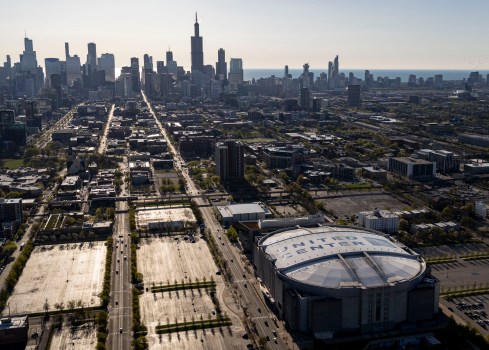

Back in the summer of 2024, we heard a presentation from the Reinsdorf and Wirtz families, owners of the United Center, about an exciting new $7 billion development on the Near West Side of Chicago. Instead of the United Center being surrounded by a sea of parking lots, as it is now, there would be a new music venue, aiming to offer a superior concert-going experience likely to attract long residencies in the Las Vegas mode, as well as restaurants, hotels and housing.
Lots and lots of various kinds of housing. Parks, too. The renderings looked fabulous.
We were excited about the prospect. Project 1901 sounded much like what the Ricketts family had built in Wrigleyville around their historic Chicago Cubs stadium, and we saw it as a way to encourage the growth of Chicago’s explosive West Loop district farther west, replete with all the economic opportunities that would bring to Chicago’s oft-overlooked West Side.
“This is very good news for Chicago,” we wrote. “The two families own this land and this is a development they are funding themselves, presumably acquiring various partners along the way. When we inquired about any public funding asks, the response at our meeting was that some minor infrastructure improvements might be needed from the public purse, which sounded reasonable given how much the city stands to gain from this level of private investment.”
Things have changed a tad.
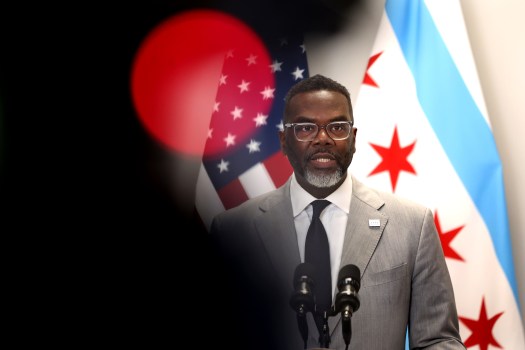
On March 18, Mayor Brandon Johnson introduced an estimated $54.7 million in property tax incentives for the 1901 Project to the City Council, noting the support of Ald. Walter “Red” Burnett, 27th. This is something within Cook County called a Class 7B incentive. Under these terms, the project’s property tax rate for the first phase would be 10% for the first 10 years, 15% for year 11, then 20% for year 12. Without this deal, reserved for projects costing at least $2 million to develop, the rate would be 25%.
So is this still really private investment? How is this just for infrastructure? And how can ordinary, incentive-free taxpayers in this cash-strapped city evaluate these projects from rich franchises and families fairly against each other? Should the council agree to this one?
After all, many of Chicago’s elected officials in Springfield have balked loudly at any public money going to pay for a new stadium for the Chicago Bears. No public funding for rich sports franchises has become a mantra. And, of course, there are two other notable comparatives: the new Chicago Fire stadium being developed by Morningstar Chairman Joe Mansueto in the brownfield South Loop site known as The 78, with Mansueto coming up with some $750 million in private investment, and the $862 million Ryan Field stadium in Evanston, primarily paid for by insurance mogul Patrick Ryan and his family.
It’s complicated. The position of the Wirtz-Reinsdorf partnership is that this remains entirely a private investment, merely one that will get to pay property taxes at less egregious rates than the hefty commercial rates in Cook County. They deserve the subsidy, their argument goes, because the city will make far more in property taxes in the long run after all their privately funded development.
“Cook County incentives such as a Class 7B are standard incentives designed to encourage private investment in underserved areas,” goes the official United Center statement, “and this project is exactly that. Developments across Cook County routinely pursue these types of incentives, and we’ve done so with the understanding that the development will generate significantly increased property tax revenue over time.” (Bally’s Chicago casino, for the record, unsuccessfully shook the same tree).

That argument formed the basis of the mayor’s supportive statement for the incentive. The mayor, of course, lives on Chicago’s West Side and has a particular interest in investment there. We’ve no problem with that for the most part; the West Side needs investment. It just does not happen to be alone.
Ryan Field is in its own category — essentially a pure gift from a billionaire to Northwestern University.
Back in Chicago, it’s worth noting that the City Council in 2019 approved $700 million in tax increment financing for The 78, intended at the time to drive both public infrastructure and affordable housing. Clearly, the Fire’s new stadium will need roads and sidewalks to surround it and we can assume those TIF monies will be tapped for that. The United Center crew argue that they are not tapping TIF funds, so their ask is not unreasonable.
All of these are very fair points. But we’d also highlight the entertainment-venue aspect of this project. Phase One of the 1901 is centered on that huge music theater, which will create big new competition for historic venues, such as the Auditorium Theatre and the Chicago Theatre, in Chicago’s struggling Loop.

Along with the Salt Shed, which is going gangbusters on the near Northwest Side, the new venue at the United Center will inevitably pull people out of the Loop and benefit the restaurants in the West Loop, which hardly needs the help, rather than eateries downtown, which are suffering.
Let’s remember: In a post-Bears future, Soldier Field will need concerts. Also, sitting unrestored is the Uptown Theatre, acknowledged as one of Chicago’s most important architectural treasures, a music venue with a capacity not that different from the one proposed at the 1901 Project and a theater itself located in a neighborhood that needs investment.
A good case could be made that while the United Center should be free to build a stellar new music venue and compete with those historic venues already standing, the case shifts when it also asks for property tax breaks. As it just did.
Even before the request for this incentive, other venue owners were arguing against the necessary zoning change.
One might broaden that argument, too. The growth of the West Loop, especially when it comes to housing, restaurants and leisure, has come to a large degree at the expense of the Loop and the Magnificent Mile north of downtown. If you see the 1901 Project as helping things to the west or growing the pie when it comes to the city as a whole, then the argument for public support is much stronger than if you see it as mostly adding fuel to the West Loop fire, which is doing just fine already, sucking oxygen from the established nightlife districts in the Loop and around Michigan Avenue.
Although we know at least one developer there who argues the West Loop has become stymied and still needs a lot more help.
Heck, everybody likes help.
So how to sort this out? We think the City Council should put away the rubber stamp and focus on extracting benefits and commitments as a condition of its approval.
One is gaining more clarity on what any further asks for infrastructure will look like; there was talk in 2024 of a new Pink Line station, for example. Who will be paying for all that? Will more asks follow soon after the property tax incentive is secured? Is this to be a matter of TIF cash plus property tax incentives, or is this the one and only ask?
Furthermore, aldermen should consider the impact of this project on Chicago’s existing venues; their going dark too often would greatly affect their businesses. And thus others in the Loop.
Further to the further, the council should ensure there is a firm commitment in terms of housing and the associated retail that appeared in the original plans. Consideration should be given to requiring the Wirtz-Reinsdorf partnership to shift some of the planned housing into Phase One.
Phase One currently is centered on a music theater that (from the point of view of the city) is very much in the nice-to-have-but-fully-served-elsewhere category and on a hotel, which is more promising but still less beneficial when compared with housing. We would not want to see a situation where the music theater gets built with these incentives and none of the housing happens or it gets kicked years down the road.
Further to the further to the further, we’d like to see the United Center folks throw some compensatory support behind the efforts to make improvements to the Loop, which is where many of their customers still will be staying and wandering around. Finally, we’d like to see genuine efforts made truly to grow the live-music pie for Chicago, which means investing in new, tourism-boosting residencies, and not simply stealing acts from other venues fighting for the finite number of existing tours.
We think our consistent position here is one held by the vast majority of Chicagoans: We support significant public infrastructure help for big, private projects, even those involving lucrative sports franchises, but not the actual building or operating of them when they are successful for-profit operations that look set to make a lot of money.
We also understand the need for cities to seed investments for future benefit, and we remain excited by Project 1901. But these are less than lovely times when it comes to this city’s fiscal picture, and the council should make sure it gets all it can in return for that $54.7 million in property tax breaks.
Submit a letter, of no more than 400 words, to the editor here or email letters@chicagotribune.com.