
The Chicago Tribune covered the trial against R. Kelly extensively.
A federal jury in Chicago convicted Kelly in 2022 on child pornography charges for explicit videos he made of himself and his then 14-year-old goddaughter, “Jane.” Kelly was also found guilty of inappropriate sexual relations with Jane and two other teenage girls, “Pauline” and “Nia.” Kelly abused the three girls in the 1990s. The jury acquitted Kelly on separate charges of conspiring to rig his prior Cook County child pornography trial.
On Feb. 23, 2023, a federal judge handed the R&B singer a 20-year prison sentence for his convictions that include producing child sexual abuse materials and federal sex trafficking charges, but said he would serve nearly all of the sentence simultaneously with a 30-year sentence imposed a year earlier on racketeering charges.
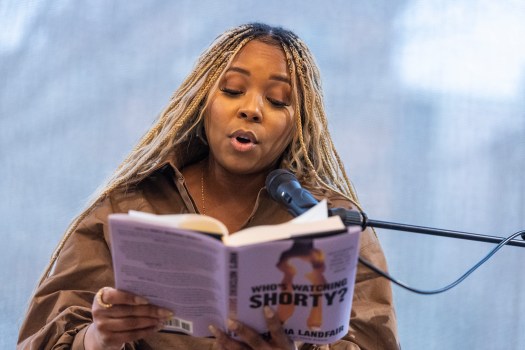
Reshona Landfair, aka Jane, penned the memoir “Who’s Watching Shorty?” about Robert Sylvester Kelly’s presence in her young life. She starts the book with the question: “What was that foolish girl thinking?” referring to herself in connection to her relationship with the singer back then. Landfair gives the details of what happened in those years she was a minor “being saddled with the wants and whims of an adult. A predator who made your injury your own fault. It wasn’t.” By the end of the work, Landfair poses another query to herself: “How could you have known there were sharks in the water where you swam? No one posted signs. When he nibbled at your toes, you didn’t know he wanted to suck the marrow from your bones.” In sharing her story, she hopes it helps others in bad scenarios on their journey of healing.
“I didn’t sugarcoat anything in this book,” Landfair said. “I didn’t make excuses. I didn’t point the blame either. What I did was speak on my experience, on how things truly played out, how they went right or wrong. I gave an explanation of what looked one way to the public versus how it really was. If you’ve ever been in a position where you felt silenced by your trauma, you felt you couldn’t be open or honest, I wanted to bring awareness to the fact that you do have power, you do have a voice, and it’s never too late to change your mind and make a correction.”
Landfair spoke with the Tribune about her life following her publicized trauma. The interview has been edited for length and clarity.

Q: Your book was released during Black History Month, but also in the shadow of the Epstein files. Do you consider your book a primer for survivors, a way to say, “you can get through it?”
A: Yes, that’s very important. My situation took place about 25 years ago, before social media. Times have changed tremendously. … We’re bringing awareness to these kinds of secret situations. It’s happening so much. Just imagine the people, the women or the boys who are going through these things with people who aren’t in the limelight that are still suffering.
Q: What don’t we know about Reshona, the 41-year-old mom of a 5-year-old?
A: I’m a really bubbly person, a great friend, mother, co-worker. I love people. I love to see people smile. I love to host, and I have a good time doing karaoke, because I can go back to my childhood and be myself. (She used to sing professionally with her cousins in the group 4 The Cause.)
Q: It took you two years to write this book, what are your next steps?
A: I want to become a licensed social worker — something I’m in the process of working on. In our culture, so many people go through these kinds of things in silence. I want to teach workshops on awareness and help parents become comfortable with having uncomfortable conversations and children speaking uncomfortable things out loud, because we hold the power, but as long as we’re made to feel like we’re doing something wrong, that something has to be kept private or a secret, that’s when the enemy creeps in, and these kind of things can continue.
Q: The scope and scale of the abuse — so many folks were around you and R. Kelly when this was going on. In hindsight, do you want to ask: How could you?
A: I don’t blame anybody for Robert’s actions. I want the people around to understand that you created a monster, allowing him to get away with so much, it perpetuated what he was capable of doing. I know it’s not necessarily your fault, but not holding him accountable is what put him in the position.

Q: You said you had to rebuild your life in your 20s because up to that point you’d been isolated in your abuser’s world. What was that process like?
A: I was pretty much a fish out of water. I had to relearn myself. I had to learn the world — everything from age 12 or 13, up until I was 26 — I had to get into the real world and figure that out. I had to think for myself. I had to figure out how to get a job, I had never worked. I lacked educationally. I only had some college courses that were very limited on what I was able to take. So it was really learning myself, starting from scratch to really know my character, rebuild who I was, finding out what I was interested in, learning how to be normal socially and with my family members — not being around males — the level of comfort and insecurities, those were all things I had to overcome and get to know myself.
Q: Are you triggered by hearing R. Kelly’s name or similar stories of abuse?
A: I can’t say that it doesn’t affect me in any way, but I have grown a lot. The opinions and the way people view things are frustrating sometimes, because no matter how you look at the circumstances, I was a 14-year-old girl, and this is something that happened to me with a man who was 18 years older than me. When people don’t put that at the forefront, and they have such strong opinions about me, about my family and other things like that. It can be frustrating, but I’ve learned how to deal with it, how to manage it — that was a part of my process of healing.

Q: The cover of your memoir says it’s a reclaiming of yourself from the shame of R. Kelly’s abuse. Is this proof to your son on how mommy came through this?
A: Yes. My son’s future was the most important part, besides my healing, of me writing this story. Maybe me giving the correct version and the true experience of what I went through would help how things play out for him. Hopefully, by the time he gets older, the story is not as relevant as it’s been for the last 25 years for me. One of the most important things was for him to have the true and correct version of who his mother is as a woman.
Growing up, I was very embarrassed, and I was in the shadows pretty much of this entire situation. And the more I matured and came into adulthood, becoming a mother, I was able to process things a lot differently than I was with my younger self. It became a freeing thing. … If I’m dating somebody new, I don’t have to sit down and say, ‘down the line, how am I going to let this person know or do they know about my past? Or question their intentions? I’m owning my name. I’m taking ownership of what took place in my past. I feel that’s the last explanation that I have for anybody. I got tired of having to explain professionally, having to explain in friendships, relationships … having to process those things over and over again each and every time it came up. I felt like this book could be the seal of everything that I was masking versus everything that I had to face. It was therapy sessions for me … journaling, putting my thoughts and everything I had compartmentalized internally … confronting each thing that I masked and that I hid from and I didn’t want to accept for so many years.