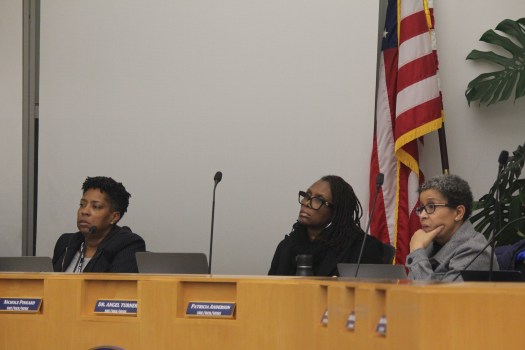

One by one, Evanston-Skokie District 65 parents approached the public comment podium to urge the Board to reconsider their policy in supporting a 1:1 technology model, which supplies every kindergartener through eighth grade student in the district with a personal iPad for school use.
Parent Lisa Weiss took a lighter approach.
“If you want to know how your March Madness bracket is doing, my son will check the score for you on his school iPad,” Weiss said at the March 23 D65 school board meeting.
“I know ESPN isn’t the worst, but every week, we discover new distracting sites and games our kids can freely access on their school iPads. Having these distractions on school devices legitimizes the distractions… the moment school iPads came home, they interrupted the way we wanted to raise our kids,” she added.
But despite extensive pushback from parents and a petition with over 1,250 signatures by parent-founded organization Screen Sense Evanston to limit technology use in the classroom, the Board approved the purchase of 1,231 new iPads to continue the 1:1 student device model in a 5-2 vote on March 23.
Parents raised concerns about students’ exposure to inappropriate online content, while district staff said shifting from a 1:1 model, where each student has their own device, to a shared-cart system, where iPads are shared between multiple grade levels, is both more expensive and less practical.
Board members Chris Van Nostrand and Maria Opdycke voted against the measure, expressing concern that the devices did little to improve student learning outcomes.
“What I’m anchoring in is the achievement report that reflected that 57% of kindergarteners were meeting ELA (English Language Arts) benchmarks, and 41% of second graders were meeting ELA benchmarks, which indicates that at least the methods by which we’re teaching are not working,” Opdycke said.
“I’m not seeing the ability for our financial decisions to support student outcomes in a way that will make a difference, and continuing to go down the path because we are on the path is not a reason to do that.”
The outlined purchase cost of all new devices and cases for the 2026-27 school year totaled to a little over $528,000, a reduced projection from the one presented at the Board’s March 9 meeting, which estimated new devices would cost the district over $551,000.
The updated proposal reflected a more optimized model, while still maintaining the 1:1 ratio, District 65’s Executive Director of Technology Elena Cáceres said during her presentation to the Board.

In the new plan, Cáceres said administrators were able to lower the cost by about $23,000 by basing the numbers on “strict enrollment projections and revised summer device storage plans.”
Based on the district’s current structure, new device “refreshes” or purchases occur in every first and fifth grade class in a four-year model to improve “fiscal efficiency.”
Students in kindergarten use devices for a fifth year of their lifecycle and the iPads are “repurposed from exiting eighth grade students and students moving from fourth to fifth grade,” according to the D65’s March 9 student device memo.
The adjusted plan presented at Monday’s meeting modified the original purchase for the first and fifth grade refresh from 1,300 iPads to a reduced 1,231 iPads.
Cáceres said this reduction was based on more accurate projections of total grade numbers and removes the “69-device buffer for summer damage/loss.”
Along with an adjusted device number total was a reduced case total, from 1,300 to 1,295 keyboard cases to align with third and fifth grade enrollment projections.
Following Board feedback, the new proposal also eliminated the need to purchase new cases for the first graders by repurposing cases already in the district’s inventory from the rising third grade class.
Kindergarten students will continue to receive 1:1 devices by “repurposing 611 fifth-year iPads from graduating eight graders,” the updated March 23 technology memo detailed.
District 65 is expected to earn back a total of $39,605 in buy-back revenue when the retired devices are returned.
“We understand and do not want to minimize the challenges of screen time,” said District 65 Assistant Superintendent Stacy Beardsley. “Too often in education, we swing the pendulum too rapidly from one extreme to another. We rush to solve a problem, and through our rush, we create a new problem. Technology, when used appropriately, brings educational value.”
“Shifting away from our current technology configuration introduces significant change for educators and students, when we want them to be 100% focused on welcoming new students and building new school cultures and routines,” Beardsley added.
Although the 1:1 model structure was approved for another school year, administrators presented two alternative options to appease parent concerns surrounding whether or not a device-per-student ratio was really necessary.

The two alternative options to the 1:1 proposal outlined a shared cart model, meaning students in different grade levels would share or rotate their devices.
The second option presented recommended that first and second graders use a shared cart model, contributing to an over $547,000 total cost, including keyboard cases.
The third, and least-cost effective option, suggested iPads are shared among kindergarteners and first grade students, with a projected cost of over $658,000 including cases.
In the shared cart model structure, cart capacities are based upon the highest enrollment class among the paired grades.
Several Board members questioned why a shared cart model would result in higher costs than the 1:1 ratio, which Cáceres explained was because sharing devices between two grades didn’t translate to a 50% reduction in educational savings.
Purchases are made for peak classroom needs, Cáceres said, not for average student enrollment. For example, if the larger of the two classrooms has 22 students enrolled, compared to a 17-size student classroom, the shared cart still must have 22 devices.
Additionally, not all classes can be paired, with some schools within the district having uneven class sections that require additional carts. Extra iPads would also need to be purchased for library and computer science use, which require their own carts for scheduling reasons.
Cáceres said that acknowledging these numbers and the predictability that a 1:1 model provides, Technology Services recommended maintaining the current device structure.
“[The 1:1 structure] ensures consistent access for students and staff, supports differentiation, intervention and instructional flexibility, and avoids scheduling, operational and systems limitations of shared parts,” she said. “Right now, with the short timeline that we had, it would align with educator and leader feedback.”
Board President Pat Anderson ultimately voted in support to maintain the current iPad structure, but agreed that the district didn’t have to “keep going down the same path with the 1:1 use of iPads,” just because that’s what’s currently being done.
“I value the input from the community about their concerns with their kids and iPad use in the schools,” Anderson said. “If we’re going to continue to use these iPads, then they should be restricted to curricular use, and it should be enforced across the district.”
Still, no parents that spoke during the public comment period voiced support for the current model.
“I can’t control what goes on in the classroom on the iPad, but you guys have the opportunity to,” said Ally Bertsche, a parent of two at Kingsley Elementary.
“It’s a wild, wild west on the internet, and we can put safety guards in place and do our best, but we can’t really keep up… you guys have the opportunity to do right by our children, and I encourage you to please do so.”