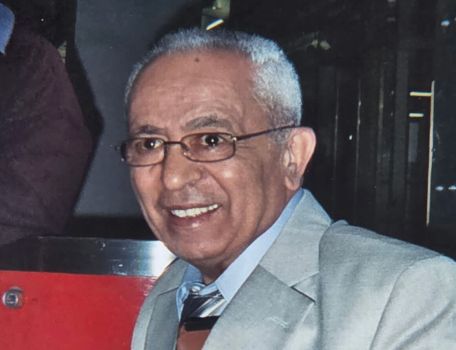

Rateb Jarad immigrated to the U.S. from Palestine as a teenager and eventually landed in Chicago, where he worked as a door-to-door salesman of home goods before opening and operating his own retail store in the Loop.
Later a successful life insurance salesman for Aetna and a similarly successful real estate agent for Coldwell Banker, Jarad was a prominent figure in Chicago’s Palestinian American community, known for his ability and willingness to mediate issues and bring people together, said friends and family.
“Rateb really played an important role in terms of bringing people together,” said Camilla Odeh, a longtime family friend. “He was well-respected.”
Jarad, 89, died of complications from Alzheimer’s disease on Feb. 19 at Resurrection Medical Center in the Norwood Park neighborhood on the Northwest Side, said his daughter, Arab American Action Network cofounder Maha Jarad.
He had been a North Side resident who previously had lived in the Albany Park and Peterson Park neighborhoods.
Born in 1937 in Palestine, Jarad grew up in Ein Yabrud, a village in the West Bank that is about 4 miles west of Ramallah. Around the age of 11, Jarad was taken out of school, his daughter said, after the West Bank came under Jordanian rule and families were required to pay to register their children in school. Jarad’s family also needed him to work the land.
“Life was hard,” Jarad’s daughter said. “There wasn’t time to baby anybody. And when his father went to the U.S., my father, by then 13, was expected to take charge, and he wanted to show his father that he was up to the task.”
At age 17, Jarad moved to the U.S. after traveling for a month on a passenger and cargo ship that went from Beirut to New York City. Carrying $14 and two shirts — one of which was far too big for him, his daughter said — Jarad connected with a contact person in Manhattan and began working as a door-to-door salesman in the Bronx, Brooklyn and Harlem.
In 1958, Jarad returned to Palestine, where he met and married his wife, Eisheh. He then moved to Chicago before returning to Palestine to bring his wife to his home in Chicago. The couple settled in the South Shore neighborhood on the South Side.
Jarad and his wife later moved to Puerto Rico, where they lived briefly and where he continued work as a salesman.“He said he could work anywhere,” Maha Jarad said. “He felt he could sell anything, and could live anywhere. He sold to people in places like Humboldt Park, Gary and Hammond. He would sell anything for your house — sheets, bedspreads, blankets, kitchen towels, drapes.”
About 1971, Jarad moved his family to Albany Park, which was becoming a hub where other Palestinians also were settling. Maintaining that “sense of community for his kids was important,” Jarad’s daughter said.
Before long, Jarad decided he wanted to start his own business, his daughter said. He partnered with his brother, Mahmood, to open a retail home goods business called Jarad Trading Co., located in a storefront at 218 W. Van Buren St. in the Loop.
The business was successful, and it also became something of a haven for anyone struggling with various issues.
“People would say, ‘I have these immigration papers, can you help me out?’” Maha Jarad said. “Or they’d say, ‘My mother is sick,’ ‘My marriage is falling apart,’ or ‘I have this problem with my son.’ He became like a businessman/social worker and case manager. People knew that if you had a problem, you go see Rateb Jarad. He would invite them for a meal and a cup of coffee and listen and offer them assistance.”
In 1979, Jarad decided to exit the home goods business after the rent tripled in the Loop building he was renting. He pivoted to working in the life insurance business for Aetna, selling life insurance and winning the firm’s Man of the Year award. He also began selling real estate at Coldwell Banker, and in 1983, he earned his license to sell auto and property insurance as well.
“He was multicultural,” said another daughter, Suha. “He got along with people from various ethnic, racial and religious backgrounds. He also was known as Roberto to his Spanish-speaking customers, and he was also known as Bob to his English-speaking customers.”
Jarad was most proud of raising his children and ensuring that each had a good education, his daughter said. He worked long hours as a door-to-door salesman, including not returning home until 10 p.m., seven nights a week.
“He didn’t want us to go through that and he understood that our independence was tied to our education. He understood that the best thing he could do for his kids is to get them that education so they don’t have to suffer,” Maha Jarad said. “My dad told us that education is the one thing you’re going to take with you. So wherever we ended up, he wanted us to be self-sufficient and not be at the mercy of anyone.”
Jarad’s daughter said her father loved his native country, despite long periods of time away from it. In 1972, he brought his family back to Ein Yabrud to get to know their extended family and and the importance of their origins.
He placed his children in local Quaker schools while he returned to the U.S. to work. Although his children thrived in Palestine, that arrangement lasted only about a year, as Jarad found it too difficult to be without his family.
Jarad retired from his work in the mid-2000s.
Outside of work, he enjoyed what is known as debka dancing — a tradition accompanied by singing folkloric Palestinian and Arab songs.
He helped start a Chicago-based Ein Yabrud association and became its president in 1991. It was another way he served as a trusted adviser to many Chicago-area Palestinians.
“He was well-known for giving advice, building confidence and maintaining an optimistic view, no matter how difficult things got,” Maha Jarad said.
Jarad’s wife, Eisheh, died in 2005. In addition to his two daughters, Jarad is survived by another daughter, Nora; two sons, Maher and Nader; five sisters, Enayeh, Alia, Rasmiya, Rasema and Aida; three brothers, Rasem, Ahmed and Rafik; and eight grandchildren.
Services were held.
Bob Goldsborough is a freelance reporter.