
WASHINGTON — He doesn’t even really root for the Chicago Bears, but U.S. Sen. Bernie Sanders says he wants to ensure Bears fans — and sports fans of all stripes — are protected from the heartbreak he suffered as a teenager, when his beloved Brooklyn Dodgers left for Los Angeles.
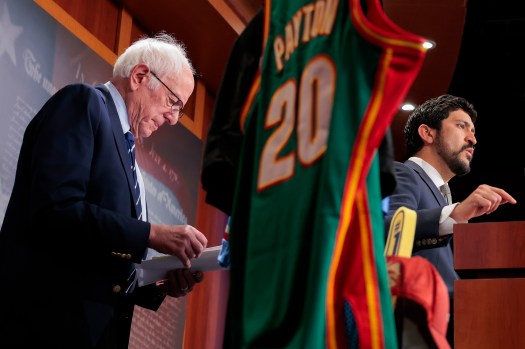
Sanders, the independent Vermont senator and two-time presidential candidate, threw his support behind long-shot legislation Thursday that would give communities a chance to keep their professional sports teams if their owners threatened to leave. Under the proposal, local leaders would have a year to find another buyer for the sports team or to organize a community ownership structure, like that used by the Green Bay Packers, to take over the team instead.
While even the bill’s sponsors of the so-called Home Team Act acknowledge the legislation won’t get passed quickly, if at all, if it were in effect, it would put the brakes on the Bears’ ambitions if they tried to move to Hammond, Ind., but not if the team left Soldier Field for a new stadium in Arlington Heights.
The legislation defines a franchise’s home as where it plays the majority of its home games. The Bears, which tout themselves in the Bears fight song as the “pride and joy of Illinois,” are exploring a move to a new stadium. But the team plans to stay in the same media market and keep its headquarters in Lake Forest, where it holds practices and oversees day-to-day operations.
The penalties under the new proposal would apply if team owners relocate their home facility across state lines or out of metropolitan areas.
“Professional football is America’s religion,” Sanders said, when touting the need to promote activities like professional sports that bring people of different backgrounds together.

“The Dodgers had brought the community together, and I think that’s true in city after city,” Sanders said at a Capitol press conference. “You see people of all backgrounds coming out and rooting for the home team. You see kids loving their favorite ball players, not even understanding that an owner, in order to make more profit, can simply shut the team down and move to another city.”
“Anytime an economic enterprise leaves a city and jobs are lost, that’s a tragedy,” Sanders added. “But when a major professional team leaves a community, it is a double tragedy. It’s not just the jobs that are lost, it’s the fact that emotionally…people suffer a deep, deep loss.”
U.S. Rep. Greg Casar, a Texas Democrat and chair of the Congressional Progressive Caucus, is sponsoring the legislation in the House. U.S. Rep. Jesús “Chuy” García, a Chicago Democrat who is leaving office next year, is the only member of the Illinois delegation to sign on as a cosponsor so far.
“Sports are a tradition that should not be held hostage by billionaires when they demand government handouts or threaten to relocate,” García said in a statement. “The Home Team Act would allow communities to take over their home teams to rein in taxpayer-funded stadium subsidies.”
Casar made clear he had the Bears in mind as he came up with his proposal.
“If you’re a fan watching at home, yes, this is a keep the Bears in Chicago bill,” he said.
“Even when teams don’t actually move, the threat of moving sets off a race to the bottom,” Casar explained. “Billionaire owners pit taxpayers against one another and then extort the government for billions of dollars. We see that right now in Chicago, where Indiana taxpayers are now put in a competition against Illinois taxpayers to subsidize a team worth $8 billion.”
“Billions of dollars wouldn’t be given out to these rich owners if it wasn’t for them essentially extorting the fact that they’re right by a state line,” Casar said. “We just want basically a level playing field for fans and taxpayers, rather than the current system that gives all the benefit to the owners.”
Sanders also singled out the Bears’ ownership.
“What makes the situation even more absurd is that Chicago and municipalities all over this country are struggling right now to educate their kids, to pave their streets,” the Vermont senator said. “The idea that you have billionaire owners running very profitable operations say, ‘If you don’t give us even more, we’re going to leave,’ and literally that means taking money out of the education of the kids, out of childcare for the kids, out of infrastructure for the people of that community, that’s not acceptable.”
A spokesperson for the Bears declined to comment on the bill.
Casar’s proposal stands little to no chance of becoming law in the Republican-controlled Congress, but the sponsors say it highlights how wealthy team owners cash in on big moves while average fans and taxpayers lose out.
Sandars and Casar pointed to the recent announcement that the Kansas City Chiefs will leave their longtime home in Missouri for a new stadium across the river in Kansas. Meanwhile, officials in Washington, D.C., reached a deal last year with the Washington Commanders to lure the team back to the city from the Maryland suburbs, with a package that includes $1 billion in subsidies. In the last decade, the St. Louis Rams left for Los Angeles, the San Diego Chargers also headed to L.A., and the Oakland Raiders decamped for Las Vegas.
The impact of those moves can linger for generations, the lawmakers said. Casar talked about the loss he felt when the Houston Oilers left the city for Nashville in 1996.
But sports economists cast doubt on whether Sanders’ and Casar’s approach would prevent team owners from leaving their longtime homes, even if the proposal were to become law.
Geoffrey Propheter, a University of Colorado Denver professor who studies sports facility economics, said the progressive lawmakers appear to be tackling two different problems with their legislation: widespread public subsidies for sports franchises and teams’ frequent relocations.
Either way, the proposal doesn’t address the root causes of the problem it is trying to solve, Propheter said.
Congress has tried to limit public subsidies for sports stadiums since the Reagan administration, he noted, but it could continue those efforts.
The federal government has sway over major infrastructure projects like sports stadiums, because it subsidizes the bonds that states and local governments issue to pay for those improvements. Bondholders don’t have to pay federal income tax on the interest income they receive for those tax-exempt bonds.
Congress has repeatedly tried to narrow the kinds of projects that qualify for the subsidized bonds, but pro teams and their boosters in state and local governments have found creative ways to sidestep restrictions Congress has imposed, Propheter noted.
“Could it be that these other pieces of legislation that tried to make debt more expensive might be a better pathway to achieve this relocation goal than a piece of legislation that is trying to force a change in ownership or a transfer of ownership?” Propheter asked.
If, on the other hand, the main problem Sanders wants to address is teams relocating, Propheter said federal lawmakers should change laws that allow the NFL and other major professional sports leagues to act as cartels, which work together to limit competition and fix prices.
The Supreme Court exempted Major League Baseball from antitrust law more than a century ago.
Other leagues have narrower, but significant, protections. A 1961 law called the Sports Broadcasting Act carves out major sports leagues from antitrust laws when it comes to broadcasting their games on network TV. The House Judiciary Committee last fall announced it sent letters to major sports leagues to determine whether those protections are still warranted in a rapidly changing media environment.
“Because of that market power that Congress is giving you (as a team owner), you can threaten whatever you want, and sports fans are essentially captive consumers,” Propheter said. “Instead of trying to regulate the cartel, why not just get rid of the cartel?”
Both Casar and Sanders touted the possibility of communities taking over their home teams, either through private organizations like the one that controls the Packers or through local government control. All major professional sports leagues prevent public ownership, but Casar’s bill would make those policies illegal.
“There is a reason why … the NFL is quite explicit in prohibiting other communities from doing what Green Bay is doing,” Sanders said. “I think they do it because they understand the profitability that other communities can enjoy if they did what Green Bay is doing. So Green Bay is a good model. We should look at it.”
The Bears have explored several options for their next home, but Gov. JB Pritzker has said the most likely scenarios involve the team leaving the city of Chicago either for the northwest suburban site of a former Arlington International Racetrack, which the Bears bought in 2023, or near the Wolf Lake area in Hammond, Ind.
State lawmakers in both Springfield and Indianapolis have tried to bolster their states’ appeal by offering incentives to attract the Bears.
Indiana Gov. Mike Braun signed legislation in February to set up a new Northwest Indiana stadium authority with the power to issue bonds, buy land and build a new facility that it could lease to the Bears. Braun, a Republican, touted the incentives as proof that Indiana is “open for business.”
But work on a bill to support the Arlington Heights site has been a slow grind in the Illinois General Assembly, where Pritzker and lawmakers are more wary about giving away subsidies.
Their skepticism is tied, in part, to the state’s precarious financial situation and to Democratic leadership wanting to prioritize support for lower-income Illinoisans rather than support for some of the state’s richest residents.
The Bears’ last stadium deal in Springfield also looms large. The Bears mounted an intense lobbying blitz, aided by then-Gov. George H. Ryan and then-Chicago Mayor Richard M. Daley, to gain approval of a $587 million package to transform Soldier Field in 2001. But now the Bears say the revamped stadium is inadequate, and they want to break their lease on Soldier Field before it ends in 2033. If that happened this year, they would have to pay $84 million in penalties.
Vock is a freelance reporter based in Washington, D.C.