My grandfather ran a printing press for decades. His hands were stained navy blue. The press building itself — “The Shop,” he called it — was authentically Dickensian, a New England factory mill and pre-Civil War relic too dank and dangerous for a child to visit, though I did, often. It was lit for a horror movie, by single bulbs at the end of long cords. Its walls of red brick had grown thicker after years of gunked ink, the slats of its wooden floors were wildly uneven beneath the buckling weight of antiquated iron machines. Metal type sat in stacked boxes. An acrid musk of unfiltered Camels clung to everything.
I have never known a more tactile place.
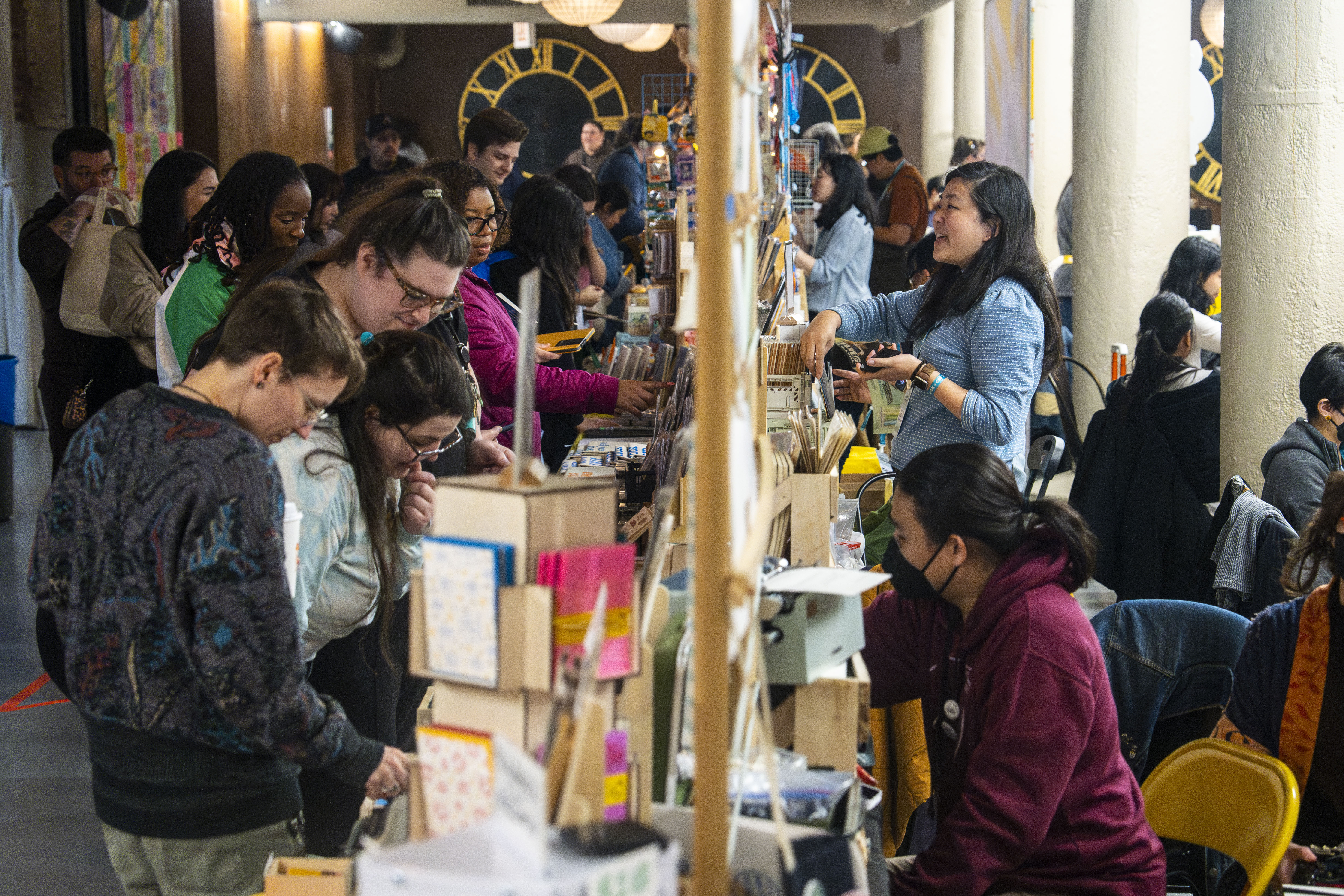
Until the other day, walking the floor of the Chicago Stationery Festival in Ravenswood, weaving in and out of stationery obsessives and stationery vendors bonding over the feel of new fountain pens, flipping the ultra-wispy pages of Japanese-made planners, brushing their fingers along the ridges of hand-carved stamps — that came pretty close.
For different reasons.
My grandfather just printed informational fliers and neighborhood posters and everyday packaging; he never said much about what he printed and never seemed to think much about what he printed and was primarily concerned that new print jobs came in. The 84 vendors of the second annual Chicago Stationery Festival — from Chicago and Montreal and Boston and California and Brooklyn and Japan and Germany, a number of them still using the same kind of ancient presses my grandfather used — cared deeply about what they made. And so did the fans of contemporary stationery who lined up at their booths.
They made posters depicting happy ducks in ramen bowls. And stamps fixed to large wooden handles. Letter-pressed placards reading “No Bueno.” Greeting cards reading “Shut the (expletive) up about Chicago.” Notebooks emblazoned with “Cults to Avoid.” Rolls of decorative tapes made from Japanese rice papers. Handcrafted inks named after boba tea flavors. Tasteful envelopes adorned with tidy drawings of pizzas, journal stickers reading “Proud Parent of a Dumbass,” letterhead inspired by old supermarket posters that screamed stuff like “Chuck Steak $3.50 LB!”
Like you, this is how dumb I was about the stationery world: Before attending, I assumed I would be meeting shut-ins out for a spring day, trading sheets of classy paper.
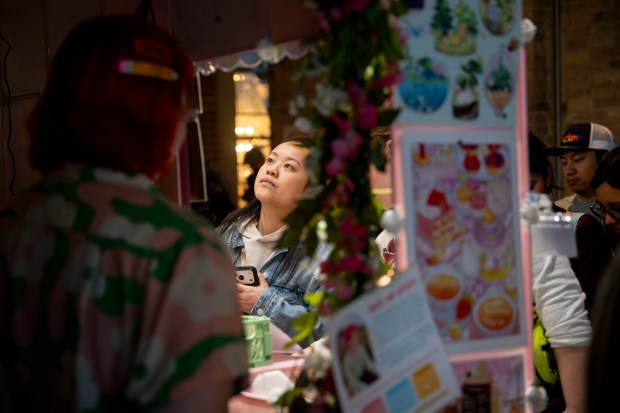


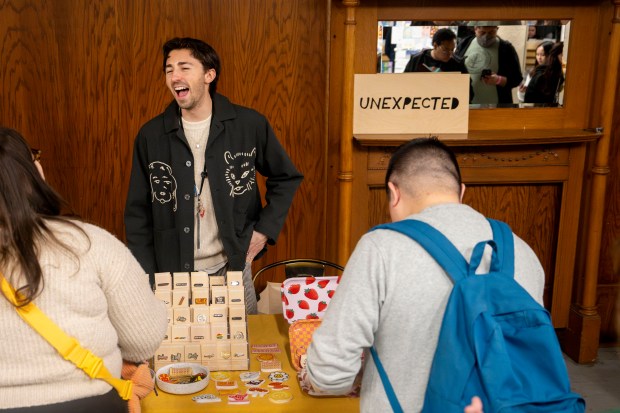


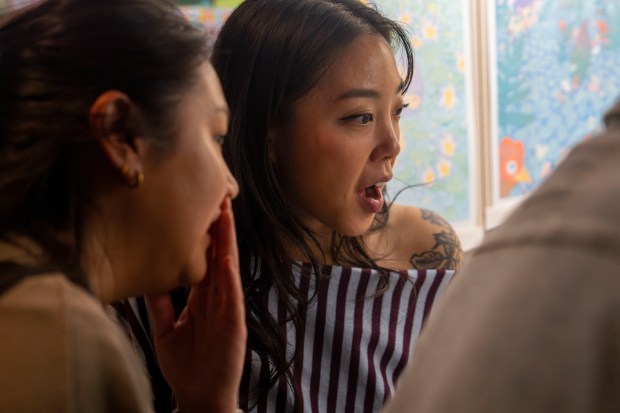


What I found was a booming subculture that favored picnic-tablecloth patterns, habitual diarists who need their daily thoughts to flow out of fancy pens and the clacking of keys, office-supply champions who arrange their days in physical journals full of irreverent flourishes. I met a decidedly analog community — Stationerycore, many call the culture — thriving on social media even as they are reviving the warmth and feel of the physical.
“Do you know that I have met people who do not know the mechanics of mailing a physical letter?” asked Donovan Beeson, a Chicago illustrator and designer who started Selvage, a service that sends its subscribers a new specially-designed postal stamp (created by Beeson) every month.
She looked out across the sleek industrial warehouse, at a mingling crowd in their 20s and 30s, mostly female, a couple thousand of them, who sold out this festival in half an hour. She said, “I see the popularity of stationery now as a realization from the TikTok generation to slow down, stay open to the unexpected — and stop reading their phones.”
Beside her stood Kimberly Adami-Hasegawa, who started Galaxie Safari about a decade ago, a Forest Park-based stationery business. She has not wavered from its mission since: She writes greeting cards on a Royal Safari typewriter from the ‘60s. She types every card herself, then fixes every accompanying envelope with a vintage stamp. She grinned: “I love a typewriter, I love a stamp, I love creating something you hold.”

Both told me they have pen pals: Adami-Hasegawa has 18, Beeson has hundreds.
A moment later, Maggie McCarthy of Wilmette passed by. She, incidentally, has two pen pals. She’s 59 and she’s had one of those pen pals since she was 7 years old and her best friend was leaving the North Shore for Baltimore. So, yes, she’s always been into stationery, she said, “but really, I suppose, I got into this” — she waved her hand at the crowd — “maybe five years ago? I’m no digital native. But for those who are, this is like a Comic-Con, for people who like to write letters and have strong opinions on pens.”
Just as nerdy, far less sweaty.
“You’ve got to meet Connor,” she said, guiding me to a friendly young man with a tote bag stuffed with decorative washi tape and the leather travel journal he carries everywhere.
Connor Donahue moved to Chicago not long ago from Montana, he said, and about two months ago he discovered the world of stationery — specifically “junk journaling,” filling a traditional journal with thoughts but also scraps of papers, letters, the stray whatnots of your day. “I became totally sucked in,” he said, “but mainly after I found Paper & Pencil.”
If there’s a rallying point for the Chicago wing of Stationerycore, it’s the tiny, typically crowded Andersonville store Paper & Pencil, which is owned by Tyler McCall and Eric Campbell, the same married couple who founded the Chicago Stationery Festival last year.
“When we first opened (in 2023) we didn’t set out to become any of this, or create a festival,” McCall said, “but we knew the community of analog fans, and we knew there were so many people around this area who were creating things, and since New York and Los Angeles had big stationery gatherings, we decided to make what was missing.”
They had good timing.
Since the early days of the pandemic — which is when many Stationerycore fans and creators at the festival date their stationery awakening — the stationery industry has been steadily expanding, even blowing up. According to Forbes, it’s nearing $150 billion in annual sales and expected to pass $200 billion a year by 2034. (Comparatively, as cultural pastimes go, global box office for movies has been hovering around $30 billion.) Last fall, there was a handy illustration: When the new Hobonichi Techo calendar planners showed up at Paper & Pencil, the line of customers wound out the door, up Berwyn Avenue and down Clark Street. Hobonichi, a Japanese lifestyle company, had a booth at the festival, displaying several versions of the Techo. The cover was aggressively bland, but inside, the paper felt flower-petal soft, and the design was intricate. A company rep told me Hobonichi made planners for 25 years and was doing fine in Japan, until they started shipping internationally — now they’re a niche smash.

It’s enough to make you wish the Scranton branch of Dunder Mifflin in “The Office” had rebranded, not closed. The very real-world Atlas Stationers in the Loop was a dedicated office supply shop for its first 80 years of existence. But then seven years ago, just before the pandemic, “we embraced the hobby side,” said Brendan Schmidt, who took over Atlas with his brother Brian from their parents, Don and Therese Schmidt. “We were seeing people who had always associated this with school supplies and three-hole binders found that there was a very deep rabbit hole here — and a new creative outlet.”
Jim Coudal, president of Field Notes, the Fulton Market-based company known for its handheld, decidedly prosaic notebooks, said they were doing well for a while, but the Stationerycore explosion “has proved great for us.” The business had been a design firm with clients like the Chicago White Sox and the Lettuce Entertain You restaurant group. Since introducing Field Notes in 2007, “we have just one client now, Field Notes.”
“The ironic thing is we developed (Field Notes) really to satisfy our own short attention spans, because, in the design and advertising world, we were moving product to product,” he said. “Which is not so different from this boom, I think. Writing things out longhand in a notebook is not necessarily a rebellion from the damned pieces of glass we’re tapping and scrolling all day long, but I do think it is about people wanting to remain thoughtful in a digital world and create something well-made and theirs alone.”
It makes a lot of sense in 2026.
The last two generations came of age in a world where digital birthday cards are standard, signatures are scrawled awkwardly using a finger and to-do shopping lists no longer offer the satisfying opportunity to scratch out item after item. No one really needs physical paper and pen anymore. Yet Stationerycore reminds us of the everyday mindfulness necessary to write anything out longhand, and celebrates even the ordinary for functional design: While I was talking to Kayla Pekkala of the “small-batch” Chicago-based stationery company Tiny Werewolves — “retro-inspired art infused with socio-political commentary” — she noted even the Bic pen I was holding was stationery.
She wasn’t as judgy as that sounds.
Indeed, unlike a lot of subcultures — “Star Wars” fans, online influencers, ballroom dancers, whatever — Stationerycore comes off distinctly unpretentious, even self-deprecating. Several festival attendees explained their stationery addictions, fueled by Instagram and TikTok, as a way of supporting small businesses. Another described it exactly like a drug addiction: “I started out with planners, now I’m buying fountain pens every week.”
Erick Gama of Chicago’s Amarillo Stationery, which sells Mexican-inspired designs, said he branched into washi after creating a podcast entirely about pens. That’s something, as a self-conscious Gen Xer, I could not have admitted. Audrey Okeya and Jon Kenzo, of Okeya Stationery Co., stood behind a booth resembling a wooden ramen stand, which is one way they sell stationery at home in Los Angeles, out of a pushcart. Okeya was a graphic designer. Kenzo said, “My dad said you stink at college, so I left for the Philippines, met Audrey, I made rice balls, and now I make this.”

Olivia Mew, of Montreal-based Stay Home Club (“the lifestyle brand for people with no lives”) began “when I was in my 20s and all my friends were going out and I was like, ew … no.” Janine Kwoh, of Brooklyn-based Kwohtations letter-pressed greeting cards, said: “I was in the private equity world. This is the complete opposite of private equity.”
Personal, not especially efficient, definitely analog.
Jennifer Farrell, who owns Ravenswood’s Starshaped Press, started in 1996, turning out concert posters for Fireproof Press. Her boss was in the experimental lounge act The Coctails. “I was part of the local DIY culture,” she said. Before her were prints of boomboxes and cassette tapes. “And all these years later, now I feel like I’m part of a community with a commitment to ensuring that we don’t lose physical connection to actual people.”


She grabbed a blank white card.
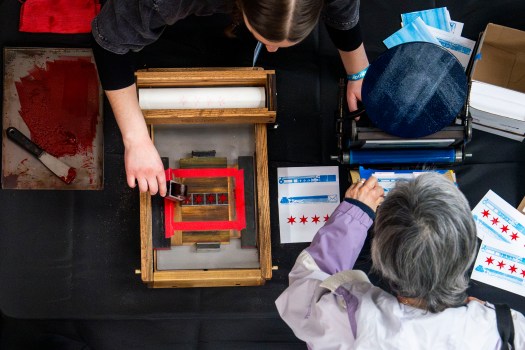
She placed it in a Kelsey Excelsior Model U Letterpress Printing Press, which is one way of saying, a small but heavy machine with a huge iron lever. She nodded to me and I pressed downward, and after a moment of true effort, two rollers crawled up and over the postcard, leaving images of a fountain pen and an ink jar and a pencil. She then transferred the card to a wooden press and slid it across a row of four stamps of stars.
Out popped a Chicago flag.
“When you come down to it, it’s just the people seizing the means of production.”
cborrelli@chicagotribune.com