
The controversial topic of a Clarendon Hill Downtown Improvement Plan likely will be settled April 13 when the Village Board is expected to vote on a path forward.
More than 90 people turned out for a March 16 meeting where consultant Houseal Lavigne presented multiple improvement options for consideration. The Downtown Improvement Plan has been a hot topic in Clarendon Hills, as several residents have expressed opposition to an option that would eliminate a right-turn slip lane that is part of the Sloan Triangle at Prospect and Park Avenues, in place of a plaza. Those opposed to eliminating the slip lane in place of a plaza say it would compromise safety and result in traffic congestion near the railroad tracks, about a block north on Prospect Avenue.
The option presented by Houseal Lavigne that seemingly attracted the most interest was one that calls for the use of temporary bollards on Prospect Avenue at Ann Street and Park Avenue as well as the northern and southern end of the slip lane to temporarily transform the space into a pedestrian only environment.
Bollards are short, sturdy vertical posts used to protect pedestrians and infrastructure and to control traffic. They often are made of steel, concrete, or cast iron.
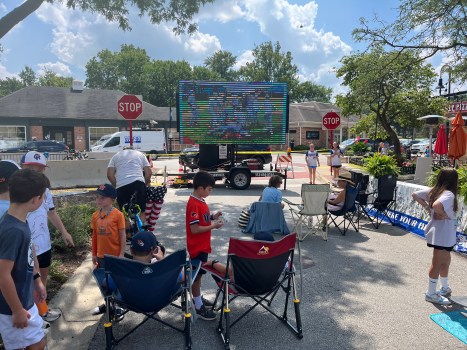
The report from House Lavigne stated that the village holds multiple events throughout the year in its downtown, many of which include the closure of Prospect Avenue from Ann Street to Park Avenue, or the slip lane portion of Prospect Avenue. Currently, the Public Works Department uses vehicles as temporary traffic blockades during those events.
The option of instead using bollards aims to allow for the downtown area to be utilized for community events and festivals without the use of village vehicles and instead use the bollards at Prospect Avenue and Ann Street and at Park Avenue. That option also would provide flexibility with temporary closures, without having to close all of Prospect Avenue, and would implement unique pavers and hardscaping to the Prospect Avenue slip lane to create a flexible shared space.
Many comments by Village Board members have been supportive of the flexibility that would be offered by installing bollards. That action could be done on a seasonal basis, or off and on during the summer.
Overall, acting village manager Paul Dalen said he believes the downtown visioning process went well.
“Staff from Housel Lavigne were consummate professionals,” he said. “They used their experience and expertise to envision various improvements for a variety of different areas throughout the downtown.
“At the end of the day, this is a board decision. The bollard concept does provide flexibility and allows for different types of events to have usable space.”
While the flexibility of using bollards seems to be a popular idea, resident Angie Sartori, who has been vocally against closing the slip lane in place of a plaza, isn’t quite ready to sign off on supporting that option.
“Bollards, just for limited event closings, could be a way to address flexibility, but the location of the bollards and their ability to keep vehicles out and children in, need to be studied before they are purchased and installed,” she said.
Chuck Fieldman is a freelance reporter for Pioneer Press.